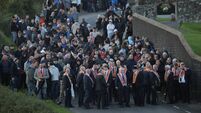
When things might get totally out of hand it’s best to stand idly by
Tampering with such material is a criminal offence and it means that somebody within the department could be guilty of collusion in what Mr Justice Henry Barron described as “the most devastating attack on the civilian population of this State to have taken place since the Troubles began”.
The report was particularly critical of the role played not only by the gardaí, which is understandable in the circumstances, but also of the part played by Liam Cosgrave’s government in the aftermath of the car bombings.
In December 1972, Cosgrave’s leadership of Fine Gael was saved by a bomb which killed two CIÉ workers near Liberty Hall. He was insisting on backing a government amendment to the Offences Against the State Act, even though only one other member of his party was supporting him.
Nobody who knows anything about Liam Cosgrave would think or suggest for a moment that he was engaged in any kind of collusion with the bombers. His leadership was only in danger because of his determination to support the efforts of Jack Lynch’s government to strengthen the Offences Against the State Act.
Some on the liberal wing of Fine Gael wished to exploit the situation for their own political purposes. They would undoubtedly have toppled him but for the intervention of a bomb, which prompted them to get back in line. Cosgrave was “the man who stood firm and had, in tragic circumstances, been proved right”, Garret FitzGerald later noted.
Jack Lynch has been credited with saving the country from a possible civil war. This was in the aftermath of Bloody Sunday, not during the Arms Crisis, when his leadership left a lot to be desired. The real crisis point for the Republic occurred on the night the British embassy was burned down. In those hours the country stood on the verge of the conflict and could so easily have been dragged in, were it not for the exquisite inactivity of the Taoiseach. People who would now describe themselves as moderates believed then that it was time for the country to get involved. Lynch saved us that night by standing idly by.
If he had called out the army to protect the British embassy, somebody would probably have been killed and passions would have been roused even further. By doing nothing, however, the government sacrificed the British embassy. The burning acted as a kind of safety valve, allowing people to let off steam.
I have never heard anybody compare the reaction to Bloody Sunday in Derry with the mood that prevailed following the Dublin and Monaghan car bombings. In one case there was outrage and the other was just shock. Of the two incidents, the car bombings were more than twice as lethal. This would have provided an ideal opportunity for an unprincipled politician to rouse public passions, but Cosgrave took the Lynch line of moderation. Now he is being criticised.
If the Taoiseach had tried to rouse people, he could easily have done so, because the British had been behaving in such a way that all too many would have been ready to conclude that they were behind the bombings.
Little over a year earlier Keith and Kenneth Littlejohn had been exposed as British intelligence agents, but they had turned rogue and gone into their own freelance robbery business. In October 1972 they were part of a gang that robbed a bank in Dublin.
WHEN the Irish Government sought their extradition from Britain a couple of months later, the British insisted that they should not be tried for any political offences that they might have committed. London privately admitted that the two were rogue agents.
Lynch criticised the Cosgrave government for agreeing to such conditions. This was a naked piece of political grandstanding. Would Lynch have done any differently, if he had been in power? Well, actually he did the same thing. It was his government that had first agreed to the conditions back in January, but he had forgotten about it. “It is impossible to remember all the scores of messages and interviews the Taoiseach gets each day,” Lynch explained. He attributed his behaviour to a “loss of memory”.
He admitted that the affair was so serious that he would have to consider his position as leader of Fianna Fáil. Of course, the bulk of the party immediately rallied to his side, and the whole thing became little more than a laugh.
“Jack can forget; I can forget, too,” Niall Tobín used to joke. Another case involving British intelligence was exposed a few weeks later.
In November 1973 the Sunday Press published a story about Wexford-born James Patrick Vincent, who spent 30 years working for British intelligence. He had set up a successful business in Cheltenham making shotguns.
On becoming aware that loyalists in the North were trying to purchase his weapons, he reported this to MI6, which encouraged him to set up a factory in Offaly. The IDA provided him with some £20,000. He hired a couple of men recommended by MI6, but he balked when it came to supplying weapons to the loyalists.
The intelligence people threatened his life, and he was portrayed as a kind of infiltrator. In the light of such activities people would probably have been quick to believe that British intelligence was involved in the car bombings.
The British intelligence community was out of control at the time. Some of them were so paranoid that they actually believed that Prime Minister Harold Wilson was a Soviet spy, and they were conspiring to bring him down.
Liam Cosgrave is being accused essentially of forgetting about the 32 who died as a result of the car bombings. The current Government would probably not have behaved any differently and the Irish people would tolerate it. Cosgrave played a low-key role in order to keep us out of the conflict.
There has been a lot of babble in the media about securing justice for the 34 dead people and their families, but that is impossible. Nobody can compensate the families for the robbed years or bring back their loved ones. What the media are talking about is not justice, but revenge.
There is going to be no justice for those people in this life, any more than the family of Jean McConville will get justice. People convicted of murder have already been freed in line with the Good Friday Agreement and the overwhelming majority of the Irish people endorsed that action.
In the midst of this controversy, some people are getting a better understanding of the hostility of those who feel so strongly that it is wrong to free people guilty of murder. Calling for justice for the victims of the car bombings is actually like calling for a renegotiation of the Good Friday Agreement.
CONNECT WITH US TODAY



Be the first to know the latest news and updates