Parity of coverage essential for the public to make an informed choice
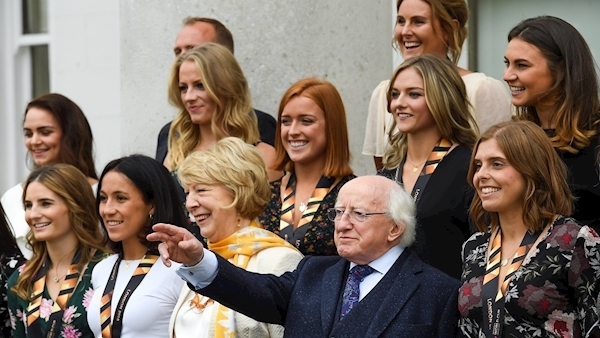

The challenge for a presidential election where all six nominated can campaign with an expectation of having their message heard is the sycophancy of the professionally sceptical.
It is an exaggeration to say the media is behind the incumbent, Michael D Higgins. There is too much affinity, and too much open incredulity, about any alternative. The ground that should be neutral is further exaggerated by the power of the office, which is effectively a campaign tool for the incumbent.
The President, of course, will continue in office during the campaign for his re-election. So naturally, he was guest of honour at the Liam Miller tribute match in Páirc Uí Chaoimh yesterday.
Tomorrow morning, he opens a new student art centre in Dublin City University. Later in the afternoon, he receives Britain’s Prince Edward and his wife, Sophie. And on it goes.
It is the power of incumbency and a very considerable asset. Curiously, it is also the feeble, cute hoor excuse for the President’s non-participation in RTÉ’s first ‘presidential debate’ tomorrow on the News at One.
The last time an incumbent sought re-election was in 1966 and then Éamon de Valera declined to campaign, effectively stymying his opponent, Tom O’Higgins. Out of some antique sense of courtesy towards the office, RTÉ declined to cover the vigorous campaign of his 40-year-old opponent.
In the event, the challenger ran the venerable president to within just over 10,000 votes of a potentially stunning defeat. Media matters, you see.
If 1966 is a ‘what if’ now, 2018 is a case of what’s next. Yesterday’s session of the Public Accounts Committee (PAC) was a step forward for the presidency.
PAC chairman Seán Fleming said it was right that the President’s accounts, as distinct from the President being accountable, is a proper matter for the PAC.
The secretary general to the Government, Martin Fraser, who is the accounting officer for the President’s vote, also said it was right in not seeking the attorney general’s advice. Instead, he and Fleming worked out appropriate boundaries which Fleming enforced.
There was no constitutional drama. Indeed, there was little fuss at all.
Instead, what should have been an established review of the monies spent by the President’s office is now a day old new normal. Yesterday’s hearing was a further small development for the Irish presidency, and a good one.
A detail outstanding from the hearing is the sum of €317,000 provided not in the President’s own vote but from the Central Fund. In accounting terms, because it is from the Central Fund, it is outside the remit of the accounting officer. Not enormous, but cumulatively significant — it deserves some further explanation.
A suggestion at the meeting from Fleming, but one not confirmed by either the comptroller and auditor general Séamus McCarty or Fraser, is that this is used for entertainment. Having recently been in the Áras at a garden party, and ingested everything put in front of me, I won’t complain. But back to the sums. There is detail outstanding.
Routinely, but in substance incorrectly described as largely ceremonial, the office has few, but potentially enormous, powers. These are the right to refer legislation to the Supreme Court and the power to refuse a dissolution to a taoiseach who has lost his Dáil majority. Around these powers, and the office more generally, is further substantial constitutional privilege.
On display yesterday was the boundary between the President and the Oireachtas. He cannot be held to account for the exercise of his office by the Dáil or Seanad. As Fraser correctly said, the balance is “delicate”. Officials, responsible for the administration of budgets, can, of course, be held accountable for their correct application. That is now the new normal.
Another question, however, elucidated the truly grand sweep of the Irish presidency and its antecedents. It is not just that the President is not accountable to the Oireachtas, Article 13.8.1 also provides that he is not answerable to any court. In the context of Freedom of Information, the absence of which in the Áras was a backdrop to the PAC hearing. It is unlikely to be ever applied. Simply put, FoI requests are routinely appealed to the Information Commissioner and then to the courts. Constitutionally, however, our President cannot be subjected to either.
In an extreme case, were a president to commit murder, to be found standing over the dead body with a bloodied axe and heard shouting “I did it”, it is doubtful he could be arrested, and certain he could not be tried in a criminal court. The only remedy would be impeachment by a two-thirds majority of both Houses of the Oireachtas. An Irish president brought before the courts could demand, as Britain’s King Charles I did at his trial, “by what power I am called hither? I would know by what authority, I mean lawful [authority].”
It was because no court could try the king, who was the font of justice. A special parliamentary body was then established. That position, arrived at in extraordinary circumstances in 1649, is precisely where we are at now, constitutionally. US president Donald Trump would be envious of the untouchable status of a president from criminal indictment. The office brings both power and privilege.
It will not, however, include the privilege for us of hearing an incumbent of seven years mix it with his challengers on RTÉ radio at lunchtime tomorrow. That is more than a pity — it is wrong.
Here I have some sympathy for RTÉ. I understand it has been inviting candidates since at least September 13. Pleading engagements, the timing of which could easily be changed, is, to put it mildly, tiresome and incredible.
More fundamentally it is disrespectful. In a functioning democracy, as distinct from a 17th-century monarchy, the people are sovereign. We are entitled to hear those who seek our mandate make their case. We can’t force any candidate into any debate, but by default we have to rely more on the fourth estate, to rebalance what, by virtue of its ‘delicacy’, amounts too often to hugger-mugger.
The true test of speaking truth to power is putting it up to someone with whom you are significantly in sympathy. The rest is self-satisfaction dressed as public interest. The treatment on air and in print of the President’s official engagements over the coming weeks are by design or default an extension of his election campaign.
Photographs and electronic coverage probably matter more than print. Where are the photographs and reports of the other five candidates placed relative to the President’s coverage at Páirc Uí Chaoimh? Well, look around you this morning.
Making space for the other five and ensuring real parity of coverage is essential if we, the public, are to be enabled to make an informed decision after rigorous debate before polling day on October 26.
CONNECT WITH US TODAY



Be the first to know the latest news and updates