Netanyahu says attacking Iran ‘one of easiest decisions I’ve ever had to make’
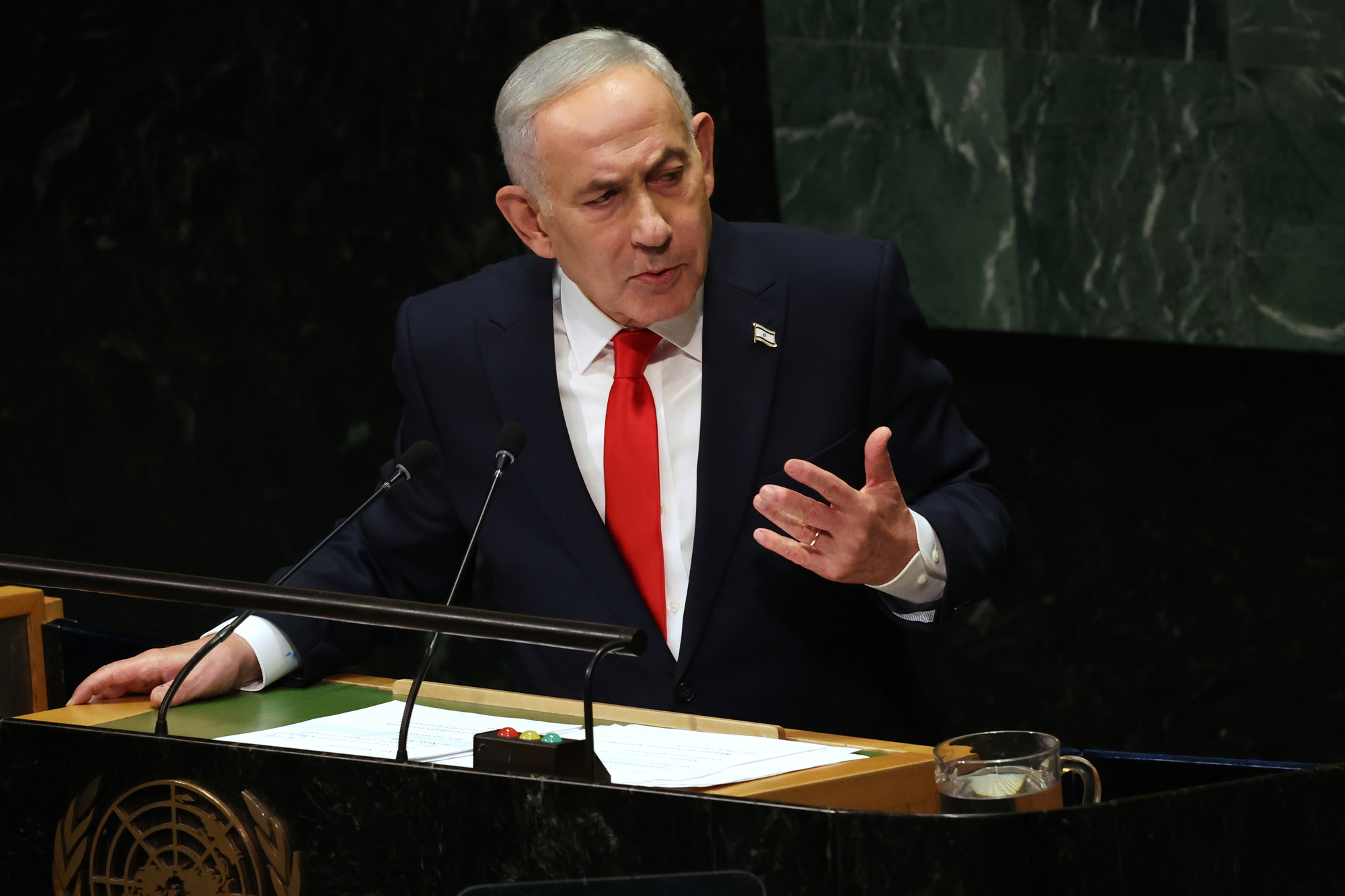
Israeli Prime Minister Benjamin Netanyahu told world leaders that attacking Iran “was one of the easiest decisions I’ve ever had to make” and denounced as “moral cowards” a mass of delegates who walked out of the UN General Assembly when he took to the podium to speak.
“In defending itself, Israel is also defending many of the countries whose delegates just left this hall,” Mr Netanyahu said.
“In fact, I want you to know that many of their leaders even thank us privately for taking out Iran’s nukes.”
When Mr Netanyahu walked to the rostrum at Thursday’s assembly, a mix of cheers, boos and mass walkouts erupted.
Scores of delegates trooped out and a majority of seats sat empty afterward.
“Order in the hall, please,” General Assembly president Khalilur Rahman said repeatedly.
“If there are any other moral cowards who have not yet left the hall, please do so now,” Mr Netanyahu said.
The Palestinian Mission to the UN urged in a message to many of the 193 UN member nations to bring as many staff as possible to the assembly hall and “collectively walk out of the assembly” once the Israeli prime minister is announced.
“This will send a clear message to Netanyahu and his government that no one is willing to aid, abet, or be complicit in its genocide and war crimes and illegal occupation, which all peace-loving states and peoples demand must come to an end,” the message said.
Israel rejects allegations that it committed genocide and war crimes and is illegally occupying Palestinian territory.
All Israeli settlements are illegal under international law, but the Israeli government insists they are legal.
Mr Netanyahu, who is prone to using visual aids during his General Assembly speeches, at one point held up a pager while reminding the audience of September 17 2024, when Israel remotely detonated thousands of pagers that had been distributed to the Iran-backed Hezbollah militant group in Lebanon.
The pager attack wounded more than 3,000 people and killed 12, including two children.
He also reminded the assembly of the scale of the October 7 2023 attack in which Hamas militants killed about 1,200 people.
“This is equal to 40,000 innocent Americans slaughtered in less than 24 hours”, he said, or 16 times the death count on the 9/11 attacks that left nearly 3,000 people dead in New York.
Mr Netanyahu thanked US President Donald Trump for taking decisive action against Iran, and he insisted Israel would prevail: “We will continue to win because we have no other choice.”
Palestinian President Mahmoud Abbas also addressed the UN General Assembly earlier on Thursday, delivering pre-recorded remarks from his office in Ramallah after the US denied him and other top Palestinian officials visas to attend the gathering for the second year in a row.
The 90-year-old leader’s popularity at home and relevance abroad have both waned.
But in his remarks, Mr Abbas made clear he did not intend to quietly accept being side-lined.
“We will not leave our homeland. We will not accept displacement. And we will not allow anyone to decide our future on our behalf,” Mr Abbas said.
Though world leaders have repeatedly invoked the plight of Palestinians in speeches throughout the week, Mr Abbas urged the international community to take more tangible action against Israel.
“How long will some countries continue to remain silent about Israel, or continue supplying it with weapons that it uses against our people? The world has witnessed the enormous cost in the Gaza Strip and the West Bank,” Mr Abbas said.
“What, then, is the international community waiting for before it acts to protect the Palestinian people?”
In past years, Mr Netanyahu has used his General Assembly speech to both denounce the United Nations as biased and make Israel’s case to world leaders.
His address — scheduled for prime time in Israel — is the cornerstone of an abbreviated trip to the US unfolding under the shadow of New York City mayor Zohran Mamdani calling him a “war criminal” and pushing for his arrest.
Mr Mamdani has acknowledged that New York does not have the authority to execute an International Criminal Court warrant but urged federal authorities to do so.
Israel has grown increasingly isolated throughout the war in Gaza.
The war began on October 7 2023, when Hamas-led militants attacked Israel, killing around 1,200 people and kidnapping 251.
At least 73,922 Palestinians have been killed in Israel’s subsequent offensive, according to the Gaza Health Ministry, part of the Hamas-run government whose numbers are generally considered reliable by the international community.
A ceasefire agreed to by Israel and Hamas last October halted the heaviest of the fighting and led to the release of the remaining hostages yet further steps have since stalled.
Israel maintains control of most of Gaza and continues to carry out airstrikes on Palestinians near military-held zones.
As Mr Abbas spoke, the Israeli delegations’ seats in the General Assembly hall sat vacant.
“The Palestinian people face one of the most dangerous periods in their history,” Mr Abbas said.
In Gaza, he said, “Neighbourhoods, cities, refugee camps, institutions, schools, universities, hospitals, mosques, and churches have been destroyed. Every foundation of life, and the future of entire generations, has been targeted”.
Though negotiations have not taken place for years, Mr Abbas urged the international community to push for a two-state solution to the Israeli-Palestinian conflict and said Palestinians could live “alongside the state of Israel”.
Mr Netanyahu has said no Palestinian state will be established while he is Israel’s leader and has argued that the Palestinian Authority is not a partner for peace.
Mr Netanyahu dismissed incidents of Israeli settler violence against Palestinians in the West Bank as a “handful of young juvenile delinquents” throwing stones, chopping down olive trees and lighting fires.
“I can’t stand that. I won’t stand for vigilantism,” the prime minister said before accusing foreign leaders and the international press of distorting the scale of violence in the West Bank.
Mr Netanyahu’s government is dominated by settlers and their allies, including the Cabinet minister who oversees the police.
There have been few arrests of settlers involved in attacks on Palestinians.
CONNECT WITH US TODAY



Be the first to know the latest news and updates