The wages of spin: Has anything changed in Leo Varadkar's first 100 days?

In the Dáil before the summer recess, Mr Varadkar confirmed details of his expansive operation during a debate with Micheál Martin, Brendan Howlin, and Gerry Adams.
He confirmed that the Government Information Service is comprised of the Government press secretary (Feargal Purcell, whose salary is €115,431); his soon-to-be replacement Nick Miller is also there; the assistant Government press secretary Sarah Meade (€82,587); two assistant principal officers, one of whom is assigned to the Pravda-esque website MerrionStreet.ie; four press officers at higher executive officer level, three communications and media
assistants at executive officer equivalent grade assigned to Merrion Street.ie, and one clerical officer.
The Taoiseach has also decided to establish the Strategic Communications Unit under John Concannon, who is on an assistant secretary grade which commands a salary of between €122,313 and €139,728, while another official assigned to the unit, Andrea Pappin, is on an assistant principal higher grade of between €83,519 and €102,212.
Then, of course, he has his inner team of advisers — chief of staff Brian Murphy, programme manager and former PR man John Carroll, and Trinity academic-turned speechwriter Patrick Geoghegan. Their salaries have not yet been disclosed but, all in all, it is quite the operation.
Mr Varadkar’s 100th day as Taoiseach next Friday is a milestone.
An important milestone, as the first 100 days are often said to be the most productive of any term.
So we must ask ourselves the question. Just what has changed since the departure of Enda Kenny and the arrival of Mr Varadkar into Government Buildings?
Elected in a blaze of international media coverage around his sexuality, his age, and his ethnicity, he was portrayed as a vision of just how far little old Catholic Ireland had come.
Yet, from the off, Mr Varadkar was dogged by scandal around the nature of the departure of the former attorney general Máire Whelan.
It was a scandal that was Enda Kenny’s in the making.
But since then, it has been a rocky period and one in which the Taoiseach has been subject to wide and persistent criticism. Slammed for prioritising style over substance, Mr Varadkar’s decision to establish the Strategic Communications Unit has given critics of Fine Gael a golden opportunity to portray him as a vain dilettante.
Rather than it being seen as a necessary move to better co-ordinate the complex message of 15 separate Government departments, it has been allowed to acquire mythical status akin to Garrett Fitzgerald’s ‘National Handlers’ back in the 1980s.
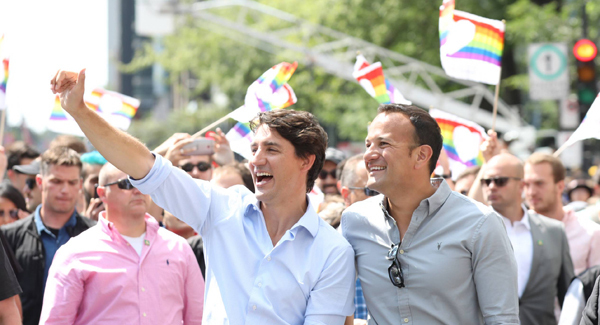
Mr Varadkar has been criticised for attending Pride march after Pride march, with controversial broadcaster George Hook taking him to task for daring to go to Canada at the time of a housing crisis. Hook, before his latest troubles, used his High Noon show to berate the Taoiseach for “swanning around Canada”.
Mr Hook criticised him for attending a gay pride parade in Canada, and took issue with Mr Varadkar’s visit after speaking about a situation in Dublin where tents belonging to homeless men were taken.
“I don’t want to hear he’s gay,” said Hook. “I don’t want to hear he’s in love. I don’t want to hear his boyfriend has gone to America. I think the Taoiseach is increasingly becoming a public relations creation rather than a leader of a country that actually faces some crises. I think he should be attending a homeless march, a balancing the budget march, and a security march, so that we would actually have some Government.”
Mr Varadkar let himself down by responding on Twitter to Mr Hook’s rantings, thereby giving licence to those who say he is image-obsessed.
.@ghook George. Not swanning around Canada. 4 meetings & 4 public events today. Business. Tourism. Media. Irish community. Jobs. Trade.
— Leo Varadkar (@LeoVaradkar) August 21, 2017
While the frustration at the lack of progress in dealing with the housing crisis was a legitimate concern, the opportunistic criticism of Mr Varadkar from all sides was bizarre.
Mr Varadkar also drew the ire of so-called pro-lifers, who took issue with him being “led” by Canadian prime minister Justin Trudeau on the issue of abortion. Wendy Grace, a well-known conservative advocate, penned a piece which said she used to admire Mr Varadkar and his trait of speaking his mind.
“But in everything he does and says these days, he seems to cosy up to the media and other people whom he thinks will keep him in power,” she wrote in the Irish Independent. “How ironic. You get to the top because you were independent-minded, and you try to stay on top by acting as a stooge.”
The truth of it is that Mr Trudeau was asked about his view on abortion by Fiach Kelly of the Irish Times at a press conference and he responded by saying that giving women a choice is, in his view, a fundamental human right. Because Mr Varadkar didn’t object, publicly anyway, he is accused of abandoning unborn children of Ireland.
Again, the truth was a casualty here. He, as a leader who is known to be conservative, is committed to holding a referendum on the eighth amendment, which is a Programme for Government commitment. He is sticking to a deal made last year.
Speaking at his party’s think-in in Clonmel this week, Mr Varadkar expanded on his desire to create a ‘Republic of Opportunity’.
The key slogan of his election campaign, his speech on Wednesday in Clonmel was a first attempt to flesh out what that actually means.
In truth, it sounds like a PR-driven slogan in search of a policy platform to justify it, but as of now, it rings as hollow as ‘Keeping the Recovery Going’.
We have heard a lot about those who get up early in the morning and go to work and the need for them to be rewarded, modestly, in the budget, through tax cuts.
Increases in spending will be prudent and responsible and would not mark a return to the boom and bust days of a decade ago.
But we know with just €300m extra, any changes will be modest at best. Even the hamfisted manner of his mention of Nama as a possible solution to the housing crisis begs the question: How composed and together is our new leader?
There was no mention of Nama in the script of his speech in Clonmel and the import of its mention was being played down by handlers shortly thereafter.
It has caused some to ask, is he making it up as he goes along?
Away from the public relations, the one area where Mr Varadkar deserves credit is for taking a bolder and more aggressive stance with Britain on Brexit. His stance, coordinated with that of Simon Coveney, has taken hold in Brussels and we have seen mounting pressure on Downing St to deliver a workable solution to Brexit which does not endanger the island of Ireland.
So far, his tougher stance has been vindicated, but let us see where we are the far side of the key summit in October. Despite this hardening of positions by a Dublin administration, there has been little else to sing about from what we have seen so far.
We have seen far too little from the Government to justify the hype we have heard for so long about the man.
CONNECT WITH US TODAY



Be the first to know the latest news and updates