Surviving the fury of worst Atlantic storm since records began

And yet, having wrangled an airline ticket out of Florida as the hurricane bore down, a small part of me, listening to the radio met bulletins, thought: “Sure they’ve downgraded Irma to Force 4, which is piddling, really, and it’ll probably go right up the east side of Florida anyway and I’ll just feel like a panicky fool.”
The downgrading was brief. Once it was over, Irma was back in full fury as a category 5 and being described as the worst Atlantic storm ever. Not just in living memory, but since records began.
Roof of a home in #Miami coast being ripped off by powerful #HurricaneIrma winds. Terrifying stuff. These winds are no joke. #Irma pic.twitter.com/P0kMIKqlf6
— Josh Benson (@WFLAJosh) September 10, 2017
As that kind of information seeped into the public domain, it quickly stopped other people playing the shame versus survival game. I overheard one man recounting, ruefully, as he packed to get into his SUV and head north, how his house was better equipped for hurricanes than it ever had been: Generator. Batteries. Food. Water. All present and correct. But it was a wood frame house and the chances of it surviving a direct hit were small. Of course, he said, the chances of a direct hit were probably small, too, and he was going to be regarded by his pals as a weenie for fleeing, particularly if he had to return, post-Irma, to an untouched intact home stuffed to the gills with unused generators, food, batteries and water.
“Why’d you buy water?” somebody asked. “All you got to do is fill the bath with tap water. Couple buckets, maybe, and you’re done. Lee County tap water is safe. Mayor said so.” The other man said he hadn’t bought that much water anyway, because by the time he got to Walmart, all they had was caffeinated water and he figured he didn’t need caffeine on top of the excitement.
“Caffeinated water?” two people asked simultaneously. He nodded and shrugged. Who knew?
The shops emptied much faster, this time around, than in the lead up to Hurricane Charlie. Back then, a Met Office version of the boy who cried “Wolf!” applied: Whenever hurricanes hoved to, they started with a grandiose fanfare but diminished in importance after a couple of days.
WPLG: Looters break into stores in Fort Lauderdale during #HurricaneIrma pic.twitter.com/cCfoyswolR
— Josh Caplan (@joshdcaplan) September 10, 2017
The threatening circle of cloud on your TV screen lost energy as it passed over Cuba or
another island, or changed direction and headed out into the Atlantic, the end result being that Florida experienced little more than thunder, lightning and lashing rain. So Floridians became comfortable with the notion that a killer hurricane wasn’t likely to happen in their lifetime.
Hurricane Charlie, in 1986, knocked a hole in benign assumptions about hurricanes. Hurricane Harvey, just a few weeks ago, albeit affecting Texas rather than Floridian, nevertheless changed everything, hammering home the messages that a hurricane is a lot more than a heavy shower and a few palm trees bent double.
Floridians, accordingly, looked at Irma, circling in the Gulf, and from the beginning took it seriously, registering the warnings that this storm was the size of France. If it barrelled up through Florida, it might not matter much which side of the peninsula you were on, it could still reach and crush you. The message was inescapable: the best thing to do was get the hell out of its path.
The instructions were clear, too. Six days ago, the Florida Keys became the subject of a mandatory evacuation. A mandatory evacuation, in Florida, doesn’t mean that the state troopers come and take you to prison if you haven’t left when you were supposed to leave. It means they repeatedly tell you to get out, now, and add a dispassionate warning: when the hurricane strikes and you find yourself on top of a roof because of flooding or clinging to driftwood or locked by fallen trees into your home, without power or air conditioning in 104 degrees fahrenheit, tough: Emergency services may take weeks to get to you, not least because you’ll have no mobile phone signal and they won’t know where you are or how badly off you are. You want to take those kind of chances? Go right ahead.
The problem is that some people have more choices than others. If you have a credit card and money behind it, you can get a flight out to another city or another country and, in this case, the airlines went to considerable trouble to lay on extra flights and get out as many people as possible.
In the chaos that was Miami International Airport, with people watching the progress of the
storm on their phones and ringing relatives to see how far up I75 they’d got, the Aer Lingus gate area was a slightly bizarre oasis of happiness. This was due to September being the inaugural month of their new Miami/Dublin flight and they laid on Irish coffee and pinwheel sandwiches for their passengers.
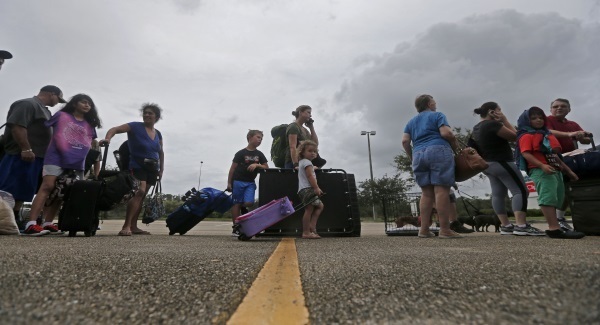
If you didn’t have a credit card, your option, given Florida’s almost complete lack of public transport, was to get in your car and go to a shelter. Hence the thousands of people clutching bedclothes and coolers in the car park of the Germain Arena, which normally hosts ageing stars who provide concerts for ageing audiences. Until Hurricane Irma passes over, the tiered seating and stages in that arena and many others will be filled with local refugees, because that’s what they are: refugees from the islands and from RV parks.
Many of the refugees who stayed close to where they live had no choice. They didn’t have enough money to drive to the Panhandle, up at the top of Florida, nor did they have the kind of car that would make it that distance. Although even people with credit and
with reliable cars ran into problems, starting with petrol shortages. Low in fuel to start with, they began to get panicky when they encountered their third filling station wrapped around with ribbon tape like a crime scene, the tape indicating that the station was fresh out of fuel.
Even the best prepared in the vehicular exodus, including those with water, food, portable urinals and — at the start — full tanks of fuel, ran into problems. The traffic slowed to a frustrating crawl, so that a journey that would normally take six hours doubled in duration. A clunk under the bonnet or a dashboard icon indicating an engine overheating would be terrifying.
Even the best-behaved children would become fractious over a couple of hours. But pulling into a hotel halfway up the spine of Florida wouldn’t work, because too many people already had that idea. As the traffic crawled, many of those in the queue covering hundred of miles felt the unique loneliness of being in a crowd of around 6m people with no
commonality other than the desire to stay alive and the hope of outpacing a hurricane. And as we go to press, we don’t know how many of them made it.
A hurricane is a lot more than a heavy shower and a few palm trees bent double
CONNECT WITH US TODAY



Be the first to know the latest news and updates