Those who expect normal service to resume in Dáil will have to wait
There is apoplexy among the politically correct about the ongoing mess that is the politics of water. The amour propre of those who believe they know best, is wounded. Knowing best, of course, is an incurable condition. And truthfully, water charges are a mess.
But they are symptoms, not cause. The cause that comes in for excoriation is new politics. Like most forms of indignation, it’s never clear exactly what that is. It’s possibly best understood as what it’s not - the hard slap of firm government.
It is rich irony that government, which was so firmly in control that parliamentary oversight was an afterthought, is now the source of nostalgia.
The yearning for lost order as a bulwark against loss of control to the white noise outside the gate underpins politicians like Putin and Erdogan. The failure to accommodate the swirl and eddying of democratic politics is evident in Poland and Hungary.
The institutionalised reaction of the dislocated here is a peevish and only comical imitation of that. It’s equally shared by the Christian Democrats in Fine Gael and the rump of the social democrat tradition in Labour.
On the issue of water at least, Fianna Fáil is gorging on seed potatoes now: not understanding it will starve for credibility if it succeeds in eventually entering government.
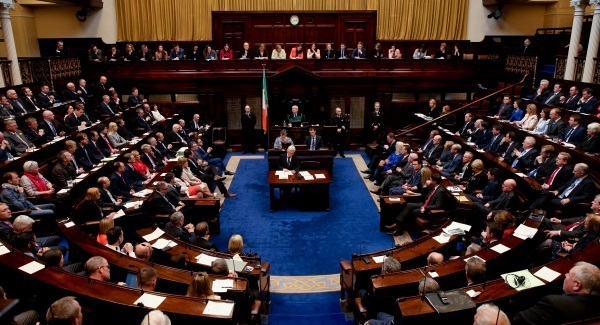
New politics, which is simply the make-up of the Dáil elected by the people, is not to blame. It is the working out of the diffuse democratic choices we made. There is no majority for stable government.
There is no majority for an entire range of policy actions. That is the inexorable outcome of the choices we the people made. The dislocation is that we have no previous experience of what in several European counties has intermittently been a norm.
It cruelly exposes the limits of tolerance of opinions besides their own, of an only faintly liberal intelligentsia here. The umbrage of the discombobulated is within the tradition of an authoritarian parish priest patrolling the perimeters of the dance hall.
One starkly obvious fact completely eludes critics of the new status quo. This is not an interlude. This is here to stay. Some commentators vented their spleen to the extent of suggesting this Dáil could do no more and it would be better to have an election.
I predict that the results of an election, sooner or later, will not materially change the diffuse make-up of our democratic choice. The relative size and running order of the parties may change, but not the net fact of a lack of stable government. Even the use of that term ‘stable government’ must be qualified.
Current instability is relative to what we experienced for most of the 90 years prior to 2016. In fact we have stable government, after a fashion. Ours has been in office for more than a year. It has delivered one budget and has a better than even chance of delivering a second.
Admittedly I wouldn’t put my money on a third budget at this juncture, but let’s wait and see. The status quo, for all its shortcomings, is clearly aligned with the self-interest of the two main parties it is dependent on, for now.
Those who decry what they call new politics have no alternative. There is no electoral realignment evident now that would substantially change the status quo. Most troubling for those most afflicted, is that there is no evidence and perhaps no hope of a reversal to the status quo ante.
The real issue, and the one worth addressing, is not maudlin nostalgia, but the failure to institutionally adapt to what has arrived. Previously when we had stable government of the firm and slapping sort, the powers and resources of the Oireachtas were wholly inadequate to hold it to account.
It is only a very selective memory might forget that the last most egregious episode of overpowering government railroading legislation through the Dáil, was the establishment of Irish Water. A more considered approach then, is one of the great what-ifs now.
Firstly to adapt, there must be recognition that electoral choices like ours, probably mean a more minimalist style of government. If parliamentary majorities are harder to arrive at on issues, less is possible. Personally, I am of the view that less government is underrated.
Secondly, because the nexus of power has shifted from the cabinet room to the Dáil chamber, effective supports and resources must follow. But they haven’t. This Dáil now has all resources it had when it was a rubber stamp. A key move-on is the establishment of a budgetary office within the Oireachtas to assist scrutiny of a very complex area and to cost proposals.
Only now, after months of delay has the post of head of that office at assistant secretary level, been agreed with the Department of Public Expenditure and Reform. The delay served two purposes. Firstly it ensured the office will not be established in time to offer any effective oversight of Budget 2018 next October.
Secondly, the initial insistence of positioning the post at principal officer level, was intended to nobble what, institutionally, is deeply unwelcome oversight.
The classic mistake is equating government with the 15 ministers at the cabinet table.
At any given time only some ministers are fully in control of their own departments - a few are full-time passengers. The heaving hulk of government is the permanent civil service. Its use of time, of anonymity, and relatively speaking a lack of accountability make it, over time, by far the more powerful part of the executive.
Its current dislocation is far more severe and consequential than that of politicians in the public eye. There is no sense of any institutional realisation within the civil service, that this Dáil is anything more than a passing fad.
It hasn’t faced up to the consequences of longer-term political change at all. Across departments it is hunkered down in a holding pattern, awaiting a return to normalcy which will likely never arrive.
The budgetary office is one example. The office of the parliamentary legal adviser is another. It is wholly inadequate to assist a Dáil now in the political saddle. 123 bills are at Second Stage now - many woefully drafted. The committee system cannot process them.
A critical issue for an Oireachtas that wishes to legislate, as distinct from rubber-stamping legislation, is the quality and effective processing of legislation. Cookie-cutter bills are tabled, and then parties won’t prioritise at committee, meaning most go nowhere.
Rules need to be constructed and resources need to be realigned to follow a shift in power that is embedded political reality. This requires a fundamental recalibration between government, including the civil service, and Oireachtas.
Given current levels of disbelief and denial, that move-on must await a new Dáil I predict will be very similar to the current one.
The results of an election will not materially change the diffuse make-up of our democratic choice