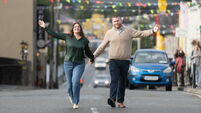
Irish supporters arriving in Pristina this week might reasonably have expected the blue and white flags of the host country to adorn the streets and boulevards. Less expected were the nightly demonstrations flowing through the centre of Europe’s youngest country.
Young and old walked together towards Skanderbeg Square, carrying Albanian and Kosovo liberation army (KLA) flags. They were protesting against the convictions in The Hague of former president Hashim Thaçi and three other senior KLA figures.
The slogan was 'Jo në emrin tim': “Not in my name.”
The prosecutions represent the most consequential attempt yet to hold Kosovo’s former KLA leadership individually accountable for crimes committed during and immediately after the war.
Yet, by placing revered architects of independence in the dock, they have also reopened old wounds and strengthened the belief among many Kosovo Albanians that international justice has treated their liberation struggle as equivalent to Serbian aggression.
Wednesday brought an eighth consecutive night of peaceful protest.
Thursday, when Kosovo defeated Ireland 1-0 at the Fadil Vokrri Stadium, brought a ninth.
Read More
The result mattered, certainly. Kosovo is a young footballing nation seeking its place among the established countries of Europe.
But for 36 hours in Pristina, the match offered only a narrow window into a much broader story: That of an emerging country displaying all the energy of youth while still wrestling with the contested history of its birth.
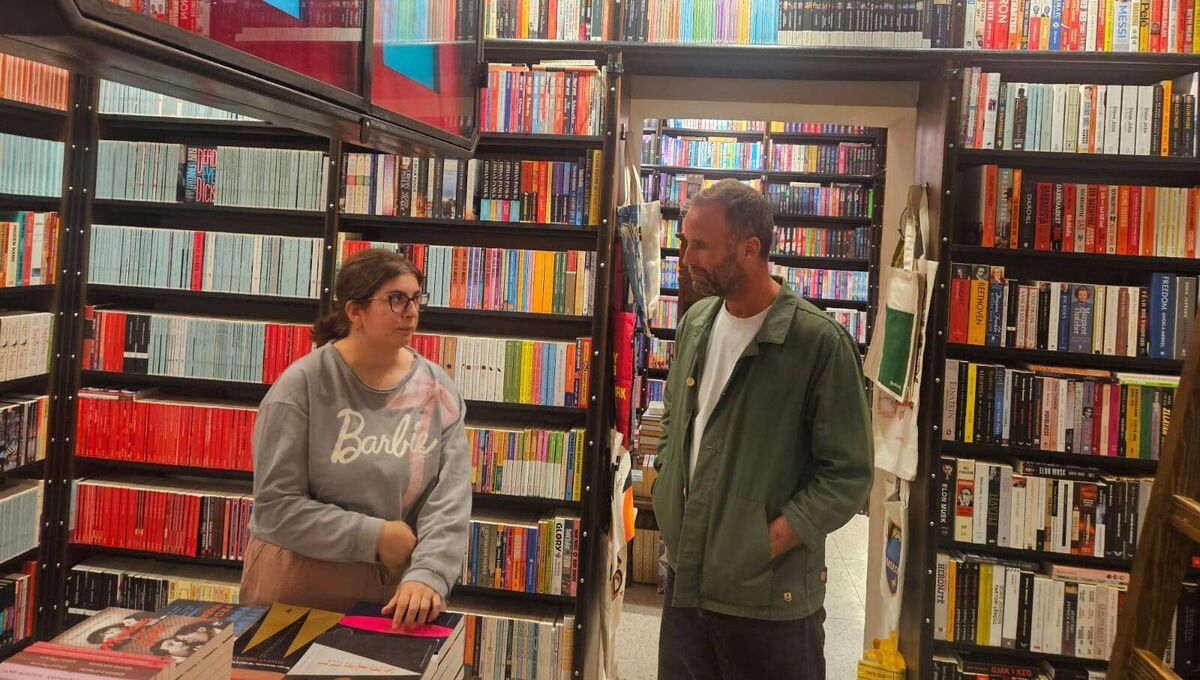
That duality was visible from the window of the Buzuku bookshop in central Pristina.
Libenta Spahija, from Gjakova, works there and seems representative of a young, educated, and multilingual generation increasingly confident about presenting Kosovo to the world.
“I love this job,” she said. “Being surrounded by books is such a positive thing. Reading is such a fundamental part of life for us growing up here. This place is busy day and night.”

She moved easily between shelves of English and Albanian editions, pulling out works by Ismail Kadare, Rexhep Qosja, and a younger generation of Kosovo writers.
“We are proud of our Albanian identity,” she said, happily and without qualification.
Her colleague Zana, a law student at the University of Prishtina, belongs to the first generation with no direct memory of the war.
“We didn’t live through it, and our parents are careful not to worry us too much with what they saw,” she said.
“I love being from here. I want to stay and have a career in Pristina. It’s an exciting time to be here.”
Dua Lipa is an obvious avatar for that outward-looking confidence: A global pop star who has never treated Kosovo as an inconvenient footnote to her success.
“We are very proud of Dua Lipa because she is so proud of us — of where she is from,” Zana said.
“She wants to show our culture off. She promotes Kosovo and Albanian identity, especially through our art and books. Her brains, basically.”
As she spoke, the crowds heading towards the demonstrations passed directly outside the window.
“We are used to chaos here,” she said, watching them go.
"When people are not happy about something, they will protest.”

Pristina moves at the pace of a city anxious to make up for lost time. Its bars, cafés. and restaurants are full. The population is young, sociable, and strikingly multilingual. Bookshops remain open late. Although Kosovo is overwhelmingly Muslim by affiliation, the public culture of its capital feels emphatically secular.
The influence of the diaspora is everywhere: In the languages, the foreign registration plates, the new apartments, and the money returning from Germany, Switzerland, Britain, and the US.
Remittances are not merely an economic category here. They are visible in concrete, glass, busy tables, and family ambition.
Yet Pristina is not Kosovo, or at least not all of it.
Drive 20km south and the capital’s cosmopolitan confidence gives way to villages, farmland, and the geography of an unfinished peace.
I first travelled these roads in 2004 as a young Irish Defence Forces lieutenant serving with peacekeeping forces. Returning now, I found our old base at Camp Clarke had all but disappeared. At its height it contained accommodation, kitchens, workshops, checkpoints, and hundreds of Irish soldiers.
Ireland’s major deployment there ended in 2010, although a small Defence Forces presence remains.
Little of that life remains now. On the wall of one empty building, an Irish tricolour is still visible beneath the weathering. The green, white, and orange have faded almost into the concrete.
It is an arresting image. The paint has faded; whether the legacy has done likewise is a harder question.
Irish troops were sent into the surrounding villages to provide reassurance, patrol vulnerable communities and, during the ethnic violence of March 2004, help protect Serbian enclaves.
No simple resolution
The assumption at home may be that Kosovo Albanian and Kosovo Serb communities exist in neatly divided territories. On the ground, it was never so simple.
The villages bleed into one another. Sometimes there is no obvious point at which an Albanian village ends and a Serbian one begins. Houses, shops, farms, and roads remain much the same. The changes appear gradually: A flag, a church, a name written in Cyrillic, a memorial telling an entirely different version of history.
Gračanica, a Serbian-majority municipality dominated by its magnificent 14th-century Orthodox monastery, is barely 10km from central Pristina. Geographically, it is not some distant outpost pressed against the Serbian border.
For Kosovo Albanians, Nato's intervention ended Serbian repression and expulsion and opened the road towards independence in 2008. America is celebrated in Pristina through flags, statues, and Bill Clinton Boulevard.
For Kosovo Serbs, independence brought the loss of a state, institutions, and security. Many remain tied economically and emotionally to Belgrade.
Serbia still refuses to recognise Kosovo, while Kosovo’s attempts to extend its authority over Serb-majority areas are frequently experienced there as coercion rather than state-building.
The latest census illustrated the separation. Kosovo’s population was recorded at about 1.6m, but many Serbs boycotted the process following calls from Serbian political representatives.
Even the apparently straightforward question of who lives in Kosovo remains politically disputed.
To stay or to go
Last month, the Kosovo Serb news outlet KoSSev offered a stark and revealing picture when they asked six young Kosovo Serbs about staying, leaving, and fear.
“My heart says I want to stay,” Milena Jevtić told the publication, before acknowledging that employment, security, and the future of her family might eventually dictate otherwise.
In Gračanica, Andrija Denić expressed the same attachment: “My family, friends, and people I grew up with are here.”
But remaining would require stable work, a viable income and confidence that the community itself possesses a future. Emigration is not an abstract anxiety among Kosovo Serbs. It is happening family by family.
The contrast with Pristina is striking. In the capital, youth feels like Kosovo’s greatest asset. In the enclaves, the departure of the young threatens the community’s survival.
These are not the only two Kosovos. Any such division excludes Roma, Ashkali, Bosniaks, Turks, and others whose experiences complicate the national story further. Yet the contrast encountered over 36 hours was difficult to miss.
One Kosovo is young, crowded, and impatient, filling its bars and bookshops, celebrating its football team.
The other is quieter and more apprehensive, its Serbian communities uncertain of their place in a country they may not recognise, but in which their families have lived for generations.
Between them stands the empty shell of Camp Clarke.
The tricolour painted on its wall is fading. The villages still dissolve almost imperceptibly into one another. The peace has endured, but the distance between Kosovo’s competing memories remains harder to measure.
Kosovo has arrived. The question of what, precisely, has arrived remains unanswered.
CONNECT WITH US TODAY
Be the first to know the latest news and updates