Wind energy: Why does Ireland still have only one community-owned wind farm?
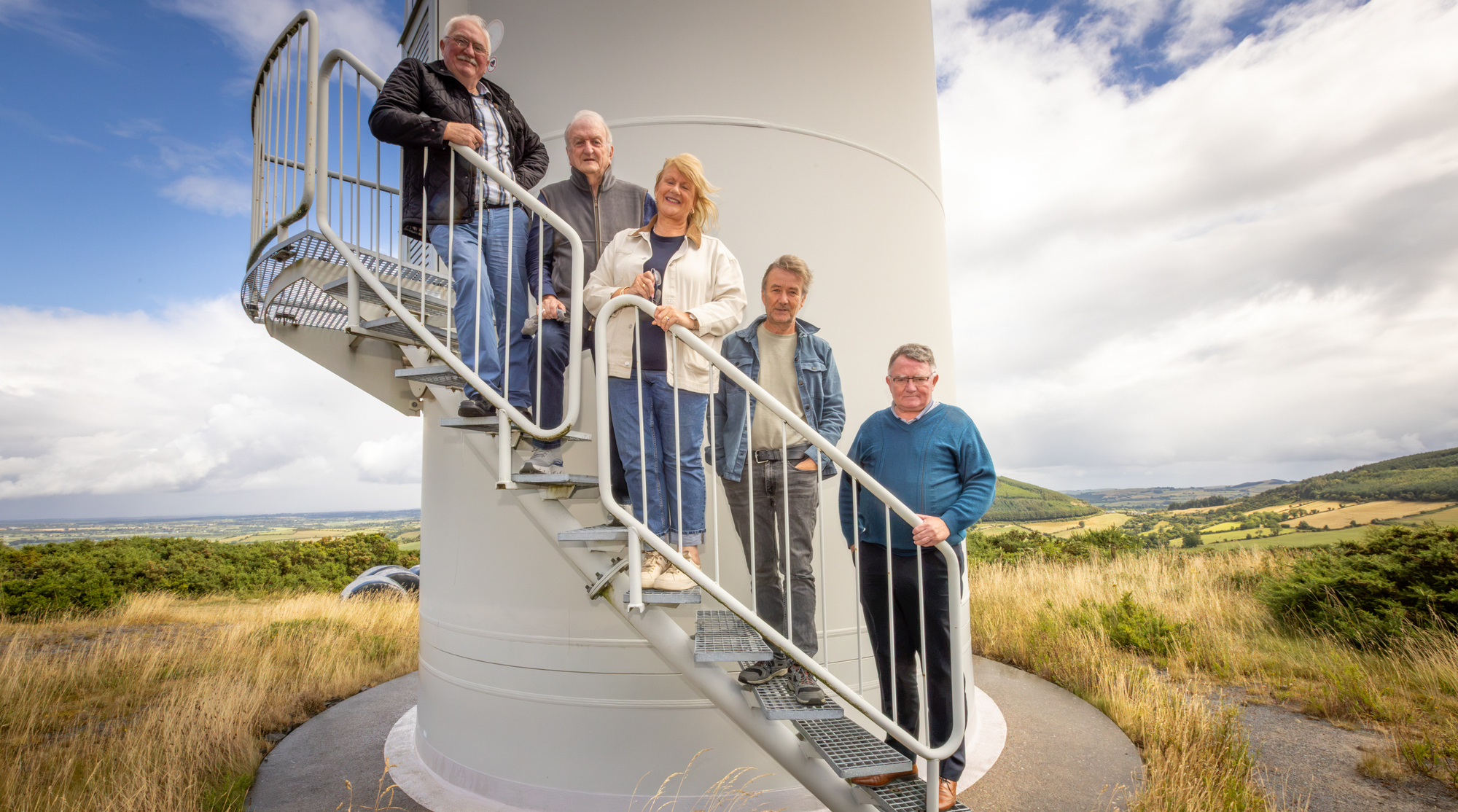
Shareholders of Ireland's first and (so far) only community-owned wind farm in Templederry, Co Tipperary — Matt Murray, John Fogarty, Carmel O'Donoghue, Gregg Allen, and Noel Carey. Mr Fogarty said: 'The system is very much weighted in favour of the big companies.' Picture: Neil Michael
When John Fogarty addressed the Oireachtas joint committee on climate action in October 2019, he hoped his experience would help make it easier for local communities to develop their own renewable energy projects.
By then, the Templederry community wind farm in Co Tipperary had been generating electricity for seven years, following a journey that took more than a decade from conception to operation.
Mr Fogarty, 77, a former Merchant Navy radio and electronics officer, appeared before TDs and senators to urge changes that would allow more communities to follow Templederry’s example.
More than six years later, he believes too little progress has been made.
He passionately believed Templederry’s success — which led to the establishment of Ireland’s first community-owned renewable electricity utility company — could be replicated many times across the country.
CLIMATE & SUSTAINABILITY HUB
This article is part of the Wind Power Special Report published in the 'Irish Examiner' today in print and online here from 6am.
But, as he told the committee members, “the system” was making it too difficult for small, community-led players to enter Ireland’s burgeoning renewable energy market.
His sentiments are echoed by the Irish Wind Farmers Association’s Paddy Phelan.
Most of the organisation’s 40 or so members were among Ireland’s original wind farmers, operating between one and six turbines each, long before the emergence of the large-scale companies that now dominate an industry they helped kickstart decades ago.
Mr Phelan is also chief executive of the South East Energy Agency initiative to create Ireland’s first ‘near-zero emissions rural region’ spanning Waterford, Carlow, Kilkenny, and Wexford.
He said: “Entry into the wind generation market in Ireland has become so complex and expensive that it is almost hardly worth the effort unless you are a major multinational with a lot of finance and infrastructure behind you.”
A review by Interreg Europe, the European Regional Development Fund-backed inter-regional co-operation programme, described the Templederry project as “an inspiring example of community empowerment”.
Its February 2020 review noted: “The driving rationale for the project was to deliver benefits to the wider community and this helped to create universal buy-in, and reduce resistance.
“Good will only gets you so far, and it was the dedication and stubborn perseverance of a few individuals that won the day.”
It said it had relied on “an innovative mix of EU and national exchequer grants, tax relief, and guarantees to leverage private and community financing”.
The review also detailed the wind farm’s €6.2m development and construction costs.
Funding included initial investments of €1,000 from each of 29 local investors, along with approximately €200,000 in LEADER grant aid.
A further €1.2m was raised through the business expansion scheme, an investment support programme since replaced by the employment and investment incentive scheme (EIIS).
Under the scheme in place at the time, investors could claim tax relief of up to 40% on their investment. The relief available under the current EIIS has increased to 50%.
The bulk of the necessary €4.8m project finance came from De Lage Landen, a subsidiary of Rabobank.
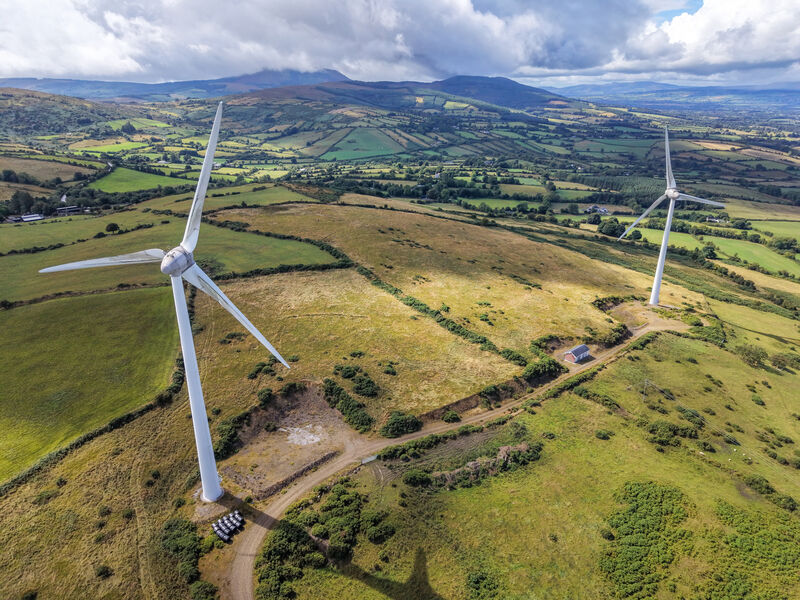
Today, Templederry’s two wind turbines produce around 15GWh of electricity each year, which is enough to power around 3,500 houses. The electricity the turbines generate is fed into the national grid.
While Templederry shareholders pay the same variable amounts of money as everybody else for their electricity, depending on tariff and supplier, the project generates €1.1m every year.
Rather than distributing the dividend among shareholders, the income, after maintenance costs and loan repayments are deducted, is reinvested in other renewable energy projects that members are helping to develop.
These include plans for five 6MW solar farms and the establishment of Community Power, Ireland’s first community-owned electricity supplier.
Templederry’s business manager Gregg Allen said: “Our plan isn’t just to generate energy, but also to be a supplier of it as well.
“Our wider goal is that other plants around the country would generate power, either from wind or solar panels, that we would then sell to customers.”
As shareholders in the first wind farm of its kind in Ireland, Mr Fogarty and his colleagues believed they were at the helm of what had promised to be a revolution in community-run renewable energy generation projects.
Such schemes were widespread around Europe back in the 1990s and early 2000s, and there was a sense that a network of community-run schemes could take off in Ireland too.
Mr Fogarty opened his address to the Oireachtas committee in 2019 by telling members that when he and his fellow shareholders set out to develop a community wind farm, they did not think it would take 12 years.
Now, 20 years on from that initial idea, they did not think theirs would be the only community-owned wind farm in the country.
He said: “That is a testament to the fact that the system is geared against community generation projects.”
Nearly seven years on, Templederry wind farm is still the only community wind farm in operation in Ireland.
“Addressing the committee at the time was very much out of my comfort zone,” he recalled. “But I thought it would make a difference.
“On the day, everyone seemed very positive and interested but little has changed since.
“Templederry shouldn’t be the only community-run wind farm in Ireland, but it is.
“I can’t quite put my finger on why exactly there are not more community projects like ours.
“I do, however, suspect a lack of joined-up thinking at government level across the various departments involved may well have something to do with it.
“I genuinely feel there is a lack of either urgency or enthusiasm for community-run renewable energy schemes in this country on the part of successive governments.
“The system is very much weighted in favour of the big companies and it can feel like the smaller wind farms with only two or three turbines are just basically a nuisance.”
Mr Fogarty laughs when asked if anybody has managed to get enough in dividends to buy a Rolls Royce or a yacht in the south of France.
“A yacht with an out-board motor on Lough Derg would do nicely,” he said. “At the moment, the best we can hope for is to hire one.
“The reality is we have covered what we put in and much of the rest we get out of it is being put into other community-run schemes, to help them do what we have done.
“I would love to see more people coming forward to set up community projects.
“However, I do think that until there is a will to co-ordinate government departments on issues like local wind power generation, or any other community-based energy projects, I don’t know what the future holds.”
Mr Fogarty agrees that what he and his shareholders are trying to do is impressive, but adds: “It’s very impressive thinking, but there is no magic wand to make it happen.”


CLIMATE & SUSTAINABILITY HUB
CONNECT WITH US TODAY



Be the first to know the latest news and updates