Achill Island farmer challenges Mayo council over ownership of commonage lands
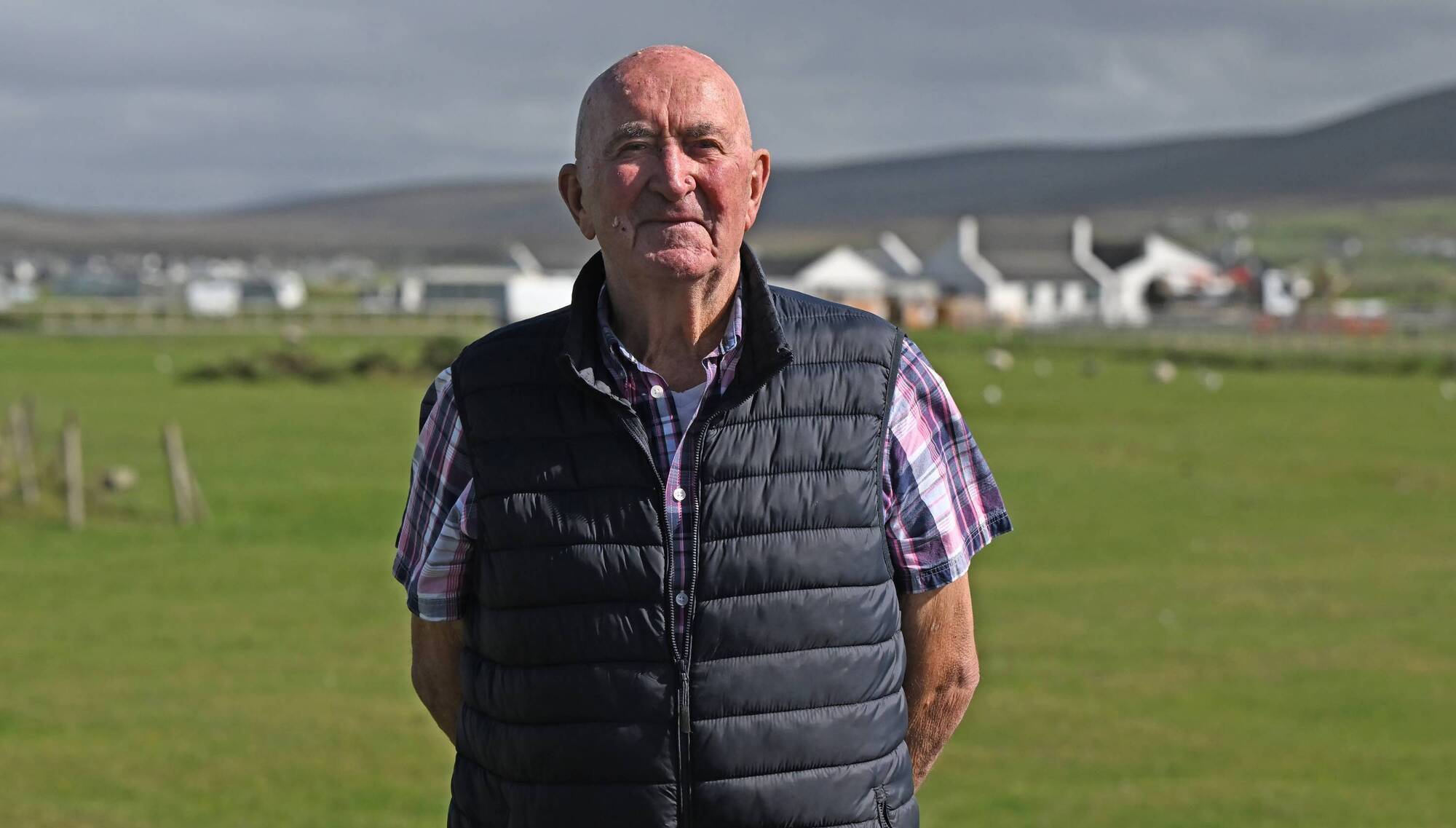
Martin Calvey: An Achill Island farmer is challenging Mayo County Council’s claim to land containing the Keel campsite, amid questions over a supposed 1970s purchase. Picture: Conor McKeown
There was an issue at the boom-bridge on Achill Island that blew open a dispute reaching back decades.
Land, inevitably, was at the heart of it.
Martin Calvey pulled up at the boom-bridge, used as a barrier for entry and exit to the Keel Camping property.
This was September 2025. Calvey was 84. He had spent seventy of those years as a working man and he wasn’t finished yet.
Up until that point, he had access to the park on Achill on the basis that he had sheep grazing there.
Later, it would emerge that there were no sheep grazing at the time, but as far as he was concerned he had a right to come and go as he pleased.
He was accustomed to the bridge responding to recognition of his vehicle's numberplate and raising.
The boom-bridge didn’t budge this time.
He got out and walked into the reception area. There was no resolution there.
He was told he wasn’t allowed entry. This, as far as he was concerned, was not on.
He is a shareholder in the commonage on which the campsite is based. The site operators lease the land from Mayo County Council on the good faith that the council owns the land.
Calvey left his vehicle at the boom-bridge, thus blocking entry and exit from the campsite.
Following the intervention of the gadaí, the vehicle was removed and impounded in Castlebar.
He also received a legal missive from the council through an external solicitor.
The letter pointed out he had “blocked access to the Keel Caravan Park owned by Mayo County Council and leased by them to a third party.
“You are not entitled to do so and we call on you on behalf of the council to immediately remove the obstruction.”
The letter went on to state that the council “acquired the property (along with sandy banks and other lands ) on the island in 1970 by means of a compulsory purchase order.
“If the obstruction is not removed immediately, we have instructions to issue proceedings against you,” the letter threatened.
This is standard fare is a dispute.
However, there was one difference here. The council was claiming ownership of lands and threating legal action against an 84-year-old man, yet all the evidence suggests it was doing so on a false premise.
Despite attempts by this newspaper and a request from within Mayo County Council last February, not one scintilla of evidence has been produced that Mayo County Council compulsory purchased the lands in question, despite claiming ownership.
Not only that, but Calvey and other farmers on the island claim EU farm payments on the basis that the lands are used for grazing animals.
And shares in the commonage are bought and sold on the basis that farmers and not the council owns it.
What emerges is a picture that might have been lifted from the 19th century, with an arm of the state effectively engaged in a “land grab” from citizens.
Martin Calvey is a native of Keel on the west coast of Achill. Next stop New York.
The village nestles between mountains and a sea that sends in folds of waves, turning in white spray, and crashing onto a beach of soft sand. But you can’t eat the scenery.
The land is uneven and befitting a topography assailed by the elements from the cranky Atlantic beyond.
Sheep farming is one of the mainstays of agriculture here.
Drive through the village and you immediately realise that the de facto speed limit is south of 20mph in case you hit one of the sheep who wander the road.
Calvey’s family have been farming here since 1866. An only child, he was just 12 years old when his father died after a long illness.
While he and his mother had a few animals, there was not enough there to sustain a bereaved household.
“In the country at that time you’d only get children’s allowance if you had two or more children,” he says.
“And my mother was too young to get the widow’s pension at the time. So we had no money. My mother went working doing the laundry in the local hotel, making whatever she could. It wasn’t easy for us.”
Calvey had no choice but to leave school at 13 and try to earn a few bob. He helped out on local farms and then one day his mother’s employer asked him for a favour.
“The owner of the hotel, Tia Boyd was her name, she was a good woman. My mother was glad of the work there. And then one day she asked me could I get a lamb for her for the guests.
“We had one but I didn’t know what to do with him so I went to one of the butchers who killed it for me. Then Ms Boyd hands me five pounds for it. I couldn’t believe that it was worth that kind of money. That set things off in my mind.”
At 16, he went to England to work on building sites in Leeds. While there he met a butcher who showed him the trade. He retuned home after about eighteen months.
“I got into it and I was quickly operating an abattoir at the back of my home.
"One day an inspector called, said he’d got a complaint. He asked was my father in. He couldn’t believe that me, at my age, was responsible for that. Anyway the same man once he saw what was going on and how I was, he helped me to get a licence and from there things took off.”
Martin met his wife Angela on the island.
“We had a son and I said, 'sure it would be grand to have a second son',” he says.
“But then we had eight daughters before the second fella came along.”
His company, Achill Mountain Lamb, was started in 1962 and has gone from strength to strength, with two generations of the family following him into the business.
One feature of farming on Achill is the use of commonage.
Around 500 owners share roughly 17,000 acres of unfenced commonage on the island. The land is in effect used for grazing rights.
The system dates back to the 19th century when tenant farmers had a small enclosure but access to a wider area for communal grazing. After land reforms in areas like Achill, the large tracts that had been used weren’t parcelled individually for purchase but instead farmers were given a collective grazing right share in the commonage.
On the island there are around 200 active farmers using their share for grazing but the remainder of owners still have rights and their share is tradable.
Local auctioneer Joe Mulligan confirmed that he often is contacted about buying or selling a share in a commonage on the island.
“It happens on an ongoing basis,” he says.
“There are a number of different commonages on the island and with the odd exception they are transferable and registered on folios as separate items.”
The commonage in front of Keel village and looking out on the Atlantic is the Achill Mission Estate, otherwise known as the sandy banks.
As the 1970s rolled in and tourism took off, visitors often pitched their tents in one area of the commonage that sits between road and beach.
In 1988 this was officially opened as a camping park by the council.
Calvey says he wasn’t bothered.
"My sheep weren’t stopped going in or out,” he says.
“They could graze there and whenever I needed to dose them or anything else I just went in.”
As a sharedholder in the commonage he also received payments from the EU under the Common Agricultural Policy.
There was an attempt by the council to purchase the commonage.
“It was in the seventies,” Calvey remembers.
“We were all called up to the hotel to a meeting but it wasn’t going anywhere so it was left at that.”
In 2004, the newly formed HSE wanted to build a health centre on the commonage on the basis that the council had given it the go ahead.
It didn’t go ahead, according to Calvey’s daughter Martina, because there were objections and the council couldn’t establish that it was the owner.
In 2022, a new leasee, a couple, took over the park.
Michael and Lisa Fitzsimons also moved to the area.
Attempts to contact them by both email and phone didn’t receive a response.
All things being equal it would be entirely reasonable for any businessowner to have control over who enters the premises they are operating out of.
One way or the other, their business arrangement with the council is undoubtedly based on the good faith that the council owns the land.
But does it?
In 2024, an issue arose between Martin Calvey and the operators and the local man felt compelled to have clarified his ownership of the land on which the campsite is based.
According to the land registry, he is the owner.
This was confirmed in a letter from his solicitor to the council in 2024.
Ownership, the solicitor pointed out attaching a copy of the registry, included “the area of the commonage outlined in red which includes the area that a query has been raised over.”
Yet according to the solicitor’s letter, sent by the council to the farmer last year, the land in question was compulsorily purchased in 1970.
The problem is there is no record of any such purchase and, as one of the owners, Calvey is adamant he wasn’t contacted about it.
“How could they have purchased it without at least talking the owners,” he says.
His daughter made a complaint to the ombudsman but got no joy, with an investigator replying: “The council’s position is that it has a right to lease the land, whereas you said that while there was talk of a CPO it never happened."
The alleged CPO, the investigator noted, “predates the ombudsman’s act”.
The matter came up at a meeting of Mayo County Council last February when the members were asked to ratify an extension of the lease for the camping park operators. The lease was to be for a sum of €20,000 per annum.
Councillor Paul McNamara proposed that the council “defer this item and provide full title deeds to the meeting”.
The title deeds have not been produced before the council members since.
Ratification from the council is required to renew the lease.
The Irish Examiner first submitted questions to Mayo County Council on 27 August on whether there was any documents to prove a CPO, why the folio was not registered in the land registry and how could farm payments be made on land that was being leased by the council as a campsite.
On the land registry, the response was “the land was not registered on land registry”.
This, 56 years after the alleged purchase took place.
The council also claimed the caravan and campsite were leased to private operators “since the 1980s with the land acquired by CPO from shareholders at the time.”
No documentary evidence of this was provided.
When it was pointed out that the council’s solicitor had claimed the CPO was in 1970, a further response said the CPO “was in the 1970s, I did not make that clear in the previous email”.
Regarding the farm payments, the council said it is “not aware of and has no oversight of, or involvement in, any agricultural subsidy payments that may be claimed in respect of the land in question.”
This, by any standards, is quite of a feat of ignorance.
Further questions and attempts at clarification did not receive any response from the local authority.
If Mayo County Council has legal title on the land it appears to be doing everything to hide it from both elected councillors and the media.
“They’re claiming they own that land,” Martin Calvey’s daughter Martina says.
“Yet they have not one iota of proof of it. This supposed CPO never happened. Instead they send out a legal letter threatening to take an 85-year-old man to court. That says it all.”

CONNECT WITH US TODAY



Be the first to know the latest news and updates