How a climate startup is working to thicken Arctic sea ice and protect Inuit communities
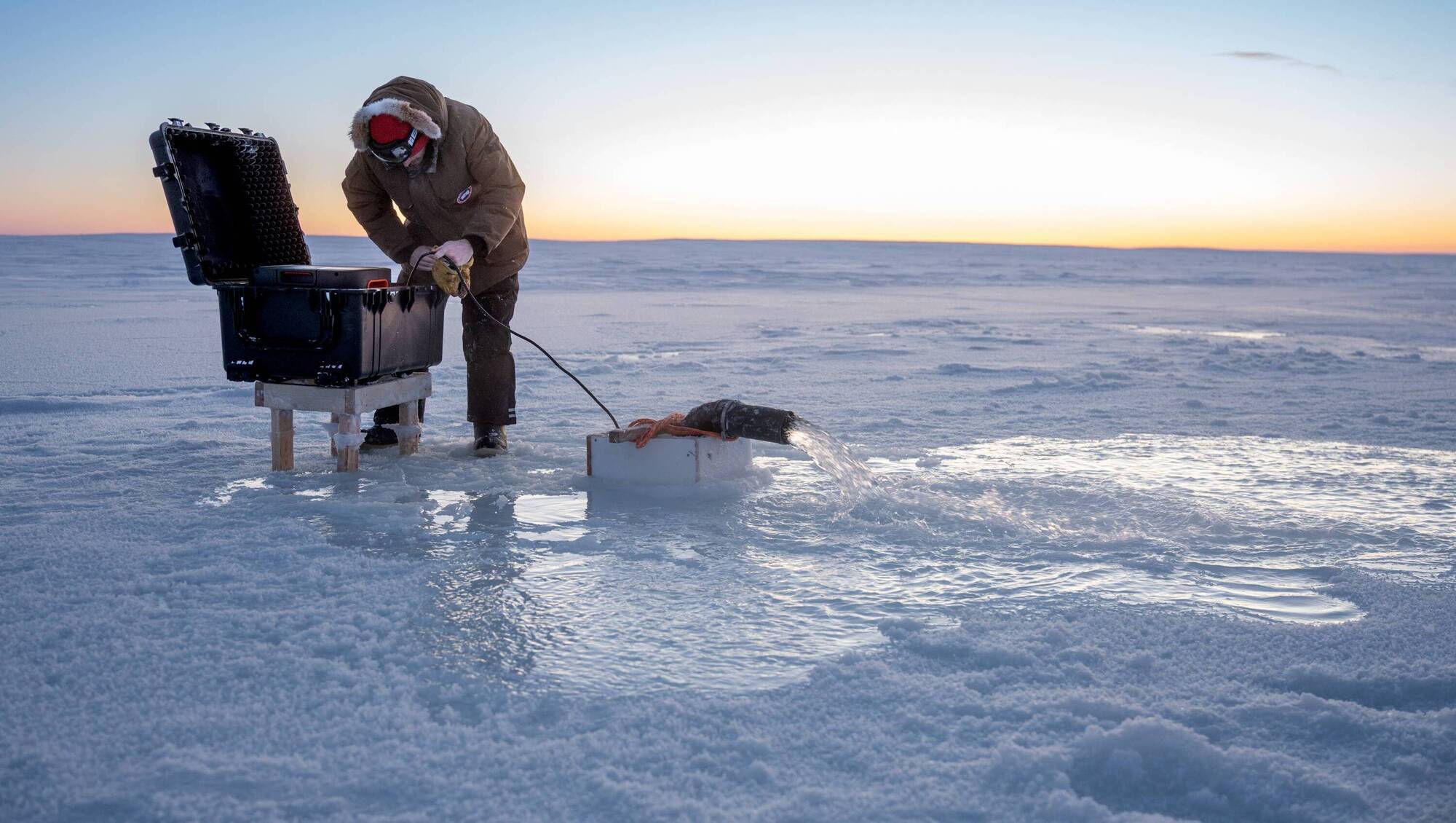
A Real Ice machine, which aims to refreeze sheets of ice in the Arctic, in action in the Cambridge Bay area of the southeast coast of Victoria Island in the Kitikmeot Region of Nunavut, Canada. Picture: Elise Imbeau
While many children grow up to be accountants or teachers, Cían Sherwin has taken a more ambitious career path that involves refreezing ice in the Arctic.
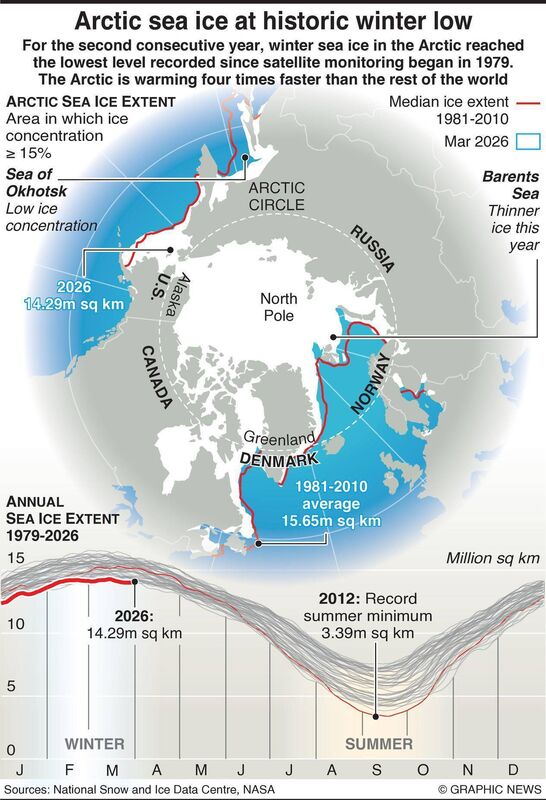
Concern has been mounting about depleting sea ice for decades. It comes as Antarctica and Greenland report a combined loss of 400 billion tonnes of ice annually.
Formed in 2022, and having begun life with the Dublin native and a team of students and graduates from Bangor University in Wales, the Real Ice system uses a solar pump to draw water from underneath the Arctic ice sheet, creating a lake on the surface. The lake’s exposure to the air causes it to freeze and in turn restores and thickens the ice.
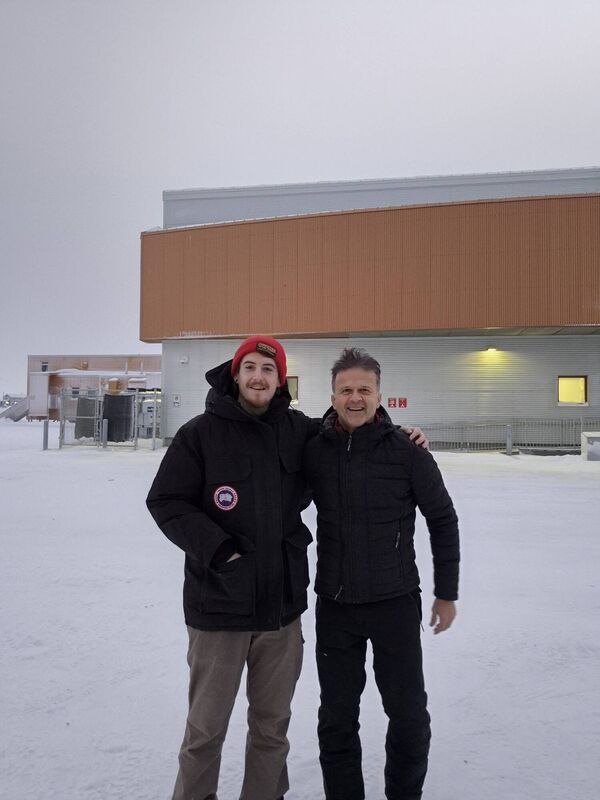
Ice thickening has been used historically for a number of purposes, including the creation of temporary platforms for drilling rigs. However, company director Cían and chief executive Andrea Ceccolini hope their efforts will not only positively impact climate change but also protect the cultures of indigenous communities.
Many Inuit people rely on the ice to survive as it provides a stable platform to hunt and fish. By blending science with indigenous knowledge, the idea is to allow Inuit people to take control of and maintain the machines used by Real Ice.
Read More
The company plans to introduce new technology next year in the form of underwater drones, allowing for greater agility and access to ice sheets. Field tests are under way.
“I pinch myself every day to be involved in something like this,” Cían says.
“We have managed in the last few years to build relations with groups in the community in Cambridge Bay on Victoria Island in the Nunavut territory, northern Canada. We work with the hunters and trappers organisation, the local research centre and various local consultants on a day to day basis.
Cían is extremely passionate about his work.
“We are looking at a way to preserve Arctic sea ice at scale with the use of underwater drone technology. We are still going through the iterative research process. The packaging of the ice thickening into an underwater drone is quite new. It is still in the early stages.
"I am focused on the field operations but we are hoping to bring our very first drone up to the Arctic next year. In the hamlet where we work, there are only 2,000 people. The people there are hopeful and that’s the best way to sum it up.
"When we speak to the elders, they are able to tell us how much has changed over the last 10 years. It’s really heartbreaking in some ways because they have some very sad stories about people being lost to the ice or different accidents that have occurred because of the changes.
"This is motivation and inspiration for us to continue doing the work that we do. We are not trying to be saviours. This is a technique which we hope we can develop with the community and other communities in the Arctic.
"By taking this on we hope we can inspire the Canadian government to really do this at scale at some point.”
Cían’s work is not for the faint hearted.
“This is a harsh environment. We all know how difficult it can be to work there and we have experienced temperatures as low as -60C, which is quite challenging. The foxes like to chew on any equipment that is left on the ice, which can also be difficult. We leave some measurement instruments on the ice so we can gather data while we are working. However, we have realised it is necessary to “fox-proof” our devices. We do this by wrapping them up in chicken wrap.”
Meanwhile, Mr Ceccolini emphasises the significance of the new technology developed to improve the company’s operations.
“Ice thickening is about pumping water on top of sea ice in the Arctic in the middle of winter,” he says.
“That’s obviously not something you want to do manually. The climate is just horrible. We are talking about -40C with strong winds, blizzards, you name it. It’s not just humans but also machines that struggle to work on top of the ice.
"If you want automation to cover large areas of ice, you need machines to do that for you. Working underneath the ice might seem counterintuitive, but actually you are in a very nice environment. The temperature is constant, just above the freezing point of sea water. You can move with very little energy in three dimensions. You don’t have obstacles if the ice breaks because you are still under water.
"When you get to a point where you want to thicken the ice, you make a hole in it from underneath. These drones carry a large battery for energy and a water pump to pump out water on top of the ice.”
He is enjoying watching the company evolve.
“We tested our first prototype last February in Finland. This location was much easier for us to reach from a logistical perspective and the tests went well. We are now working on a second prototype which we’ll bring to Canada next January. That’s where we are with the technology.
"We have also done manually operated electric pumps to make a hole in the ice from above the water. We place this pump in the water and let it pump for hours. That’s how we have been doing our field tests.
"Cían is our key person for field testing and field operations. He spent many months in Cambridge Bay over the last three winters. The first winter was in Alaska and he has been leading the field operations over there. At present, we have to put the pumps in and take them, which is why we are so motivated to automate and get the community running this. They know the ice and how important it is.
"If we can give them tools in the future that have no impact on the ecology, they will be the ones who will be best placed to run the system. They can remain local to save their culture.”
He explains why the project is so close to his heart.
"Their mental health is also affected because generations are changing their way of living. This is not just a climate story. It is a story about saving a culture that depends on sea ice.”
Mr Ceccolini enjoys defying expectations.
“We started against all the odds. Even the scientists who studied this told us this wasn’t going to work. They are our advisers now and they are counting on us to push the research forward.”
CLIMATE & SUSTAINABILITY HUB
CONNECT WITH US TODAY



Be the first to know the latest news and updates