Special report: Faces of homelessness have been changing over the last decade
The rate of homelessness ballooned from 8,830 the month the Rebuilding Ireland plan was released to 16,966 the month its successor, the Action Plan for Housing and Homelessness, arrived. File Picture: Paul Faith/AFP/Getty
In 2021, the Department of Housing counted 7,991 people in Ireland as homeless.
Read More
It’s very difficult to write about a crisis when the public is resigned to the fact that it may never be solved.
In Ireland, homelessness has almost become as accepted as a wet day.
Countless promises, a succession of action plans, and what have amounted to laughable government targets have come and gone as the number of families who drag suitcases in and out of emergency accommodation continues to spiral in one direction.
Repeat something enough times and, no matter how powerful the message or distressing the situation, it becomes normalised.
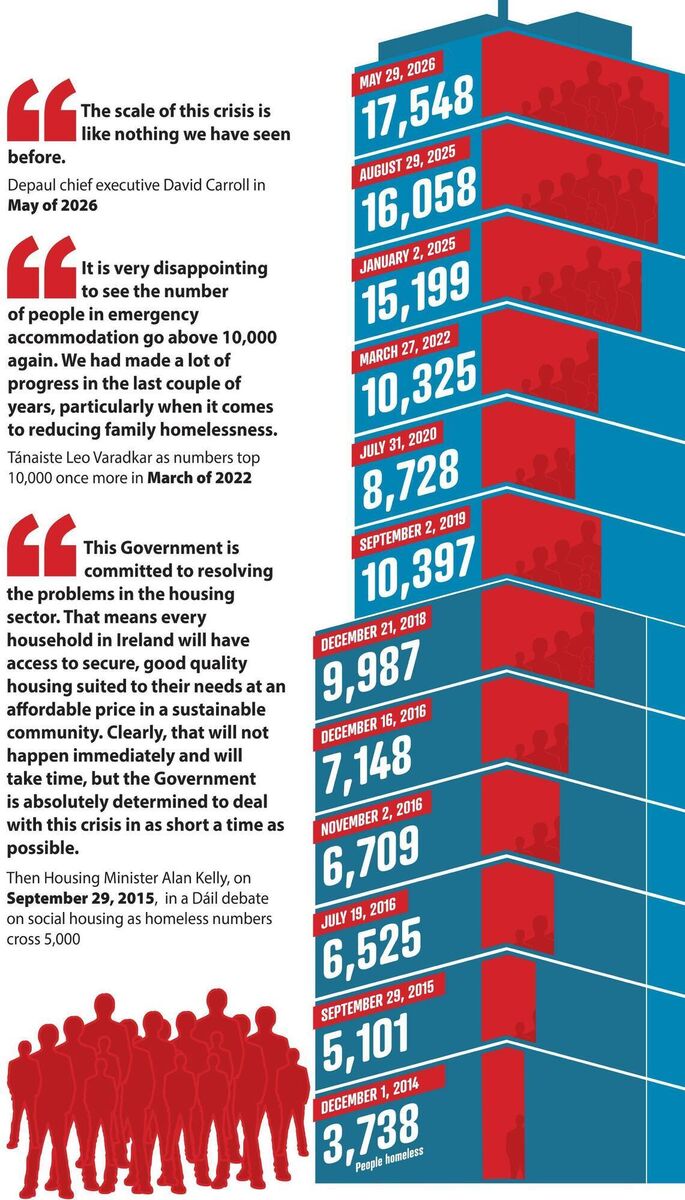
This was not always the case. Back in early December 2014, with 331 families in temporary accommodation, then housing minister Alan Kelly called an emergency homeless summit. It went on for over six hours and was attended by various government departments and agencies, local councillors, the heads of charities, opposition spokespeople, and even church leaders.
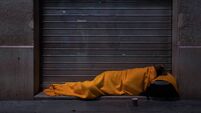
The death of Jonathan Corrie, who succumbed to hypothermia on a doorway just metres away from the entrance to Leinster House a few days prior, had sparked public outrage, dominated the Dáil agenda, and taken up endless column inches and airtime.
A number of measures were decided on out of the forum, including a direction that local authorities in Dublin put 50% of all new housing allocations towards vulnerable groups such as those long-term homeless and people with special needs.
The implementation plan on the State’s response to homelessness had been published the previous May, and it pledged to bring an end to involuntary long-term homelessness by the end of 2016. Leaving the meeting, then lord mayor Christy Burke had reason to be hopeful.
“It’s the first time in 30 years as a public representative that I’ve ever been to such a positive meeting in all those years,” he said, “it was a breath of fresh air.”
Then taoiseach Enda Kenny spent three hours in Dublin City that same week meeting homeless people and providing assistance to them.
It was a time when anger was mixed with a significant will to fix a situation. Of course, the 2016 deadline came and went.
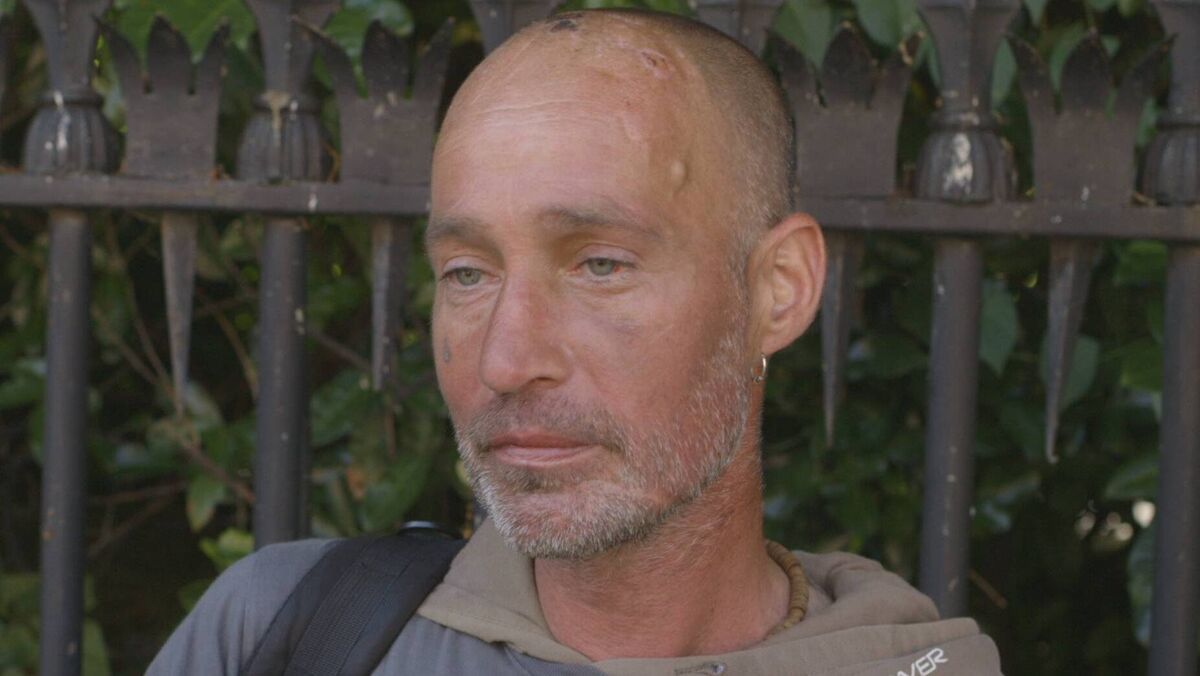
In the intervening period, ministers Simon Coveney, Eoghan Murphy, Darragh O’Brien, and now James Browne have all pledged to work towards a solution with very little, if any, improvement seen. A decade on, homelessness is represented by a runaway figure that is announced each month.
Akin to climate change, hospital waiting lists, or rising household costs, the public has collectively conceded that homelessness is a problem that may never be completely fixed. Outrage fatigue has set in.
Lasana Harris, a professor of social neuroscience at University College London who has investigated how the brain perceives marginalised groups, has found that being empathic to others takes its toll, and so our brains are “trained to disconnect” when we see a homeless person.
“We’ve developed this as a strategy to help us get through our social environment,” he said.
“Most people think, and rightly so, that homeless people are having very negative experiences and constantly suffering. We may not always want to resonate with that suffering.
Mr Harris has found that this process of dehumanisation is similar to that of medical professionals who, in order to do their job, must to a certain extent disassociate with the suffering of the patient under their care. To do otherwise would trigger an overwhelming emotional response.
As the uncontained crisis of homelessness continues, the public mood has shifted from a state of palpable frustration and fury at the injustice of having families cooped up in hotels, hubs, and emergency accommodation to one of apathy.
The real danger now is that sensing the issue is no longer top of the agenda for voters, politicians will treat homelessness as an ongoing annoyance that doesn’t require the full focus of Government.
Some might argue this has been the approach all along.
Homelessness is not complex, despite some of the political narrative recently. Solving homelessness starts with a home.
At Simon Communities across Ireland, we see every day both the human reality of homelessness and the clear, evidence-based solutions that can end it.
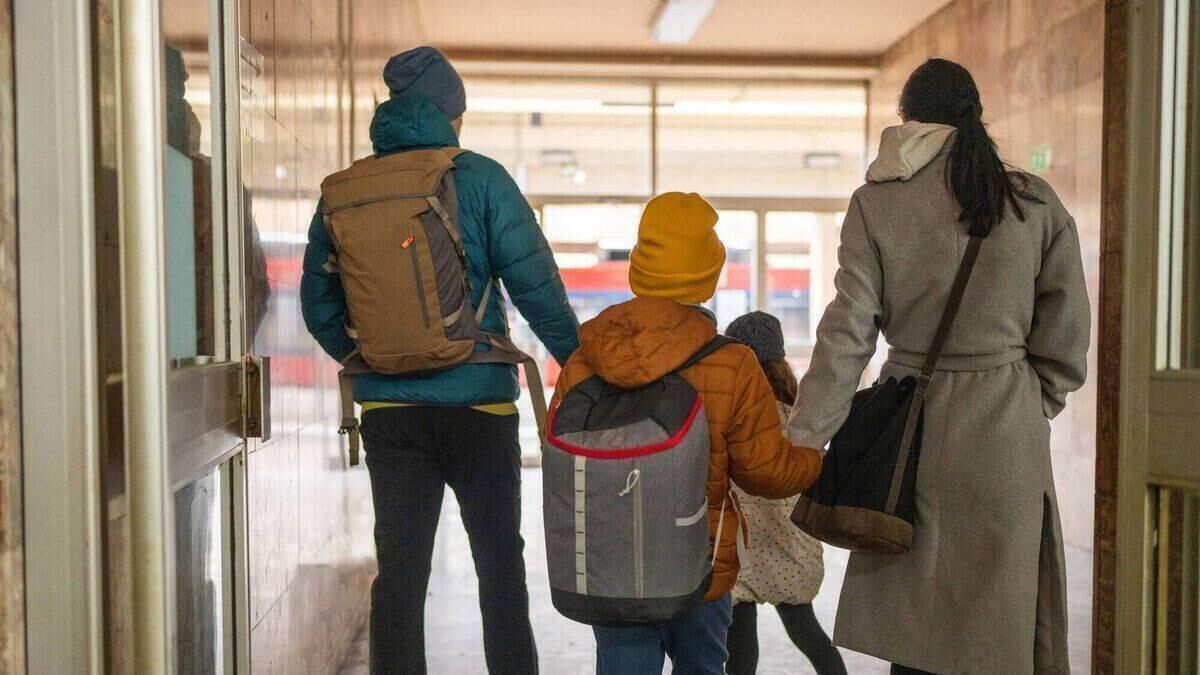
The faces of homelessness have been changing over the last decade of this crisis. We are seeing more young people, more families, more people who simply cannot afford the rent, more complex needs because of lack of access to addiction or mental health services, people sleeping in their cars throughout college, people unable to afford food, and, of course, pensioners being forced to retire into emergency homeless accommodation.
It is simply not good enough. Ireland is a rich country, with plenty of empty properties and land for building. In June 2021, when Ireland signed the Lisbon Declaration (an EU-wide commitment to end homelessness by 2030), there were 5,847 adults in emergency accommodation, and 932 families with 2,167 children.
Shamefully, the most recent report from April 2026 shows heartbreaking increases across all age groups and counties. In April of this year, there were 11,944 adults and 5,604 children in emergency accommodation (2,707 families).
It is important to note that the official homeless reports are just the tip of the iceberg.
The official monthly numbers also don’t include the many women and children in domestic violence refuges, nor the thousands of people legally allowed to stay in the country but stuck in Ipas accommodation.
For decades, we have put forward policy solutions to the government. We take part in public consultations, any available fora, sit on the national homeless action committee, and try to play a productive and constructive part in ending homelessness.
The most effective way to end homelessness is to prevent it from occurring in the first place. Yet prevention has historically been underfunded and under-prioritised. We know that early intervention works. Homelessness can be avoidable if we act early enough.
That means reforming the private rental system, which is now the single biggest driver of homelessness. We need HAP rates that reflect real market rents, stronger protections to prevent evictions into homelessness, and easier access to supports when people are in difficulty.
We must scale up what we know works for those already experiencing homelessness. The housing first model has shown that providing a person with a permanent home, alongside intensive supports, is far more effective than expecting them to move through emergency systems. This has worked in Finland and is working in parts of Ireland.
We also need to significantly increase the supply of social and supported housing.
Long-term supported accommodation is essential for those who cannot live independently without ongoing assistance. Without this, people remain stuck in emergency accommodation that was never designed to be a long-term solution.
Ending homelessness will also require stronger accountability. We have called for clearer data collection, better sharing of information between agencies, and ultimately a legal duty on the State to prevent homelessness.
The Department of Housing alone cannot solve homelessness. Only a whole-of-government approach including health, social protection, and justice will bring about the change that’s needed. The solutions exist but they require co-ordination, political will, and sustained investment.
The scale of homelessness in Ireland today is deeply concerning. But it is not without hope. Every day, the incredible people working across Simon Communities see the difference that the right intervention at the right time can make. We know what works. The question now is whether those with the power to end homelessness choose to act on that knowledge.
- Paul Hosford is the Deputy Political Editor with the Elaine Loughlin is the Political Editor with the. Ber Grogan is the executive director of Simon Communities of Ireland.
CONNECT WITH US TODAY



Be the first to know the latest news and updates