'Hopefully this will end at some point': Taoiseach sees a miracle amid the war in Ukraine
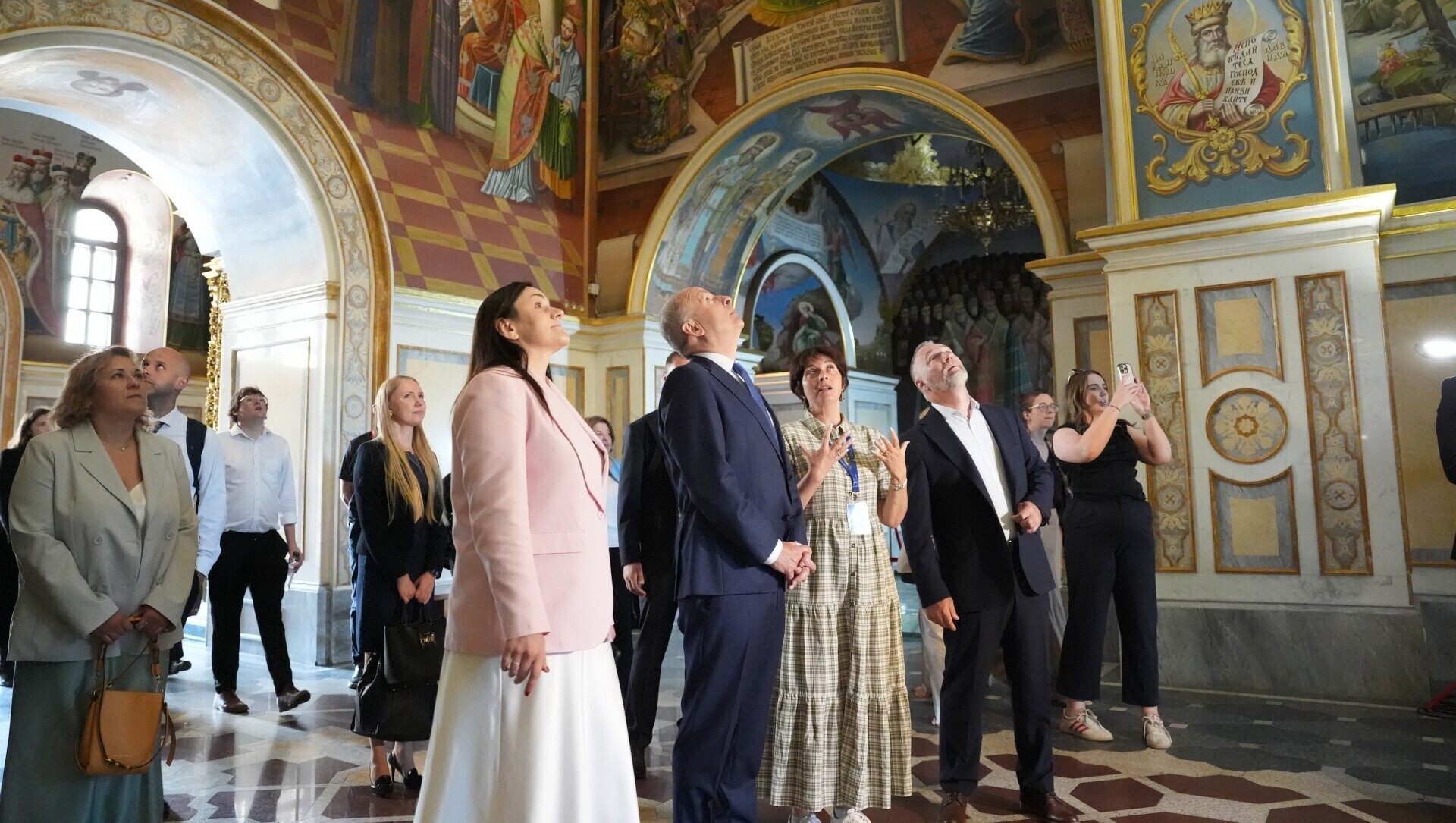
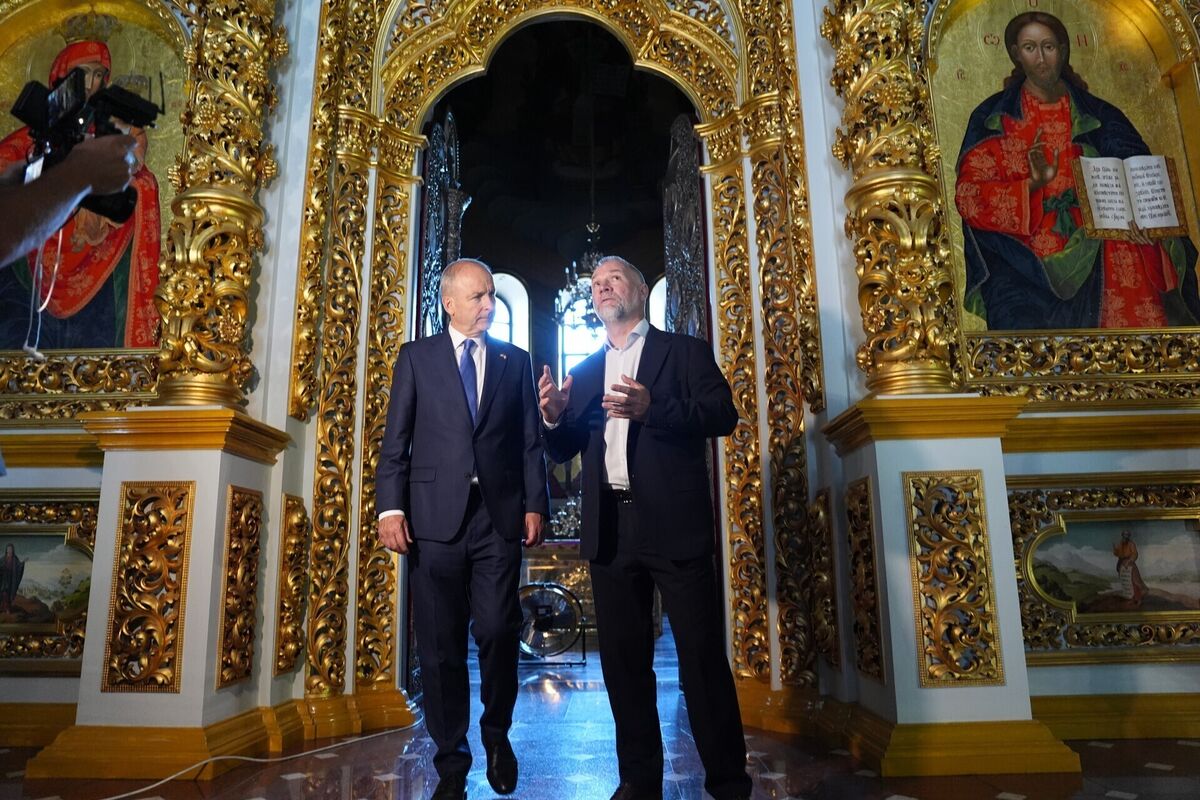
Micheal Martin, Tetyana Berezhna (left), guide Yulia Vizir, and Maksym Ostapenko, inside the Dormition Cathedral during the Taoiseach’s visit to Kyiv. Picture: Niall Carson/PA
On the final stop of his 12-hour trip to Kyiv, Taoiseach Micheál Martin lamented that he had left his phone in the car.
It was clear why he wanted it. He was in the most beautiful cathedral, lavished with gold decorations, as intricate artwork of saints and scholars painted on the ceilings looked down from on high.
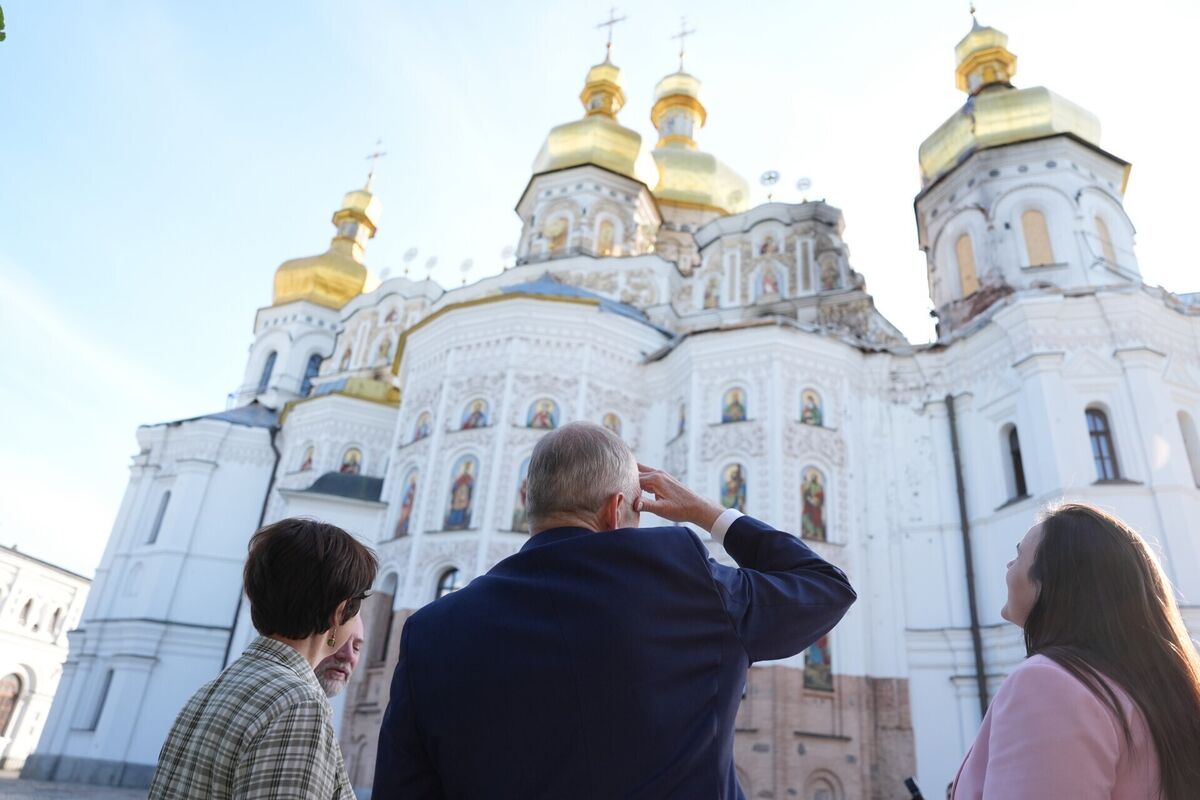
Walking through the grounds of the Kyiv-Pechersk Lavra monastery complex in the evening sunshine, one would have been forgiven for thinking they were in any European city.
The Unesco World Heritage Site, which sits just up from the Dnieper River, brings a sense of peace, calm, and solitude to visitors in a city that has not known those attributes since February 2022.
But look a little closer, and you could see the damage to one of the cathedral’s domes.
It is a sharp reminder — as if the anxiety that is always at the back of your mind in Kyiv would ever let you forget — that Ukraine is still very much a country at war.
Kyiv-Pechersk Lavra, also known as the Kyiv Monastery of Caves, has been targeted by Russia as president Vladimir Putin continues his fifth year of indiscriminate bombing across the country.
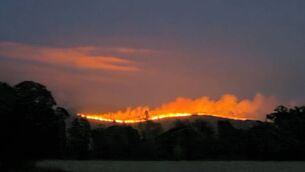
On June 15, a massive Russian strike sent the monastery complex up in flames. Ukraine’s deputy culture minister, Tetyana Filevska, showed the Taoiseach the video of the vicious inferno on her mobile. It was hard to believe it happened just six weeks ago.
“80% of the roof was burned out,” explained Yulia Vizir, the tour guide.
“The fire teams were here for all the night, but the rain helped, because the rain was starting.”
“A miracle,” agreed the Taoiseach.
This was not the first time the church, which was constructed in the 11th century, was destroyed. It was set on fire in 1096. In 1230, it was destroyed by an earthquake. In the 1400s, it was destroyed twice by different armies under two Khans.
Another fire hit in 1718. In 1941, the cathedral was almost destroyed by a powerful explosion during the Second World War.
“It’s like a phoenix,” noted Maksym Ostapenko, director general of Kyiv-Pechersk Lavra.
In many ways, Ukraine itself could be described as a phoenix.
It keeps on rising from the ashes, even when you think it should be down and out, completely dejected, and ready to give up as Russia shows no sign of doing.
And yet, it keeps fighting.
It was Mr Martin’s third time in Kyiv, but it was the first time many of the travelling media had made the long journey.
It is not as simple as hopping on a flight; It was truly a case of planes, trains, and automobiles.
Most had to take at least two flights to get to Rzeszow, in south-eastern Poland. From there, they were bussed to an overnight train.
The media were also on board the presidential train, albeit completely separated from the Taoiseach’s delegation.
We each had a cabin, where a tiny, thin couch doubled as a bed. On safety briefings before the trip, we were told that if an attack were to occur, we were to deboard the train and seek shelter.
If the noise and the bumpiness of the train were not enough to keep you awake most of the night, the knowledge that it could be targeted meant that you could never fall completely asleep.
The journey lasted 10 hours, with multiple passport checks along the way.
The first thing you saw when you got off the train in Kyiv was the military gunmen, who were dotted all around the city.
Despite this, the city feels like any other during the day.
But it is at night that the Russian attacks usually start. When the Taoiseach arrived, there had been four peaceful nights, following the largest ballistic missile attack of the war so far on Sunday morning.
On Friday, just hours after he arrived back in Poland, Russia launched a rare daytime ballistic missile attack.
There had been the faint ring of a siren as journalists sat in a holding room in president Volodymyr Zelenskyy’s official residence, Mariinskyi Palace, on Thursday morning.
For security reasons, journalists had been stripped of their phones, smartwatches, and laptops, so we could not have googled what was happening even if we wanted to.
The Ukrainian press corps did not budge an inch, which meant the visitors simply followed their lead.
These sirens have become a regular fixture in their lives. Who were we to panic if they weren’t?
As he addressed the Irish embassy in Kyiv, the Taoiseach acknowledged the difficulty of the situation.
“I am conscious of the enormous toll that takes on all of you, anybody living in Kyiv or in Ukraine,” he said.
“It’s very difficult for those of us not living here to fully appreciate the realities of living in a city that's under daily aerial attack; loss of sleep, chronic fatigue, and being in a constant state of high alert and fear.
“I admire your resilience, your courage, and your commitment.”
Jonathan Clibborn, who is originally from Cork, first moved to Ukraine in 2007 as a student in an agricultural company with Irish investment.
He worked in several agri-holdings and Ukrainian-owned outfits, later setting up his own business.
Nearly 20 years later, he is still here. His Ukrainian wife and their three children are living in Tipperary. They moved as a family in 2021, but Mr Clibbord returned to Ukraine after the war started.
“The country has transformed enormously since '07,” he explained.
“It's been a privilege to bear witness to all that. But the last four and a half years have been really hard on friends and family here.
“Hopefully this will end at some point, and the country will be stronger and stronger.”
Like all areas with even the tiniest scattering of Irish people, the capital has a GAA club, the Kyiv Gales.
It has 52 members, Kieran O’Sullivan explained, with up to 15 turning up to practice on Monday evenings.
Its members largely work across international development, with NGOs, UN agencies, or the European Commission.
“[It is] mostly just to like bring the Irish community together, but also to introduce a little bit of Irish culture to the Ukrainians,” Mr O’Sullivan said.
“We also know that there's a lot of Ukrainians that are back in Ireland. When they want to return back to Kyiv, and if they had enjoyed that Irish culture, if they had enjoyed the sport, they have a home to bring it back to here as well.”
Several times during his trip, the Taoiseach referenced the number of Ukrainian people living in Ireland, and how, hopefully one day, they will have the option to return home and help rebuild their country.
“It deeply saddens me that this latest visit is not to a Ukraine at peace,” Mr Martin said.
“I look forward to someday in the future when we come to Kyiv and other parts of Ukraine when it is at peace and when we don't have war.”
When this war will end is one of the greatest unknowns in our increasingly turbulent world.
But as Kyiv-Pechersk Lavra has shown so many times, it is possible to rebuild and to return from the ashes like a phoenix.
One day, eventually, the same peace that I felt there will be felt across the whole of Ukraine.
CONNECT WITH US TODAY



Be the first to know the latest news and updates