Gambling ads on social media target young men as study reveals 12.6 million male views

Ahead of the Champions League semi-final between Arsenal and Atletico Madrid on Wednesday, Paddy Power ran an advert promising huge odds to new customers on a goal to be scored in the game. Picture: AP /Jose Breton
Anyone who follows sport is used to seeing gambling advertising everywhere.
On jerseys, on advertising hoardings, on the half-time ad breaks, and when they’re scrolling on social media.
Research published this week revealed the extent the Irish public is facing such adverts when they log into social media platforms.
The researchers from Cambridge University and Munster Technological University looked at 411 advertisements from 88 gambling operators in Ireland, and found young men were reached 2.3 times more than women across Meta platforms such as Facebook and Instagram — even if the adverts did not directly target young men.
The age group that saw the most advertising was 25-34-year-olds, which accounted for more than one third of all unique accounts reached, a total of 6.2 million times.
Read More
Ninety-one adverts (22%) targeted men only, with no adverts targeted only at women.
All 411 adverts reached 12.6 million men compared to 5.4 million women.
One Betfair advertisement alone reached more than 1.32 million unique accounts — equivalent to 26% of the Irish population.
Deepak Padmanabhan, a senior lecturer in computer science at Queen’s University Belfast, said it was striking adverts aimed at both sexes were seen far more by men, highlighting how social media systems funnel ads to users.
“If one looks at the technology itself, however, it shouldn’t be too surprising,” he said.
“We may subscribe to certain channels on YouTube, but even when they post new videos, we often see other ‘interesting’ content at the top of our recommendations.
"The algorithm prioritises content similar to what we spend more time on, sometimes over what we’ve explicitly subscribed to. In technical terms, this is called content-based filtering — where what we see is shaped by what we’ve already watched.”
Mr Padmanabhan said social media platforms use a range of filters — including location, age and interests — to push adverts into users’ feeds, enabling companies to generate profits.
"In this hi-tech environment, the system sets up the game, and users merely play by it. We might rightly see young males getting heavily exposed to addictive gambling ads as a problem, but the deeper issue lies with the platforms themselves, which design these systems to maximise engagement and profit."
Advertisements being targeted at users on Meta platforms can be tracked using the “ad library” on Facebook.
Under the EU’s Digital Services Act, Meta and other online providers must publish all the advertising shown on its platforms in EU countries and the demographic data about who saw them.
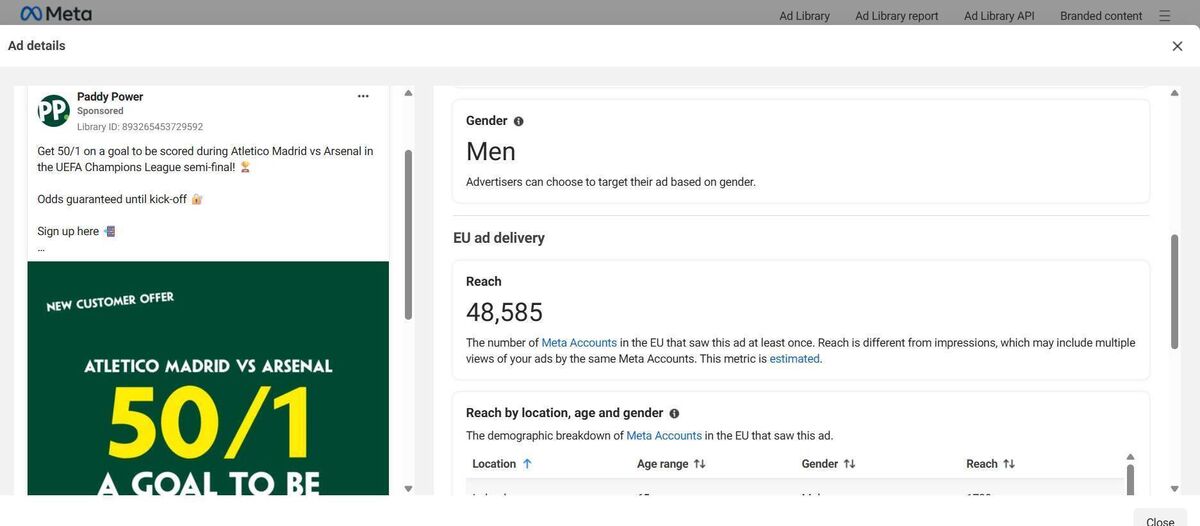
An analysis by the this week showed dozens of active advertisements targeting users in Ireland with gambling adverts.
For example, ahead of the Champions League semi-final between Arsenal and Atletico Madrid on Wednesday, Paddy Power ran an advert promising huge odds to new customers on a goal to be scored in the game.
It was targeted at men in Ireland, and the age group with the most views on the advert was 25-34-year-olds.

Another advert from Boylesports offered cash incentives for betting a set amount, along with free bets on its casino games for new sign‑ups.
While it was targeted at men and women, almost eight times as many men in the 25-34 age range saw the advert compared to women of the same age.
An advert for William Hill promised lots more money in free bets for users who staked €10 on the Punchestown Festival.
Such advertising is pervasive in other jurisdictions such as the US, where betting on prediction markets has become a prominent part of both sporting and wider discourse.
At home, there is a strong and growing awareness of the impact exposure to gambling is having on young men, in particular.
An initiative called The Gameplan was launched last week, aimed at tackling gambling-related harm in sport.
An online resource designed for sports-oriented audiences, it is fronted by former Armagh GAA star Oisín McConville — who has spoken about his own experience of problem gambling — and former rugby player Mark Potter.
“Gambling has become part of the background noise in sport, especially online,” said Potter.
“Young players are growing up with it everywhere, but they’re not being given the right tools to understand the risks. [This] is about meeting young people where they are and giving them clear, honest information that actually makes sense in a sporting context.”
Cambridge researcher Elena Petrovskaya, who led the study published this week, described the number of gambling adverts being seen by social media users in Ireland as “dizzying”.
Other experts in the field have called for robust curbs on advertising to protect young people, while urging all elements of Ireland’s gambling legislation passed in 2024 be enacted as soon as possible and that the new regulator be adequately resourced.
“Firstly, we need to roll out the advertising controls contained in the Gambling Regulation Act as quickly as possible,” said Frank Houghton, principal investigator of the tobacco, alcohol, and gambling research group at Technological University of the Shannon.
“We don’t want a situation like alcohol advertising controls, where we are still waiting to implement some sections of the Public Health (Alcohol) Act 2018 almost a decade later.”
Paul Kitchin, a senior lecturer at the School of Sport and Exercise Science at Ulster University, said the research was important as it set a baseline for social media advertising reach across Ireland.
“With mobile phones and social media being everywhere, young men facing harm are easily connected to gambling operators' offers of quick money," he said.
Colin O’Gara, head of addiction services at St John of God Hospital and clinical professor at the UCD School of Medicine, said it spoke to a “real problem with the proliferation and normalisation of gambling among young men, driven in large part by advertising”.
He said heavily promoted, celebrity-endorsed campaigns have become the norm, and such advertising was a “key engine of harm” that must be tackled if the country is serious about tackling gambling harm.
“The question is whether [the Gambling Regulatory Authority of Ireland] is set up to handle this kind of challenge, and whether the legislation underpinning it goes far enough," Mr O'Gara said.
"In the past, I have commented that this is a huge task, particularly when you consider regulation of the online space.
“The [Gambling Regulatory Authority of Ireland] will have responsibility across the board, including online, and this highlights the need for significant resourcing. It will require substantial support in terms of technical expertise and investment.”
CONNECT WITH US TODAY



Be the first to know the latest news and updates