‘Walking on the shoulders of giants’: Irish peacekeepers continue to serve with dignity in Lebanon
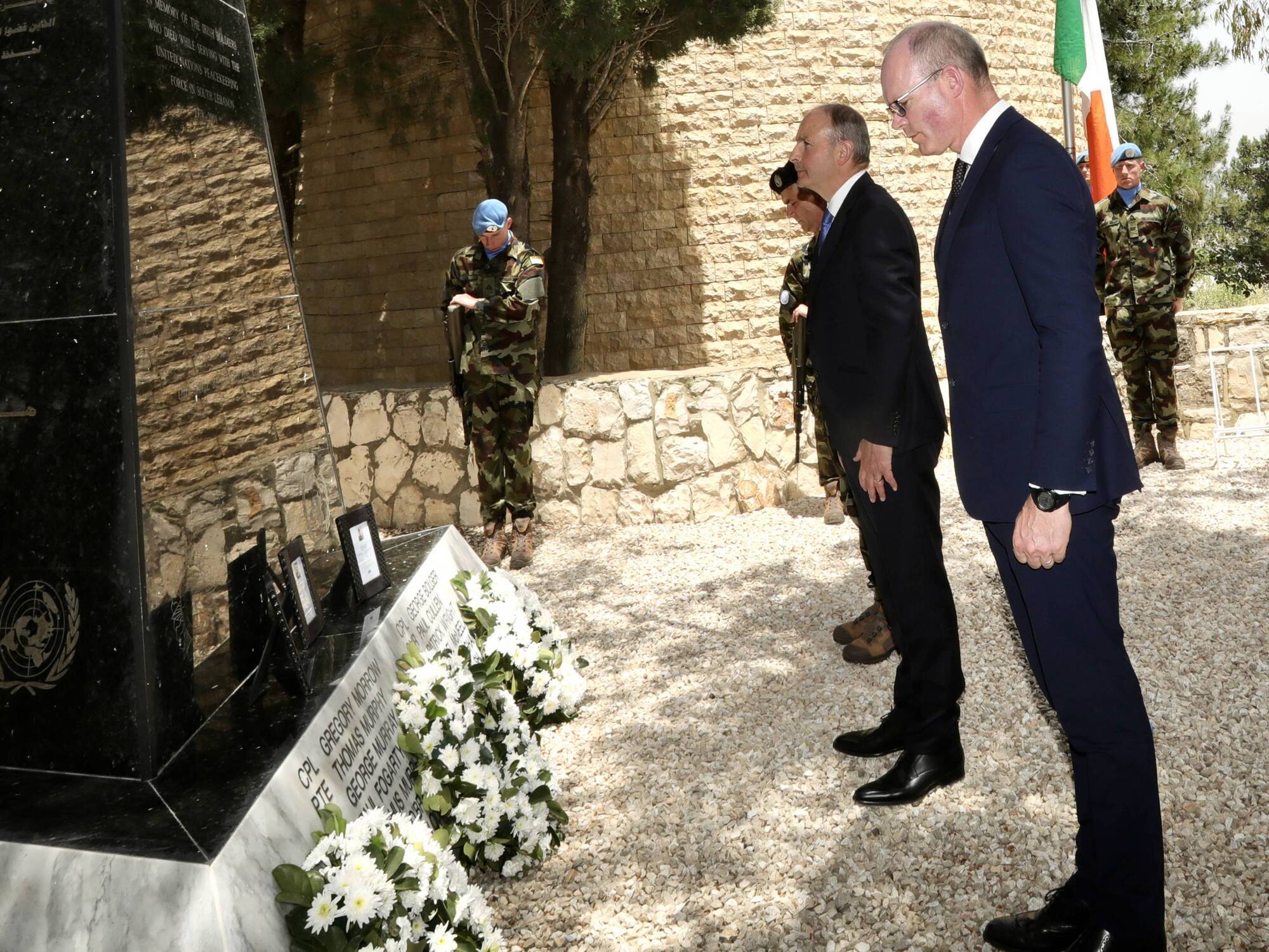
Some of the steps Lieutenant Colonel Denis Hanly and the soldiers he commands take as they serve in Lebanon fall on the same ground where Irish peacekeepers who died once tread.
Some of the paths they will cross while serving in Lebanon will be near where Defence Forces soldiers were shot dead or blown up.
Lt Col Hanly says walking in the same footsteps of these men is akin to “walking on the shoulders of giants” and he says the Lebanese locals refer to them as “the Irish martyrs”.
“It's a mixture of emotions,” he said of walking in their footsteps.
“I think about all of our peacekeeping operations since 1958.
“We're very much standing on the shoulders of giants, who are pioneers in this area.
“We're all soldiers, we all wear the same uniform and, you know, we all want to go home as well.
“We should never forget the sacrifices that the soldiers made, and one they made in a very noble way.”
The father-of-three added: “It's the ultimate sacrifice for peace and it's something we in the Defence Forces never forget.”
These are the same sentiments shared by Taoiseach Micheál Martin as he addressed the troops at the end of his visit, which started with him laying a wreath at a stone monument with the names of the 47 soldiers, all but one of whom died serving with UNIFIL, also known as the United Nations Interim Force in Lebanon.
Before he addressed the troops he mingled with armoured personnel carrier crews, including one contingent from Cork.
Later, he told them: “A number of peacekeepers have lost their lives as they have carried on their duties.
“They will never be forgotten.”
He said that to join up is “never an easy choice”.
He added: “We're very mindful of that personal sacrifice and each one of you has made it by being overseas serving your country.
“What you do is the difference between life and death for so many people by performing your duties overseas, which require considerable sacrifices, leaving your whole family and your loved ones behind.”

The commemoration he attended earlier will have had a sobering impact on those present as the latest to serve with UNIFIL as it passes its 44th anniversary.
More than 324 soldiers of all nationalities have died since the peacekeeping mission started in March 1978, although Ireland has the biggest death toll.
Launched to oversee the Israeli withdrawal from Lebanon after its 1978 invasion of the country, its mandate has been repeatedly extended.
Tens of thousands of Palestinian and Lebanese civilians are estimated to have died since the 1970s with many more injured and hundreds of thousands made homeless.
As well as the Lebanese civil war of 1978, and the Israeli invasion of that year, there has also been the Israeli invasion in 1982, and a protracted and bloody conflict between Lebanon and Israel which led up to the 2006 Lebanon War.
Despite the various agreements to end hostilities, tensions remain high between the various factions and Israel at a time when the country’s economy is on its knees and more than three-quarters of its population live in poverty.
Although the memorial is in Tibnine, the Irish camp – Camp Shamrock – is actually some distance away.
This is because the Defence Forces’ Infantry Battalions, which rotated every six months, were located in the small town until November 2001, more than one and a half years after the Israeli withdrawal from Lebanon.
Irish peacekeepers returned temporarily after the 2006 war but it wasn’t until May 2011 that Ireland returned to the regular deployment of an infantry battalion, after a request for help from the UN.
Stallholders who used to sell their wares outside the original Camp Shamrock have since relocated to the new camp.
Such is their association with the Irish troops that most of the stallholders are taking over from their fathers who took over from their fathers before them.
They clock the fact that they are now selling their goods to the sons and grandsons of troops who served more than 40 years ago.
Many of them speak English in either Cork or Dublin accents.
For the soldiers in the latest deployment, their home will mostly be Camp Shamrock, or UNP 2-45.
Murals of Queen Meadhbh of Connaught and the warrier Cú Chulainn adorn its outside walls alongside what looks like a stencil drawing by the famed street artist, Banksy.
It depicts a peacekeeper being handed a flower by a small child.
There are 338 Irish personnel serving with the 120 Infantry Battalion currently deployed to Lebanon, who will serve alongside nine members of the Armed Forces of Malta.
There are 20 Irish female soldiers serving, with the battalion, and 104 soldiers in total are serving with UNIFIL for the first time.
They are operating as part of a multinational battalion, composed of Irish, Maltese, Polish and Hungarian personnel, collectively referred to as IRISHPOLBATT.
Among the troops Pte Paul Murphy, from Cathal Brugha Barracks Dublin, who has some 17 overseas tours to his name, including missions in Lebanon, Chad, Kosovo, and Liberia.
One of the younger privates he is serving with is Pte Saoirse Sands, who has a tally of her own to be proud of.

A native of Co Down, the 21-year-old has accumulated three Ulster Senior Championship titles and an Intermediate All Ireland Championship.
She is also a Gaelic Life Club All Star for 2021, representing Portaferry GAC.
For much of the next two months, she will be serving at the outpost about six kilometres away from Camp Shamrock known as UNP 6-52.
It is one of a number of observation posts along the so-called Blue Line. Saoirse, who is a distant relative of the hunger striker Bobby Sands, arrived in the camp just over two weeks ago for what is her first posting abroad.
“So it's been an experience really because you're not really knowing what to expect and but yeah, it's been good to have so far, so far from good,” she says.
Asked what she misses most about the home she laughs and says: “I should say it’s the family, but it’s the camogie. That’s a big miss.
“I am told troops do play football and stuff with the locals, so I am hoping we can all get a few hurleys out.
“But you never know, maybe this is the first time they’ll have been exposed to camogie.”
Also among those who have just joined the camp is Fr Ted Sheehan, who also has the distinction of being the oldest member of the battalion.
The 58-year-old priest, who is from the village of Glounthaune, near Cork City, arrived last Wednesday.
He has only been an army chaplain for a year now, and he volunteered to come out to Lebanon.
But he laughed when asked if he thought he was put up for the job of army chaplain in the first place to get rid of him because of his controversial views on vaccines.
“I wouldn’t to be honest,” he said. “But then, you have to have the vaccine (in the Defence Forces).”
In February 2021, a statement had to be issued after he warned parishioners during a mass that they should “act with great caution” when it comes to taking the vaccine.
He said that while he wasn’t advocating taking or not taking vaccines, he said he “certainly would be worried pharma companies producing the vaccines have no legal responsibility if anything goes wrong”.
He described this as “a red flag for most right-thinking people”.
He later had to say in a statement, issued by the Diocese of Cork and Ross on behalf of Bishop Fintan Gavin, that he was sorry if his remarks "caused offence or confusion”.
Although still in quarantine, he was hoping to get to meet the Taoiseach.
The last time they met was in the 1990s, when Mr Martin was Lord Mayor.
“I was teaching in Farranferris, in Cork City, years ago,” he said.
Speaking before Mr Martin’s arrival, he said that although he didn’t expect to be allowed to meet the Taoiseach, he was trying to promote the idea that “non-Cork people” should get their photo taken with him so they can “improve their social standing”.
Was he planning to stick his head out of the window of the place where he is quarantining from and wave frantically at him to get his attention?
“It'll be like a papal visit,” he laughed.
“I will have a flag in my hand and I'll wave it as they pass by, shouting ‘look at me, look at me’.”
Fr Ted doesn’t have a rank but tradition dictates that he is the same rank of whoever he is talking to, so he can be a general one moment, and a private the next.
He doesn’t carry a gun, and if shot at – his plan is to “duck and head for a bunker”.
It is said that while most peacekeepers are lucky to return back to Ireland, everyone who serves in Lebanon and other missions is changed forever.
Lt Col Hanly, whose five overseas tours include one in Afghanistan and another in Kosovo, agrees with this.
“I think sometimes in Ireland we can take for granted the state of development in many of the conflict zones we operate in,” he said.
“We switch on a switch and the power comes on and clean water comes out of our taps.
“Our children go to school, and we have a university system.
“We have all of these sort of things.
“If you serve in a country that is less developed than Ireland, that has to be humbling.
“These are harsh environments, and that's why we deploy peacekeepers.”
He pauses for a moment, and then he adds: “I think you wouldn't be human, and you wouldn't be an Irish soldier if you weren't changed by your experiences abroad.
“I think you actually come back as a better soldier and you come back as a better citizen of Ireland because you know the benefits of what we have in Ireland.”