Behind the scenes at Cork's Naval Service Diving Station in Haulbowline
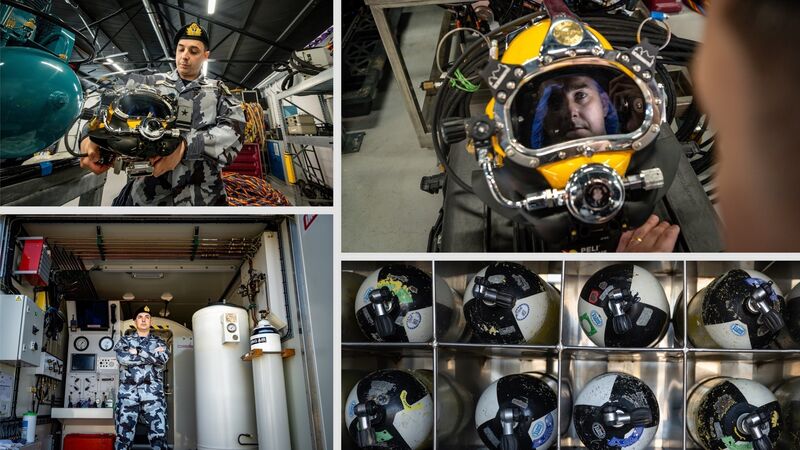
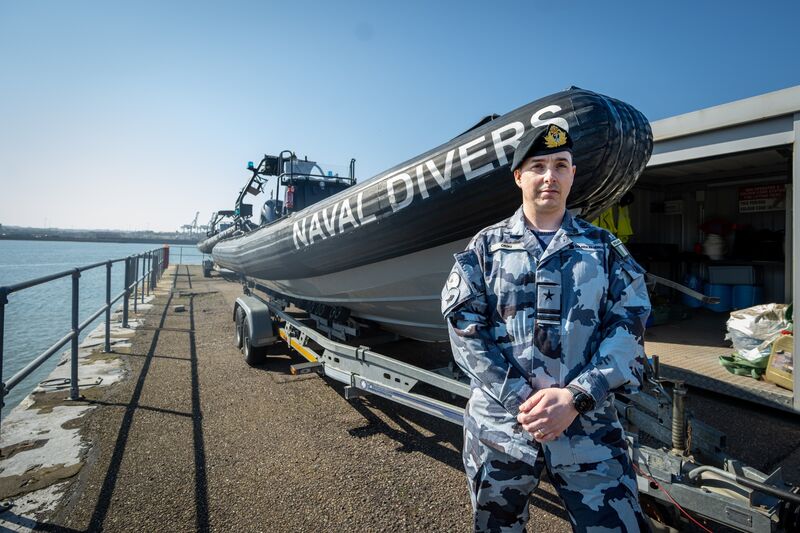
Lt Jason Croke, Officer in Charge of the Naval Service Diving Section, inside the unit’s facilities at Haulbowline Naval Base in Cork, where highly specialised equipment — from hyperbaric chambers and diving helmets to remotely operated vehicles and surface-supplied systems — supports a small, highly trained team undertaking demanding subsea operations. Picture: Chani Anderson
The scenes in the classic German war series depicting the physical effects and mental torment from descending into the sea are excruciating to watch.
The hull of the U-boat creaks and moans and crew members scream from the intense pressure as they go deeper to escape depth charges.
While Lieutenant Jason Croke doesn’t have to worry about that level of stress — not least because the Irish Naval Service has no such vessels — corresponding risks apply for his divers once they descend into deep waters.
Also see: Cormac O'Keeffe's analysis of challenges facing Ireland's naval service, and what it is doing about them
“As you go down 10 metres, you’re experiencing two bar of pressure and it grows as you go deeper,” he explains.
Read More
“At 30 metres you’re experiencing four bar and when the body is under pressure like that, you are at an increased risk of suffering a decompression illness also known as a DCI.”
The head of the Naval Service Diving Section (NSDS) says nitrogen narcosis is the effect on the brain from descending in water.
“When you've increased levels of nitrogen in your blood it can be akin to having a few pints,” Lt Croke says.
“It's kind of like being drunk. It gets exponentially worse when you get deeper. So your body, at 50 metres, you're under a lot of pressure, your blood absorbs the nitrogen at a higher rate.”
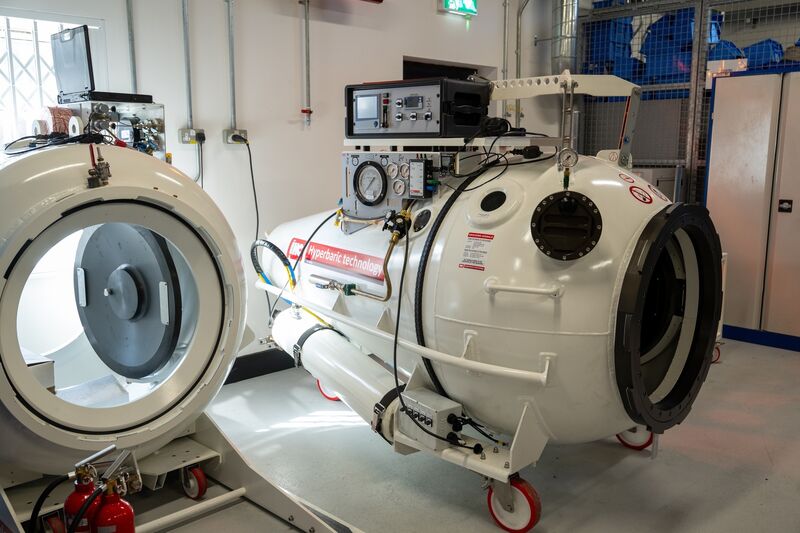
Showing the one of the section’s decompression chambers, he says new divers have be acclimatised, in order to go to this depth.
“If they go down for the first time, they won't be able to work because of the effects of the nitrogen," he says.
"So we dive them in this about once a week, if we can, to about 50 metres, so that their body and their brain is used to the effects of the nitrogen on their body, so if we get a call tomorrow that there's a job at 50 metres that we can send someone straight in.”
Lt Croke is giving us a tour of his facility, focused around a series of containers and buildings hugging each side of what he calls a “camber”, or a dock, with two “fingers” of land, divided by an inlet along Cork Harbour.
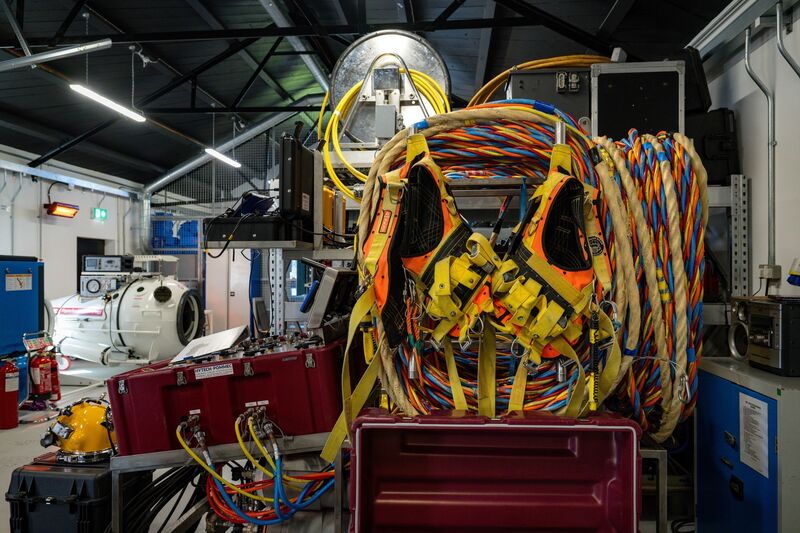
His section takes over a part of the Naval Service (NS) Headquarters at Haulbowline, where ambitious plans are being finalised to map out the future not just of his section but the entire facility and all its assets.
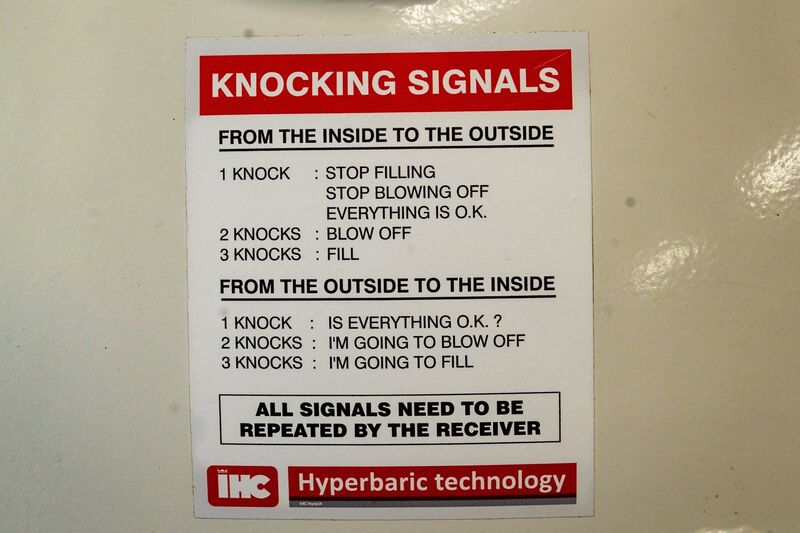
The decompression chamber is crucial if a diver, for whatever reason, isn’t able to follow procedures about ascending at the correct rate.
Lt Croke explains: “Generally you treat it by recompressing the diver in a piece of kit like this, putting the person into the chamber, pressurising it with air, so filling it with air to reduce the size of gas bubbles that have expanded in their blood and bring them back up slowly so their body has time to deal with the injury.”
He says the chamber is also used to deal with the effects of nitrogen narcosis.
“For example, if you come from 30m to the surface too quickly, you won't allow enough time for the increased levels of nitrogen in your blood cells to be expelled from your body through the lungs. You will end up with nitrogen gas bubbles in your bloodstream and experience a condition known as 'the bends'.”
The term comes from sufferers literally bending over in pain as nitrogen narcosis particularly affects shoulders, elbows, knees and ankles.
Diving is an area that is set to grow in importance in the coming years and decade with the planned expansion of offshore wind farm installations, which will require extensive commercial diving by developers.
“In the next 10 years we're going to see an increase in underwater construction in relation to all the renewable energy sites and all that,” Lt Croke says.
Read More
As a result the HSE is keen to build up its capacity to treat diving-related illnesses and injuries. Talks are underway to see if the HSE can register the depression chambers at the NS so it can send patients to them.
Lt Croke says they are disposed to this as long as there is a clinical “hyperbaric” specialist supplied to treat civilians.
Hyperbaric specialists are medical doctors who use hyperbaric oxygen therapy to treat conditions such as decompression illness and carbon monoxide poisoning.
Lt Croke says commercial divers can go down to as far as 300 metres, but often having special chambers that they live in while underwater doing their work.
In terms of the offshore wind facilities, he says some can be floating while others are connected to the sea-bed, including with a cable transmitting the energy back to shore.
Lt Croke says his divers have a capability to go down to 60 metres, but said this will increase to around 100 metres, with the supply of more modern equipment.
Continuing our tour he points out the older buildings on the other side of the camber: “So the north side is going to be remedied like this side, as an interim measure. The buildings, they're kind of old. We've reclaimed buildings as we've expanded.
"But as part of the whole new infrastructure development plan for Defence Forces (DF), we will be getting a new facility on site here. What’s proposed at the moment, it's not signed off on yet, is that this camber will be filled in and both fingers extended, which will give us the 24/7 access the water because it's deeper out there.”
He says the Army Ranger Wing, the special forces of the DF, currently operates its maritime training out of a container in at the NSDS.
“It needs to be replaced and we’re doing that this year,” he says. “We’re going to get them something a little bit bigger; it will still be temporary pending the master plan.”
Lt Croke takes us to a large building, once a theatre, and still referred to as that. Here the NSDS keeps all its high-value equipment and electrical gear, and keeps them dry and secure.
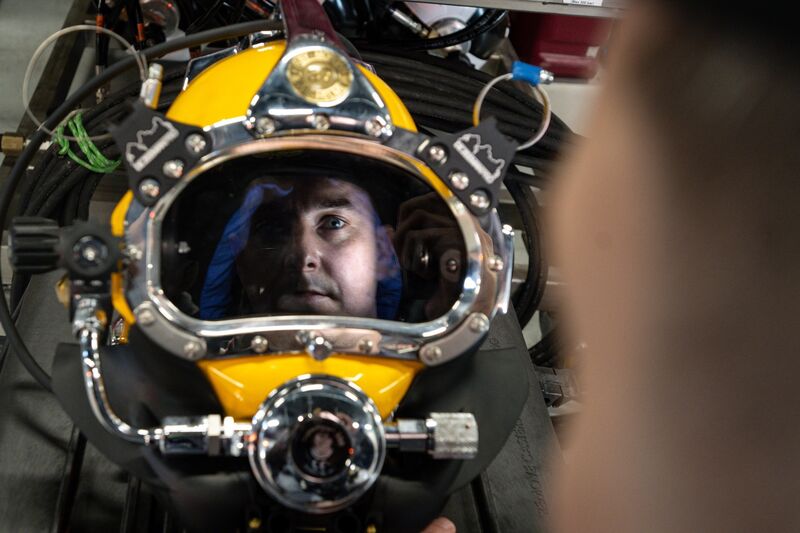
He takes us through the range of equipment. “I'll go back to our diving capabilities. We have a scuba diving capability of 30 metres, that's on air. The equipment for scuba is no different than you'd really see a civilian scuba diver wearing. The second air diving method is surface supplied diving.”
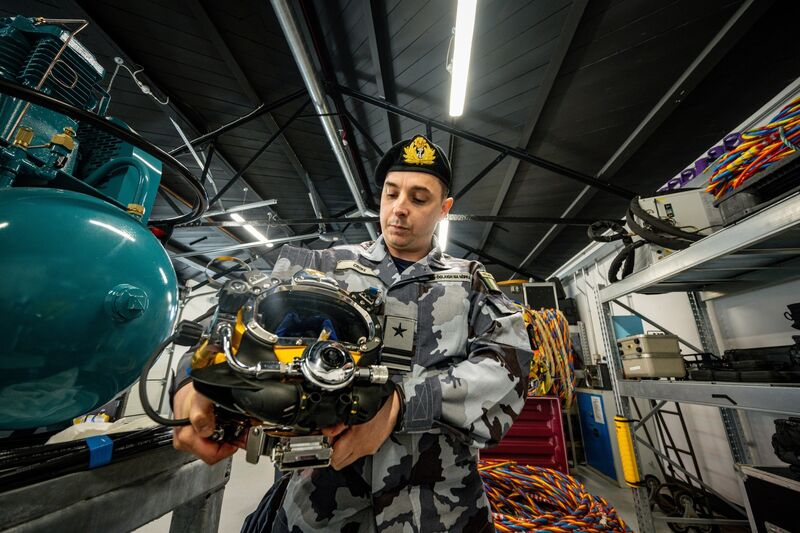
This consists of a large panel with different controls, including the supply of oxygen via umbilical cords to the diver. They have a reinforced helmet, with its own communication system, video and lights.
“We use this if we're diving between 30 and 50 metres or if we're using tools, either hydraulic tools or cutting tools or for diving on a hazardous site like a trawler or a helicopter.
"This equipment is a much safer method of diving with the surface supplied umbilical, the diver has protection for his head, it's a very robust hat but also his head is in a void so he can speak, so he has comms which are also fed through the umbilical to the surface and you’ve a camera mounted here and a light.
"That gives the supervisor who's supervising the diver much better situational awareness of what's going on.”
He said this portable version can transport in a van while they also have a 20-foot container fitted out with the equipment that can be lifted onto the back of a ship.
The third, and last, method of diving is “mixed gas”, which allows a dive down to 60 metres. This equipment is fully non-magnetic and can be used in situations such as dealing with explosives and mines.
He says: “This piece of equipment is being replaced this year by a more modern electronically dosed system that will get down to 60 metres straight away in it, but we'll be able to get between 60 and 100 metres with a dedicated team working up to that depth, because every metre between 60 and 100 the risk and the danger increases exponentially.
"You don't just jump from 60 to 100, it takes time to build the capability.”
Another piece of kit he shows is a handheld sonar. It has GPS and a navigation system and is also fully non-magnetic, so can be used in searching for mines or a car.
“In the Northeast Atlantic, most of the time, we're working in limited to zero visibility,” Lt Croke says. “First thing this can do is it has a chart display for the diver so he can see where he is in the water column or on a chart.
"It's a way for him to navigate to a certain point. There's forward-looking sonar here with a range of 50-60 metres. It can pick up things as small as a coke can.”
The device has other functions, such as magnetometers, multi-beam echo sounders and pinger locations.
Lt Croke says: “That will locate something like an [airplane] black box pinger — they ping on 37.5 [kHz, frequency] — and emissions like drug shipments.
"There have been reports that criminal organisations have moved on to putting acoustic and GPS trackers on submerged shipments — so we can use it for searching for a range of frequencies.”
He says they can also tow the device behind a boat to cover a larger area than a diver can do.
“It’s an extremely valuable kit for us that really reduces our search time,” he says.
“We've used this looking for bodies, looking for cars, interrogating suspected mines, we've used it in some of the operations with Revenue Customs when we're looking along the bottom of the ship.”
He says they have a service-level agreement with Revenue Customs to search a ship subsea. As of yet they haven’t found compartments welded onto boats underwater to store drugs and such.
“We have found evidence of welding marks, where they had been a projectile or package attached to ship’s vessel at some stage but we haven’t found an external compartment for storing drugs or drugs stuffed into what’s known as sea chests, water intakes.
"They are regularly seen internationally, welded to ships’ hull in compartments or stuffed into those sea chests.”
The lieutenant says they have also been involved in coastal searches for drugs, including an attempt by an international gang to smuggle an estimated 850kgs of cocaine into West Cork in March 2024.
The gang was seen using a black rib speedboat at Tragumna pier in West Cork but failed to collect the shipment from a mothership and were arrested on their return.
“We had a big involvement in that because it was suspected that the criminal organisation had either stashed the drugs underwater somewhere or left them floating with the tracker,” Lt Croke says.
“So we were down there for nearly two weeks, using this [the handheld device] to search for pings, interrogating different signals. It it took a long time to confidently say that there's nothing there, from our side of things anyway.”
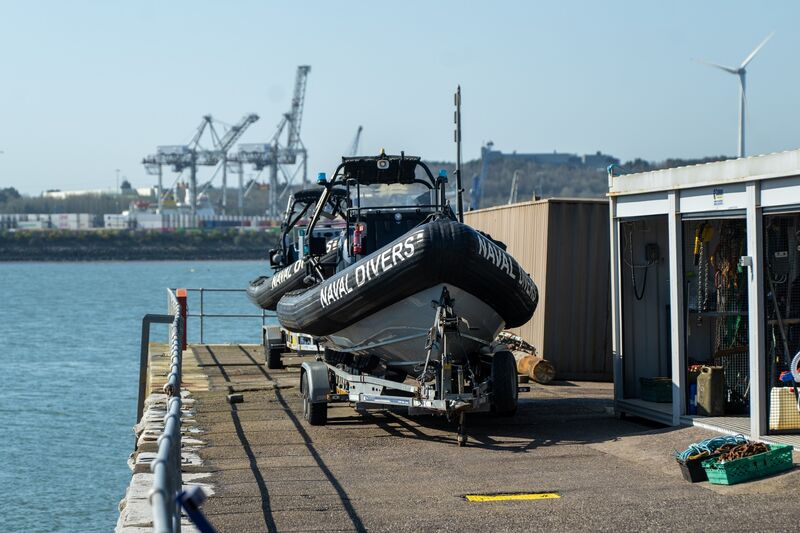
The diving section can load mobile equipment in a van and be in Dublin in four hours, but if there is an emergency search and rescue they travel by helicopter.
“If you think about the Cliffs of Moher-type operation and you think about the weather and the like — you’ve a really narrow window when it comes to tide and wind, so we try and go by helicopter to ensure we are in the best place,” he says.
“It can be difficult work and, you know for a young guy who’s 22 and seeing his first body it isn’t easy, but they are doing something positive for the family.”
He says the DF have a personal support service (PSS) to assist members, describing them as “excellent”.
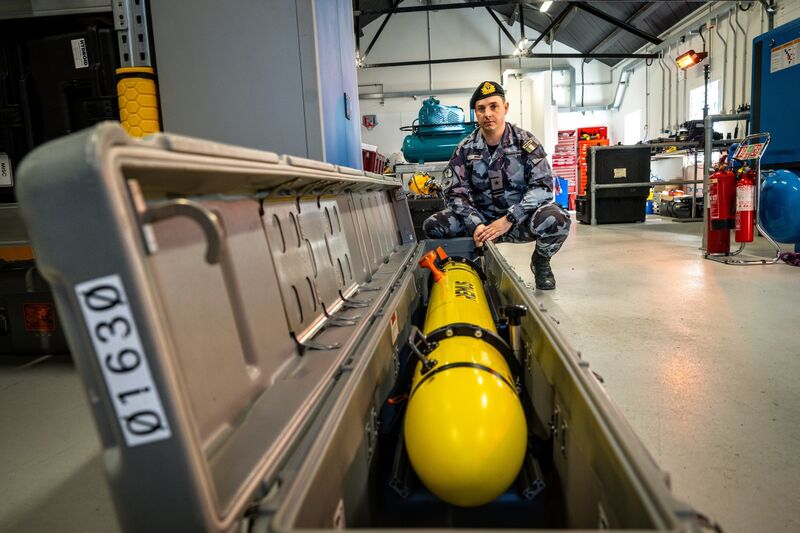
The next piece of kit the section has is the Remus AUV, or autonomous underwater vehicle. These underwater drones are primarily used for mine countermeasures (MCM), but can be used for other purposes, such as surveys of subsea pipelines.
This version, the Remus 100, is long and torpedo-shaped. It’s just over two metres long and just under 200mm in diameter.
“We have three of these,” Lt Croke says. “This is our newest one and it's rated to 100 metres. This primarily carries side scan transducers. It's a side scan capability.
"So on the surface, you plug the laptop into it, you plan a mission. You have a certain chart area and say you're doing a pipeline survey or you're looking for a car or mine, you'll plan the mission over a certain area, tell it where you want it to go, for how long, how deep and it accepts the mission.
"You lift it into the water, it dives into the water, it can go down 100 metres, generally it flies about five metres off the seabed to give the best picture.”
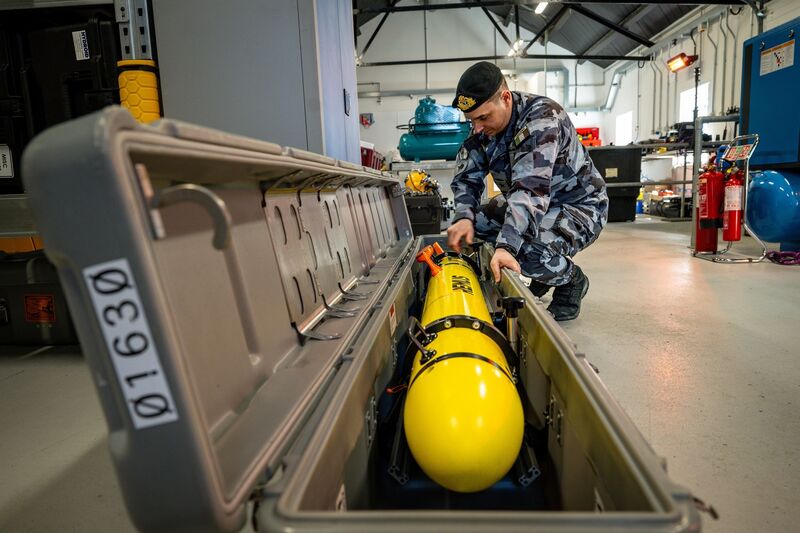
He says they can also be used for sunken trawlers and have a lighting and video system as well.
The NSDS takes part in a Nato-led training exercise, called Repmus, carried out annually by the Portuguese navy. Ireland is included as a partner country under what was called Pesco, but now referred to as ITPP (Individually Tailored Partnership Programme).
Lt Croke said these exercises are very beneficial as most of the other militaries have separate sections, between the diving unit and “diving adjacent” unit or sub-unit that looks after the equipment and technology.
“We gain access to specialist military units, they generally tend to be computer specialists, like notably the Belgians. We also have a very good working relationship with the Spanish. We get to see how other military is using it.
"We understand their report mechanisms, how they're looking for specific things, we learn the tricks that they've learned in operation in the Mediterranean. The lessons we learn from them is the biggest thing.”
The Irish section has three Remus but are planning to get a more sophisticated one, that can go down to 300 metres.
Lt Croke says there’s also a new technology called synthetic aperture side scan, which can look out to 100 metres: “When you get out beyond 25 metres out of sight the resolution will deteriorate, but with this technology it has crystal clarity all the way to 100 metres. We’re looking at that at the moment.”
Another area that militaries have expanded are unmanned surface drones (USVs) which stay on the surface.
They are being used to conduct surveillance and gather intelligence, both underwater and on the water, and are useful in high-risk or physically awkward areas, such as ports. They are also used for environmental and pollution monitoring.
“We’re currently looking at one of those at the moment,” Lt Croke says. “It’s a surface-based platform for carrying multi-bean echo sounders. They are more manageable in tighter areas, like tight harbours, the likes of Dublin and Cork ports.”
He says they can carry various scanning equipment, such as LiDAR (Light Detection and Ranging) which provides high-accuracy 3-D mapping of the water surface and close-range obstacles.
He says companies are now producing uncrewed motherships that can deploy smaller USVs.
But Lt Croke points out one fundamental issue with great kit: “Equipment is equipment, but you need people to deliver the capability — and it’s not capability if you don’t have people to deliver it.”
As it stands, his section has a supposed strength of 27 personnel. “I’ve only 14 at the moment, unfortunately,” he says, but adds that this is set to increase.
This stems from recommendations in the Commission on Defence Forces (CoDF, February 2022) and successive Government implementation plans and strategic force design teams set up internally in the DF.
Those teams have nearly completed their work and for the NS, will be included in the forthcoming Naval Regeneration Plan — which will go to the Department of Defence and the Government.
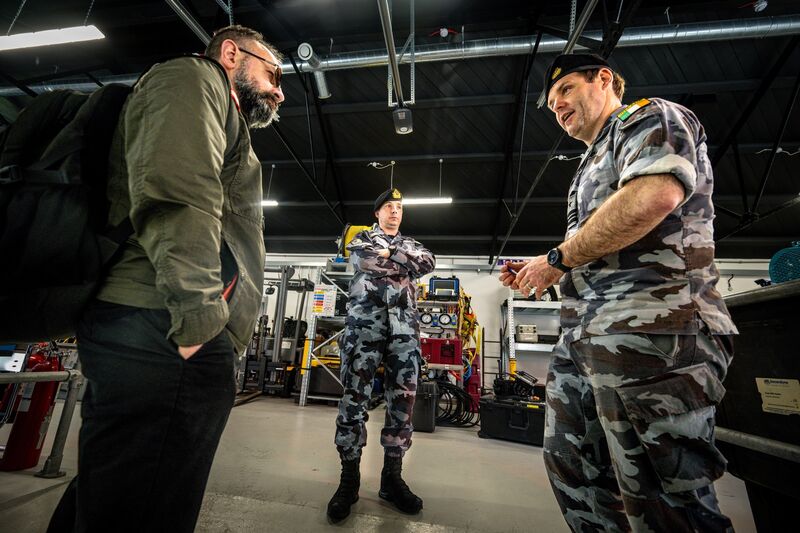
“There's about 30 qualified divers in the service,” Lt Croke says. “But the problem traditionally is that diving was an additional qualification. So all of the divers remained as a seaman or a mechanician or a logistician or a communications operative.
"They did a diving course, but their career progression is based through the comms branch, the mechs branch, so they have to go to sea to progress their career.”
Recommendation 21 of the CoDF calls for a recognised career stream for enlisted naval divers. “It means that we can retain the people in the unit and we don't lose them to external units,” Lt Croke says.
The second project is recommendation 1281 which is the modernisation of the naval service diving section and establishment of the diver safety office.
“All the equipment is going to be modernised, with better equipment and a deeper capability, but also the structure of the unit, personnel wise, is going to change.”
There’s going to be an operational unit, a diver safety office and a DF School of Diving.
“So, just in the operational unit, it'll go from 27 to about 40 or 50,” he says. “Then you're going to have the separate diving school, with between 20 and 23. And then you'll have the diver safety office, which is going to have between six and seven.
“So, you're going from a unit that has 27 vacancies to mid-70s.”
Time frame for implementation is outside his control; it's in the hands of the Government.
But Lt Croke is optimistic.


CONNECT WITH US TODAY



Be the first to know the latest news and updates