Maritime strategy marks a turning point in Irish security policy

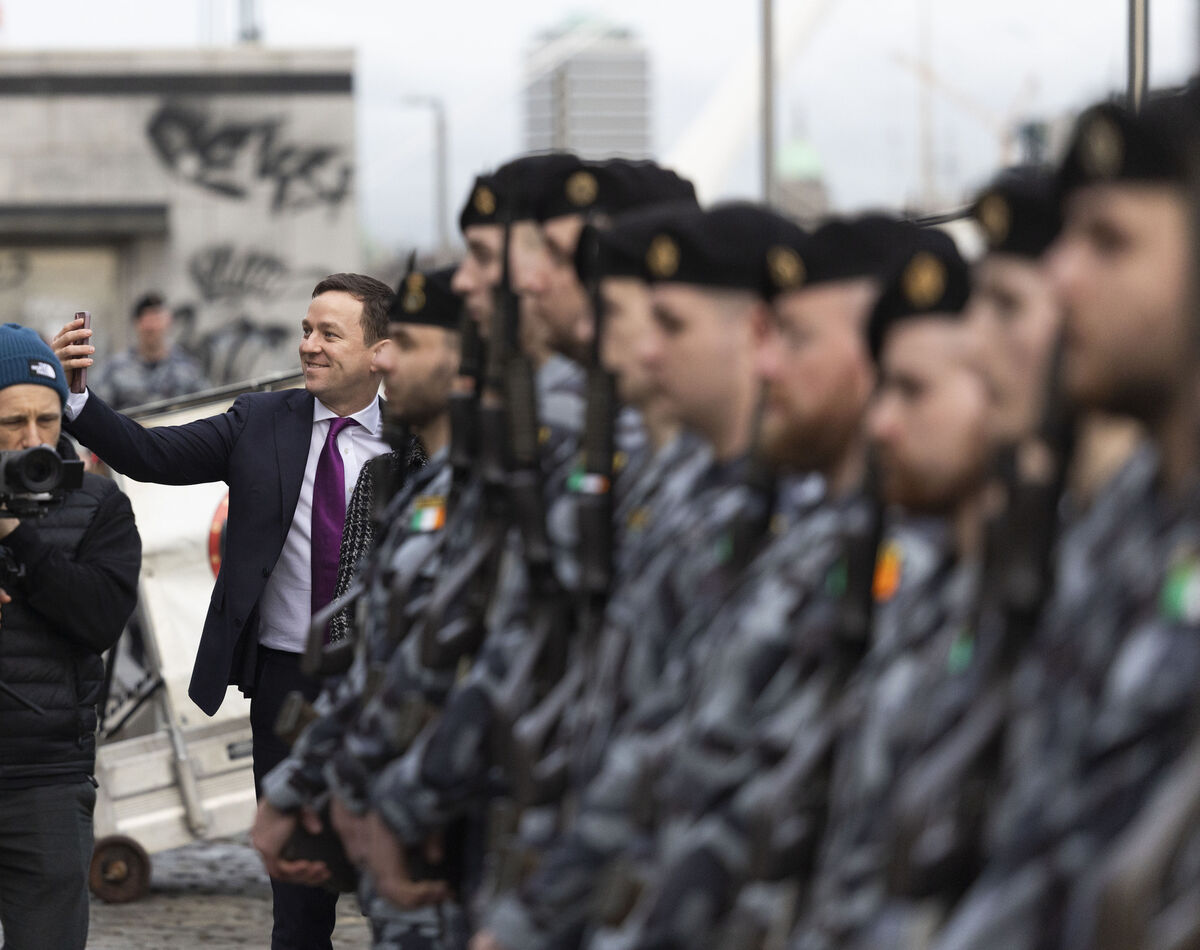
Defence minister Helen McEntee at the launch of the maritime defence strategy at the LÉ Samuel Beckett. Picture: Sam Boal/Collins
The publication of the Irish first-ever on February 25 marks a turning point in the development of the State’s security policy. For the first time, maritime security is recognised as a core element of national resilience, sovereignty, and economic stability, rather than a peripheral matter.
The strategy’s greatest strength is its clear conceptual focus, treating Ireland’s seas as strategic territory rather than just legal geography. The large Exclusive Economic Zone, the vital transatlantic data cables, the gas pipelines, and offshore renewables all underscore the country's awareness of the seas' significance.
Additionally, the document explicitly addresses the country’s vulnerability. The risk assessment reflects the current state of the increasingly volatile European security environment, thus indicating Ireland is no longer shielded. In this way, this initiative aligns with the broader European Union’s concerns, whose maritime security framework has adapted to similar pressures over recent years.
Another strength is the “whole-of-Government” approach. Maritime security involves defence, justice, transport, energy, cyber security, and foreign affairs, not just the Naval Service.
The proposed development of a “national maritime security centre”, which is envisioned to bring together both civilian and military information into a shared maritime picture, is a particularly significant innovation. If implemented effectively, it could address long-standing coordination issues, starting with the current single-agency approach, and enhance response times during crises.
Strategically, the importance of this document goes beyond its simple content. Ireland has never implemented a specific maritime security strategy. Many larger European nations do not have a dedicated instrument of this kind.
Therefore, this document undoubtedly marks a unique strategic effort for the country in this area. The document also highlights strong cooperation with like-minded partners. For example, it mentions engagement with the European Union, partnership with Nato through the 'Individually Tailored Partnership Programme', and potential collaboration with initiatives such as the Joint Expeditionary Force to demonstrate a pragmatic approach to maritime security.
However, while the strategic framing appears strong, the operational detail is comparatively lacking. The action plan accompanying the strategy serves as an initial attempt to translate the main interests into initiatives and is primarily a “rolling” work-in-progress.
While there is little doubt flexibility is a valuable tool in this ever-changing security environment, the plan often depends on vague wording such as, for instance, “explore”, “develop”, and “consider”. Ultimately, timelines, performance metrics, and budgetary commitments remain quite limited.
This is particularly evident in the context of capability development. The document rightly acknowledges serious personnel shortages within the Naval Service and gaps in maritime domain awareness, but falls short on specifying the scale of investment and the timeline for addressing these limitations.
Conversely, the European Union’s equivalent documents were accompanied by clearer implementation benchmarks and mechanisms.
There are also thematic gaps. For instance, climate change and environmental degradation are recognised as risks, but environmental security remains marginal to the core strategic objectives.
Considering the country’s reliance on offshore renewable energy and the increasing frequency of extreme weather events, incorporating climate resilience into the actual planning would have strengthened the document.
Similarly, fisheries protection, historically the main task of the Irish Naval Service, is just briefly acknowledged. While the rationale for prioritising national security and defence threats is clear, separating food security and economic security from maritime security may undermine the whole-of-Government approach proposed here.
In operationalising it, several steps should be carefully considered. Firstly, the strategic ambition must be matched by multiannual funding commitments, particularly for personnel recruitment and retention, as well as technological investment. Without sustained resources, presence at sea will remain aspirational.

Secondly, the proposed national maritime security centre should be established with clear statutory authority, defined leadership and accountability to the Government. Without early clarification, the risk of overlap could hinder the centre’s operational effectiveness.
Thirdly, transparency and democratic oversight should accompany implementation. Annual reporting to the houses of the Oireachtas on progress against defined benchmarks, when these figures will become available, would undoubtedly enhance credibility and ensure maritime security remains politically salient rather than episodic.
The 2026 National Maritime Security Strategy represents a remarkable advance in Irish security thinking, as it finally acknowledges the importance of maritime security. Yet, as with many other similar documents, its effectiveness will depend on the executive.
This means the real challenge now is to translate the Irish approach and the strategic objectives into sustained capability to ensure the Irish strategic ambition eventually matches its maritime readiness.
In this instance, this document is just the beginning, given it sets the direction and establishes the intention in this specific policy field. The real test is now whether the Government is prepared to fund
and implement the strategy.
- Dr Giovanni Parente is a Research Ireland postdoctoral research fellow at the University College Dublin for his project on the European Union’s maritime security strategy, mentored by Professor Ben Tonra, and is an adjunct assistant professor in the Department of Political Science at Trinity College Dublin

CONNECT WITH US TODAY



Be the first to know the latest news and updates