Government has 'no immediate plans' to send failed asylum seekers to EU return hubs, Taoiseach says
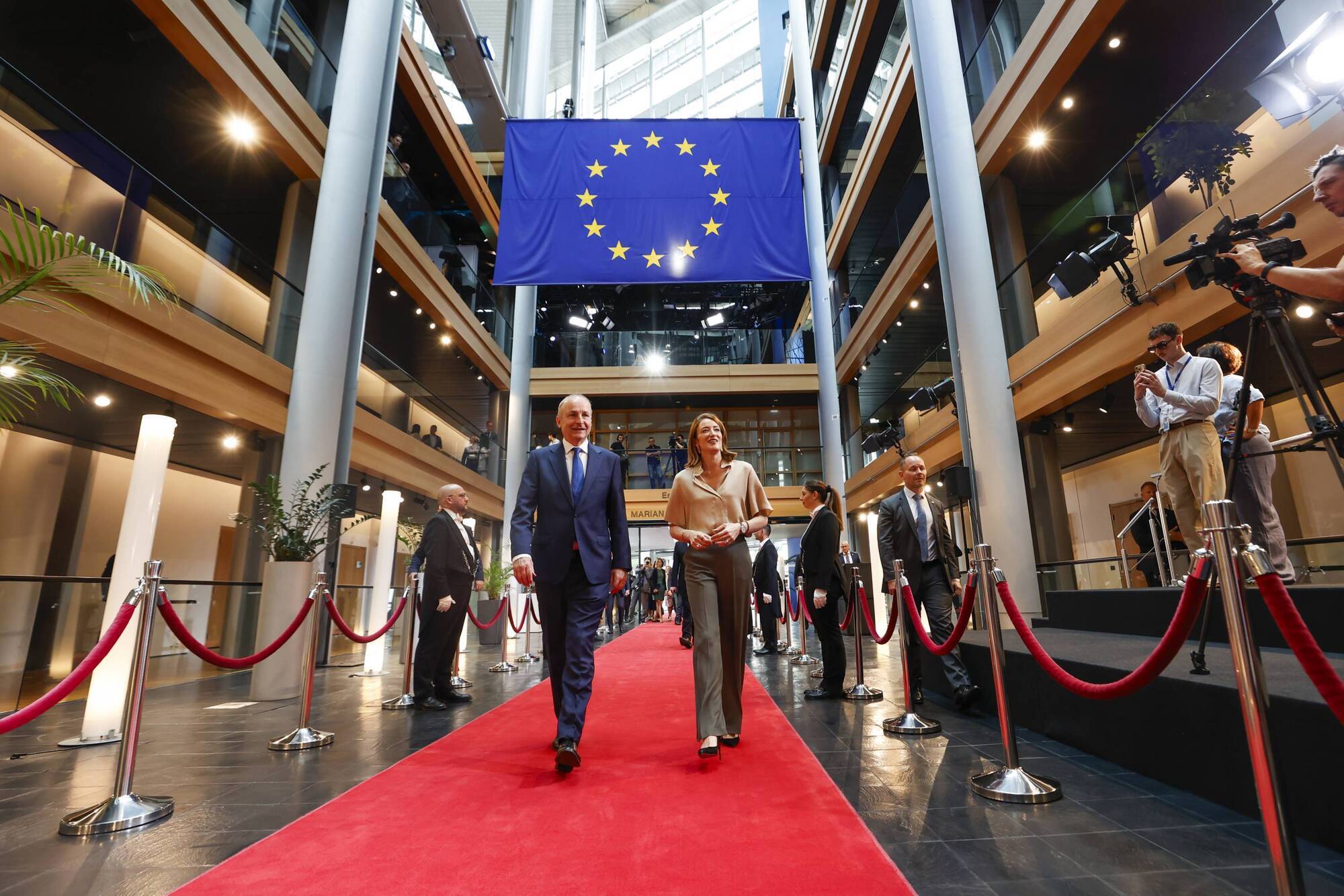
Taoiseach Micheál Martin with European Parliament president Roberta Metsola in Strasbourg.
There are “no immediate plans” for the Government to consider sending asylum seekers to new EU return hubs, the Taoiseach has said.
Micheál Martin has said there is “some distance” until Ireland considers using the new measures, where failed asylum seekers could be sent to countries outside of the EU.
“We have no immediate plans in respect of that,” Mr Martin said.
Speaking in Strasbourg, Mr Martin said the Government welcomed broader agreement on the EU migration and asylum pact as it brings a “greater degree of uniformity” across the bloc.
Return hubs were formally approved by the European Parliament last month, with it allowing member states to send asylum seekers to third-country detention centres if their applications have been rejected.
The Taoiseach said the Government particularly wanted to focus on speeding up asylum application decisions, saying previously applicants were “left hanging around for years” before a decision was made.
The Taoiseach was speaking in Strasbourg as he made a visit to the European Parliament to outline the Government’s EU presidency programme.
Read More
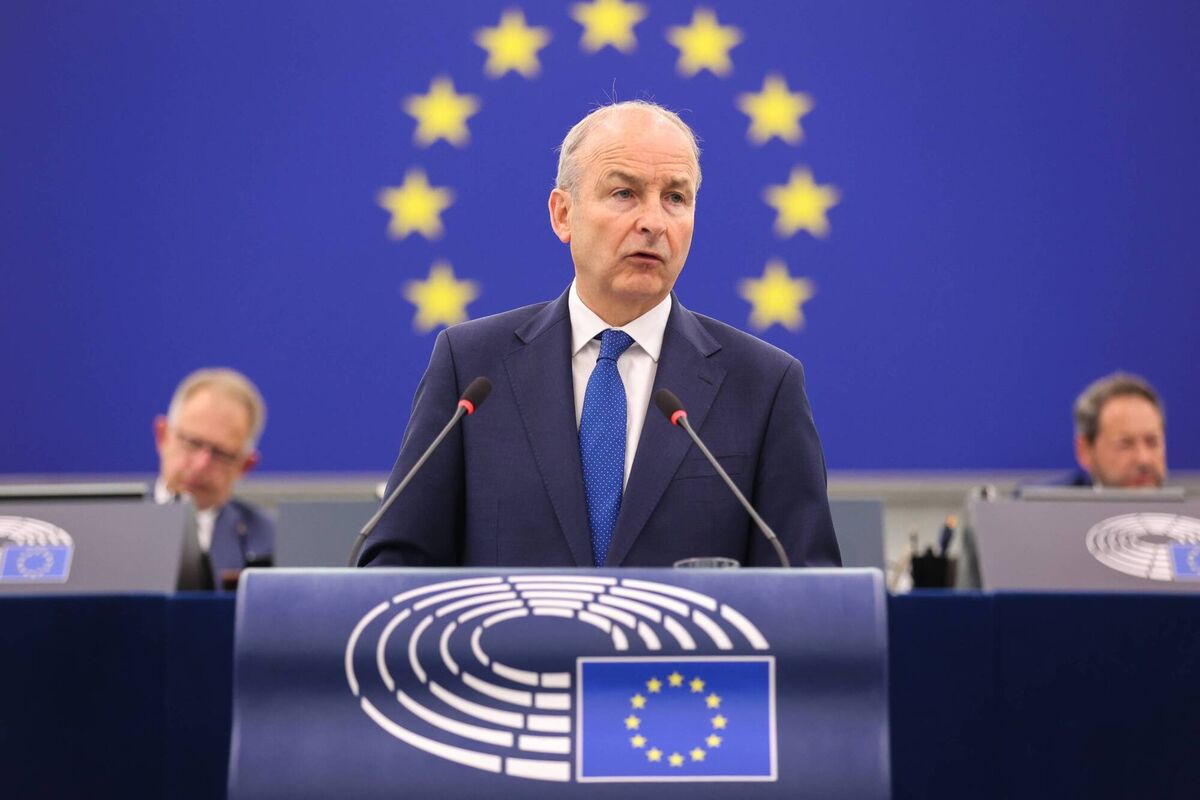
During his speech to MEPs, Mr Martin was critical of the EU’s failure to place further pressure on the “increasingly extreme” Israeli Government.
“The humanitarian situation in Gaza remains dire. The situation in the West Bank is deteriorating. The behaviour of the Netanyahu government is increasingly extreme,” Mr Martin said.
“There are no democratic or humanitarian values which are flexible enough to justify the scale of death, destruction and displacement we have seen.”
Mr Martin added the EU’s failure to pressure Israel was a “deep and justified sadness” to many Europeans.
“I fully respect and understand that this is a difficult topic for many countries and is challenging many long-established connections and policies,” Mr Martin said.
“But we simply must do more.”
Later, at a press conference alongside European Parliament president Roberta Metsola, Mr Martin said an options paper would be presented by the European Commission at the Foreign Affairs Council next week.
He said this would contain measures related to the illegal Israeli settlements in the Palestinian West Bank.
Mr Martin said Europe needed to move against these illegal settlements as they undermine the two-state solution “irreparably”.
He added the EU must demand that European representatives and the world’s media be permitted “to witness for themselves the devastation that has occurred”.
“I think that in itself would have a consequential, telling impact on policy and on responses into the future.”
During his speech to MEPs, Mr Martin reiterated the Government’s three priorities for its EU presidency would be competitiveness, security, and values.
In particular, Mr Martin said the Government’s priorities on security meant that the EU needed to “invest in all dimensions of its own security and rapidly develop its defence capabilities”.
He said the Government would work on the new European Security Strategy to ensure the EU could “respond dynamically” to geopolitical challenges.
“We will not be safe unless we address critical capability gaps. We will support deep collaboration to build European resilience, particularly in the face of sophisticated hybrid threats, and to advance our maritime and cyber security,” Mr Martin said.
The Taoiseach added further political, financial, military and humanitarian assistance for Ukraine required further pressure on Russia to end the “cruel and morally indefensible war”.
He said the Government would work to agree “tighter and stronger sanctions”, as pressure ramps up on the Coalition over the Aughinish Alumina plant.
Mr Martin also pledged to make “substantial” progress on EU accession talks with both Ukraine and Moldova, adding he hoped negotiations with Montenegro would end before the presidency.
Responding to Mr Martin, Sinn Féin MEP Lynn Boylan criticised the Government over its presidency programme, saying Ireland’s legacy on peacebuilding was missing.
“Instead, Taoiseach, we see you embracing the militarisation agenda against the wishes of the Irish people and launching a full-scale attack on their neutrality,” Ms Boylan said.
She added she had concerns about the deregulation agenda, saying it would give “billionaires more freedom to destroy our planet”.
President of the Socialists and Democrats (S&D) grouping Iratxe García questioned Mr Martin about what kind of Europe he wanted to see. She cited a previous visit to Ireland, where she visited Gardiner Street in Dublin, where 10% of the State’s homeless population live.

CONNECT WITH US TODAY



Be the first to know the latest news and updates