Kieran Shannon: Cork's Croke Park meltdown shows they must face uncomfortable truths
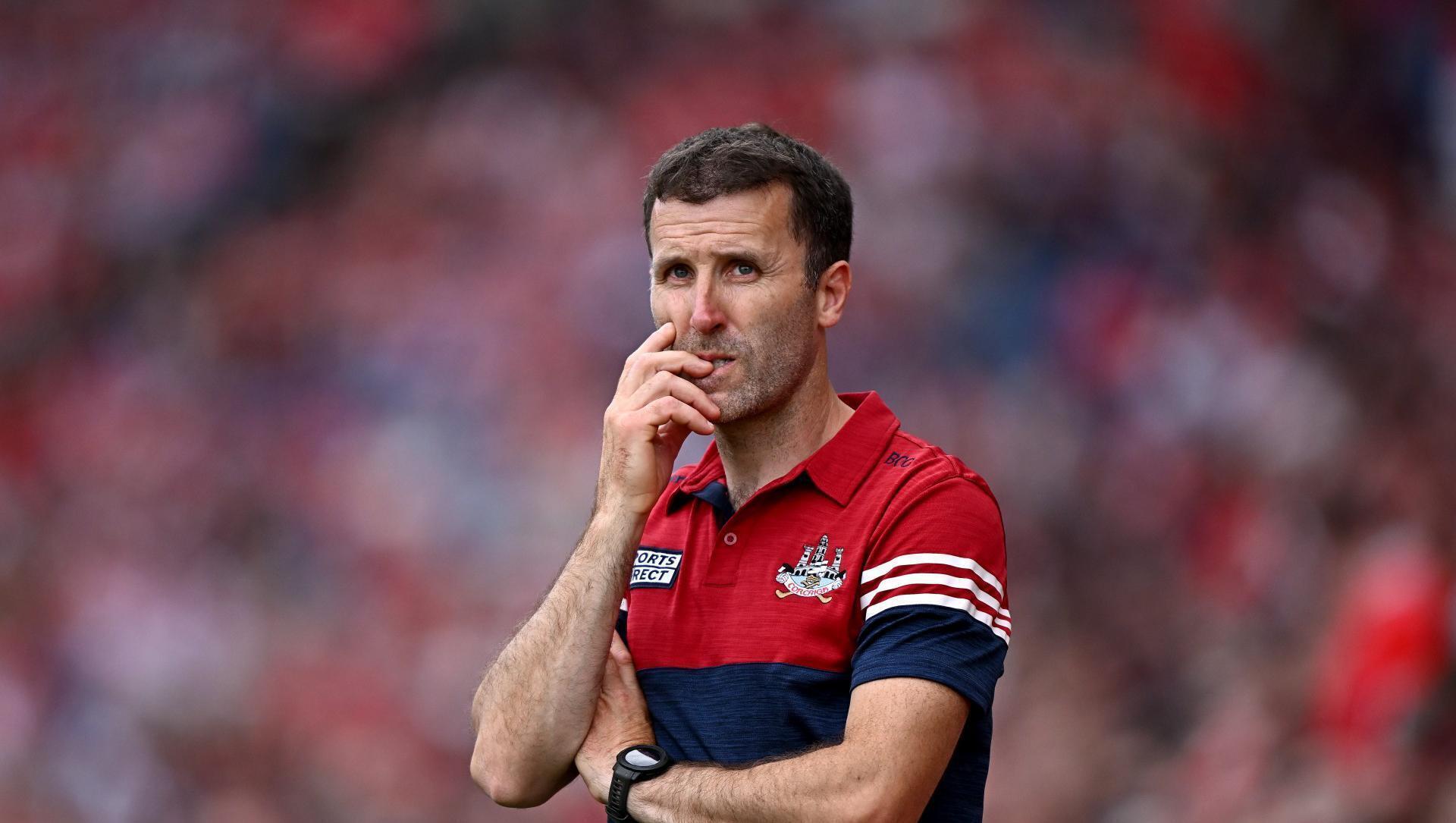
SQUARE ONE: Cork manager Ben O'Connor. Pic: Seb Daly/Sportsfile
They can’t deflect or hide away from this one.
Last year, when this column for one viewed Cork’s collapse against Tipperary as a systems failure that demanded an all-round forensic review, it seemed to be treated within the group as a freakish one-off and by the incoming management as something not to overly-dwell on as it hadn’t happened on their beat.
Others have made that mistake before. One of the finest coaching achievements of Mickey Moran and the late John Morrison was to bring Mayo to an All-Ireland football final in their first and only year in charge only for them to ignore the lessons from the county’s defeat to Kerry two years earlier. The cost of dismissing the past as the past was for the past to repeat itself: just as in 2004, Kerry aerially bombarded ball in towards Johnny Crowley, in 2006 Kieran Donaghy similarly made hay against an under-prepared Mayo full-back line.
More pertinently for Cork and Ben O’Connor, there’s the example of the Dublin football team that Pat Gilroy inherited. Just like Cork under Pat Ryan, the Dubs under Pillar Caffrey had made considerable strides over his four-year term, not least in the bond they had formed with their army of supporters, only for it to end with a stunning collapse against a rampant Tyrone who would go on to win that 2008 All-Ireland.
The following year Gilroy merely made a few tweaks around the edges, and for a period it seemed to be the best policy upon winning the Leinster final with 14 men. But then they ran into Kerry and that early-minute goal from Gooch. Tyrone ’08 had proven to be no outlier. They had been startled earwigs that day too.
Upon lifting that rock no other stone was left unturned. Everything went under the microscope and was upgraded. Personnel. Culture and values, with humility being the core principle of them all. Tactical awareness and adaptability. Psychological support and preparation. Six am training sessions in Alfie Byrne’s or runs by the North Bull Wall. No one would train harder or smarter so no one in Croke Park would play harder or smarter.
Read More
That all though started with Gilroy and his own willingness to adapt and learn, reading up on human and sport psychology himself rather than just offload it to a practitioner in that field. More so, he leant even more into taking ideas from those around him: Dr Niall Moyna, Dr Mickey Whelan, Caroline Currid who all these years and All-Irelands later has undergone a doctorate herself. Is Ben O’Connor similarly willing to upskill himself? Has he surrounded himself with selectors with the kind of growth mindset that was so pervasive around Gilroy’s Dublin setup or indeed Ryan’s Cork one and were encouraged to challenge the manager? In 2027 that cannot be a question.
Within any high-performance setup there is also an understanding and appreciation that various spheres are co-active. They do not work in isolation. The psychological blends with the tactical. It does not work in isolation. You can be one of the leading performance coaches in the country as Gerry Hussey undoubtedly is but if you’re not dovetailing with the coaches and selectors like a Currid does with a Kinnerk and Kiely in Limerick like she did with a Whelan and Gilroy before that then your impact is limited.
To all the world now Cork’s most fundamental problem would appear to be a mental one. A Croke Park one. The bigger the stage the greater their collapse.
Only it isn’t quite as simple as that. This Cork team have won massive backs-to-the-wall games in recent seasons. Just think of some of their victories against Limerick alone: The staying-alive win down in Páirc Uí Chaoimh in May 2024. The All-Ireland semi-final in Croke Park a couple of months later. The Munster final last year. Even their opening round-robin game of this year’s Munster championship. All those games were won by just a puck of a ball. They would not have prevailed if there wasn’t a certain mental fortitude, both individually and collectively.
Where they really struggle though is when a team throws a tactical curveball at them, especially a sweeper or a packed defence. Like Tipp in 2025, and now Galway in 2026.
Cork played like a team that hadn’t prepared for it. That the weekend out from the game they had staged another audition – the standard Avs B game to decide whether William Buckley or Alan Walsh would start at corner forward – rather than a rehearsal with a Shane Kingston all over the field like a Conor Whelan or a Brian Roche dropping deep like a Cathal Mannion. As if instead of getting themselves ready for Cork against Galway they had another game amongst themselves of Cork against Cork, the one game that will never happen.
The key to Limerick’s success, like Clare’s of 2013 before it, has been Paul Kinnerk’s mastery and embracing of the constraint-led approach – just as Cork’s 2010s camogie success was rooted in the Murray brothers Paudie and Kevin similarly adopting that approach. Limerick don’t just preach what to do in certain scenarios; they practise for them. They tease out their options. They stick with it when things break down. And so they’ll have conditioned games where for the next 10 minutes two out of every three scores have to be from outside the opposing ’65. Not like Cork who lacked the capacity last Saturday to score from range the way Galway routinely could.
Any tactical or technical failure though is still a reflection of a group’s mindset. Its leadership, both management and players. Did the Cork players after 2025 against Tipp ensure and insist that that in 2026 they’d have the answers for a similar puzzle that would inevitably be posed in Croke Park?
It’s part of sport psychology 101 for a team to have an agreed language, a set of verbal as well as physical triggers, to reinforce their process, especially when it faces some adversity. Eoghan Cormican of this parish cited a classic of the genre in a profile of Keith Ricken at the weekend: after undergoing major surgery all Ricken wanted and focused on was getting some tea and toast. When he told the story to his 2019 U20 team it became their mantra, one they used when going 1-6 to 0-1 down against Dublin in the All-Ireland final. Don’t try to get it back all at once. Just stick what we need to do now. Tea and Toast.
Or often such a trigger can be tactical. A condensed verbal cue which is a summary of a team’s principle of play. Through The Lines. Always Two (in the fullback line). Just some form of inner dialogue, self-talk, an individual player can lean on themselves, or if he sees a teammate whose focus might be wavering, offer that cue to them to get them back on track.
For the second consecutive time in Croke Park, Cork looked like they had no such vocabulary. And no leaders to spot the situation for what it was and run within earshot to a teammate, especially a Patrick Collins who continued to launch high ball after high ball for Galway to gobble up.
More so they seemed to have no way to arrest the momentum. Brendan Cummins in his co-commentary suggested at one point Collins should deploy a Nickie Quaid tactic of losing a contact lens to stem the tide but he could even have leaned on a go-to move of one of his predecessors. Back when Cork won their last All-Ireland, Croke Park was shaking when a Damien Hayes goal brought Galway back to within a point. Donal Óg Cusack went all the way around the goal before pucking the ball back out. The writer Denis Walsh calculated that he had taken 34 seconds before resuming the action, both allowing Cork to regather their poise and take Galway out of their flow.
There are a series of other interventions that will be required. Do they have an adequate halftime reactivation protocol? How else do you explain how flat they came out last Saturday, allowing Gavin Lee to score a point unchallenged upon the throw-in?
Alan Connolly is still a prospective All-Ireland winner but may need the kind of tough love Gilroy gave Bernard Brogan in the wake of the Startled Earwigs affair, keeping his best finisher on the bench until he became one of his best tacklers. And as refreshing as Connolly’s candour and ambition is, he needs to be more mindful of his public utterances. No one could have an issue with any Cork player declaring their intention to try to win every game and trophy. What Cork failed to mention when trying to walk back Connolly’s comments after a league win in Kilkenny was that he said Cork would win every trophy going in 2026.
O’Connor now has a full offseason to find a coach whereas this past one he clearly didn’t get or put in enough time and thought into identifying one, as reflected in his decision to part ways with Niall O’Halloran just three months in.
That coach and him have to be fully aligned, even if it means plenty of lively conversations before rolling out their masterplans to their players. And that coach and their principles of play need to be condensed by a Hussey and the team’s leaders so Cork appropriately respond when they inevitably experience some turbulence along their journey.
After another Croke Park hiding there can be no more hiding from uncomfortable truths.
A collection of the latest sports news, reports and analysis from Cork.