Irish economy to avoid recession despite Middle East conflict, Government says
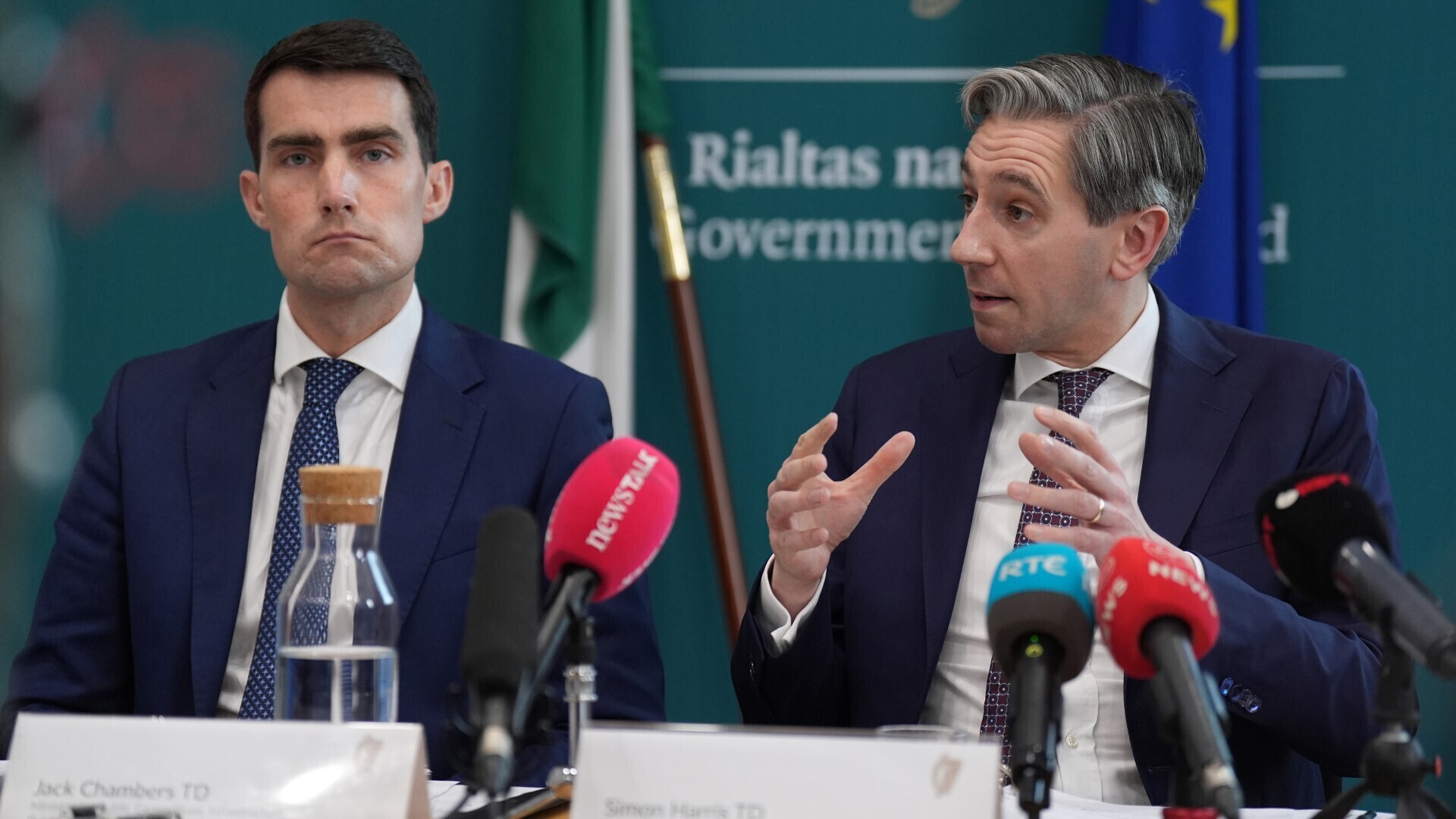
Public expenditure Minister Jack Chambers and finance minister Simon Harris speaking to the media at the department of finance in Dublin about the Spring Economic Statement. Picture: Niall Carson/PA Wire
The department of finance has said it is not predicting any recession will hit Ireland, even in the worst-case economic scenario caused by the conflict in the Middle East.
However, public expenditure minister Jack Chambers has now warned ministers that “trade-offs and choices must be made” ahead of Budget 2027.
While he confirmed that the department of education will be given an additional €646m, €466m of this will be an “expenditure levy”, with the department expected to find reforms, savings, and efficiencies to make the money up.
The Government published its Annual Progress Report and Spring Economic Forecast on Tuesday afternoon.
Read More
As part of the report, Tánaiste and finance minister Simon Harris asked department of finance officials to scenario plan what impacts a prolonged conflict in the Middle East could have on the Irish economy.
These include a reference scenario, which serves as the benchmark against which the Government can monitor developments as the year progresses.
The “adverse” scenario assumes “sustained but contained disruption to energy supply”, with the price of a barrel of oil averaging $88 in 2026 and 2027.
The “severe” scenario involves “pronounced and prolonged disruption to energy supply”, with oil prices rising to an average of $130 a barrel in 2026 and $125 in 2027.
In the adverse scenario, inflation would rise to 4.3% by the end of this year. In the severe scenario, it would reach 6.5% by year-end, rising further to 6.7% by the start of 2027.
However, the department said Ireland’s economic outlook is currently most likely to fall between the benchmark and severe scenarios.
In the benchmark scenario, inflation would average 3.3% this year.

John McCarthy, chief economist at the department of finance, said Ireland’s economy will continue to grow in all scenarios, but it will grow by less in the adverse and severe situations.
“Our assessment right now as to which scenario we see as most likely […] I do think we're between the reference scenario and the adverse scenario,” he said.
“I'm not assigning a probability to that.
“On the idea of a recession, even in the severe scenario, the economy is growing both this year and next. At the end of next year, the level of economic activity would be two percentage points below what it would be under the reference scenario.
“In the current environment, you can never say never […] but under the three scenarios that we've presented, we are not in recession territory.”
The Tánaiste said that while the Government and department of finance were not predicting the worst-case scenario was going happen, it would be “irresponsible” not to forecast it.
He added: “I can't sit here and pretend it's gonna be over in a fortnight.
“We have to plan not just for today or tomorrow, but for the rest of the year, but we do that from a position of strength."
The Spring Economic Forecast is predicting a general Government surplus of €9.2bn, up from the projected €5.1bn that was announced on Budget day last October.
Much of this surplus will be added to the Government’s long-term funds.
However, an Exchequer deficit of €1.2bn is forecast for 2026, compared to a €7.1bn surplus last year.
Mr Chambers warned there will have to be “trade-offs” as part of Budget 2027, and there must be as “much emphasis on reform and efficiencies as there is on the request for additionality”.
Following overspending in the Department of Education, it was confirmed that it will be allocated an additional €646m.
Some €200m of this will be additional funding, while €464m will be an “expenditure levy”.
This will require departments to make savings within their original budgets and try to spend the money that has already been allocated rather than looking for additional funding.
“The fact that Government has decided to reprioritise for education this year has an impact on the scale of new measures that are available for 2027,” Mr Chambers said.
“There's still significant uplift in 2027 from between €117bn and €118bn to €122.5bn set out in our medium-term fiscal and structural plan.
“That gives Government significant scope to advance a lot of the priorities in the programme for government.
“But that's being done in the context of, obviously, a wider expenditure levy, and we'll work with colleagues during the estimates process in 2027.”
Mr Chambers said there will be an onus on departments to see how measures can be funded out of additional budget allocations.
Mr Harris also reaffirmed that there will be a tax package for workers in Budget 2027, which will be announced on October 6, but that the size of the tax package compared to the spending package will be determined as part of the Summer Economic Statement in July.
Mr McCarthy said measures introduced such as excise duty cuts on petrol and diesel resulted in inflation being 0.6 percentage points lower than it would have otherwise been.
When it was put to Mr Harris that this could mean that the cuts would have to be continued beyond the end of July, the Tánaiste said “the one thing the last few weeks have told us is that nothing's inevitable”.
He said: “The genuine position of the Government is we have to keep everything under review. We have to be agile. We have to keep the powder dry.
“We have to work out when is the right time to intervene, and when is the right time not to.”