Government predicts €1.2bn budget deficit and says inflation could reach 6.7% in 2026
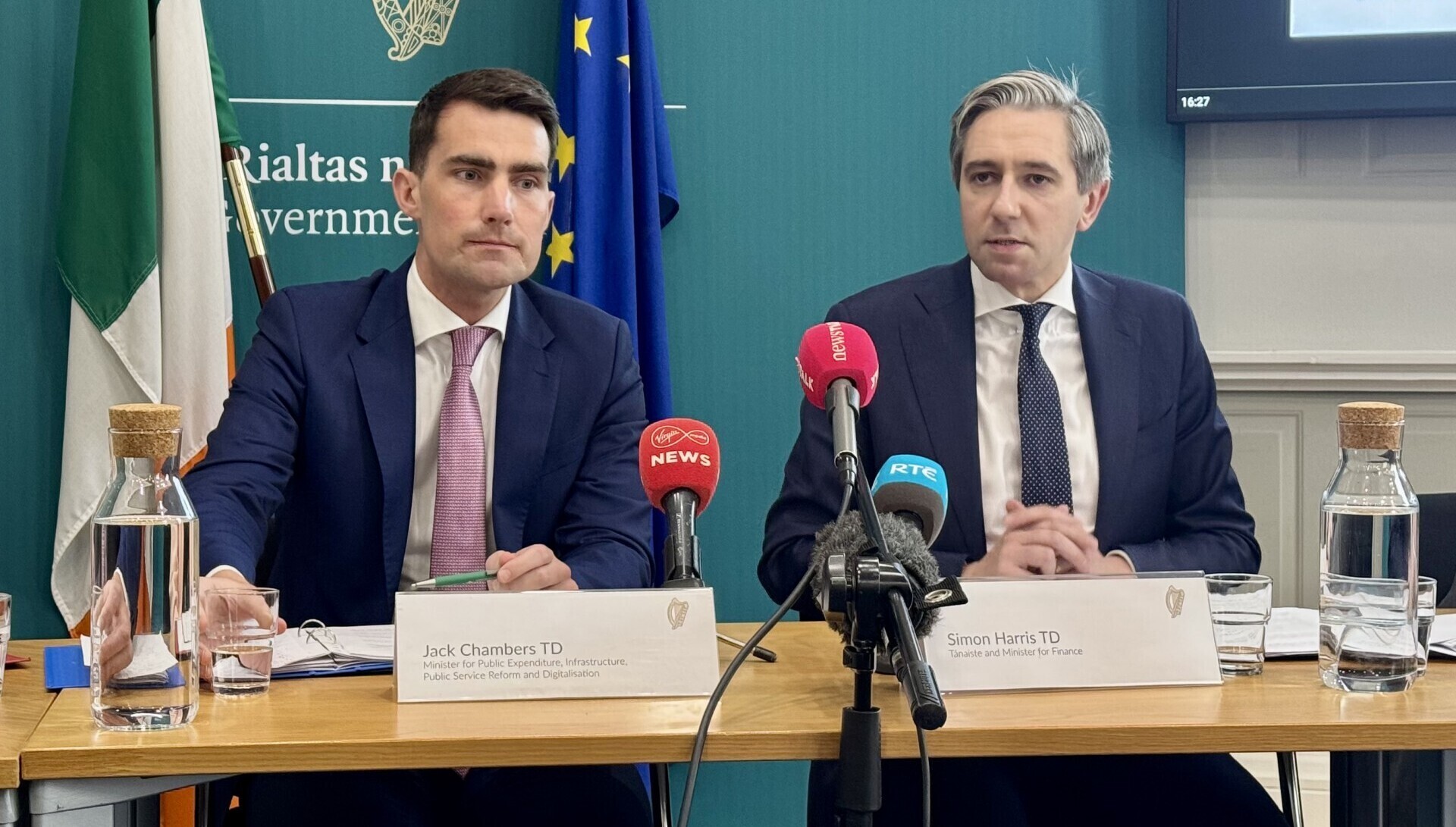
Public expenditure minister Jack Chambers and Tanaiste and finance minister Simon Harris. Picture: Bairbre Holmes/PA Wire
The department of finance is predicting a €1.2bn budget deficit in 2026, and forecasts inflation peaking at 6.7% as part of a worst case scenario if the war in the Middle East continues.
As part of its annual progress report and spring economic forecast, the department outlined three scenarios, depending on the depth and duration of the conflict.
These include a reference scenario, which serves as the benchmark against which the Government can monitor developments as the year progresses.
The “adverse” scenario assumes “sustained but contained disruption to energy supply”, with the price of a barrel of oil averaging $88 in 2026 and 2027.
Read More
The “severe” scenario involves “pronounced and prolonged disruption to energy supply”, with oil prices rising to an average of $130 in 2026 and $125 in 2027.
In the adverse scenario, inflation would rise to 4.3% by the end of this year. In the severe scenario, it would reach 6.5% by year-end, rising further to 6.7% by the start of 2027.
However, the department said Ireland’s economic outlook is currently most likely to fall between the benchmark and severe scenarios.
The central 2026 forecast predicts inflation of 3.3%, up from 2.1% last year. It also projects inflation could fall back to 2.5% in 2027.
The unemployment rate is expected to remain at 4.7% this year, rising slightly to 4.8% next year.
Economic risks are described as “tilted to the downside” in the short term, but “two-sided over the medium term”.
Potential upsides include net inward migration, which could boost demand.
Artificial intelligence is identified as both an upside and a downside, with the potential to “trigger productivity gains” but also “trigger employment losses”.
Other medium-term risks include climate-driven economic disruption, failure to address competitiveness challenges and the infrastructure gap, and a potential “wage-price spiral”.
The Government’s spring economic forecast was brought to Cabinet on Tuesday by finance minister and Tánaiste Simon Harris and public expenditure minister Jack Chambers.
Mr Harris told ministers the economy is expected to continue to grow under all scenarios, albeit at a more moderate pace.
He pointed to the importance of running budget surpluses and building financial buffers to protect the economy during “international economic uncertainty”.
Mr Harris also warned the conflict in the Middle East has triggered a major energy price shock that is “reverberating across other supply chains”.
Mr Chambers said there is a risk of “stagflation” — stagnant growth, high unemployment, and high inflation — if the conflict is prolonged.
He warned ministers of the need for stronger cost controls across departments, adding that delivery of programmes and initiatives is “dependent on ministers adhering to budget allocations”.