Bertie Ahern and Gerry Adams to discuss peace process at Oireachtas committee
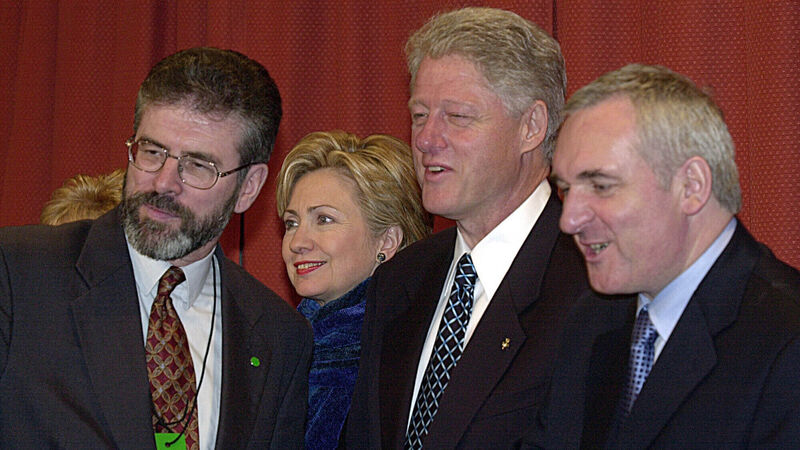
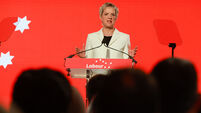
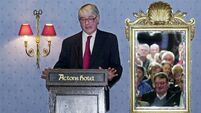
Gerry Adams, far left, and former taoiseach Bertie Ahern, far right, will address the Oireachtas committee on how Ireland's peace process, which then president Bill Clinton and wife Hillary Clinton were also involved in, could inform the peace process for the Middle East. File Picture:/RollingNews.ie
Former taoiseach Bertie Ahern and former Sinn Féin leader Gerry Adams will address an Oireachtas committee on Tuesday to discuss how Ireland's peace process can inform peace building in the Middle East.
In his opening statement, Mr Ahern will tell TDs and senators that "no two conflicts are the same", but that the experience of the Good Friday Agreement can carry some lessons.
"We do have examples of how we solved problems, overcame obstacles, and created opportunities to end violence and engage in the patient work of sustaining a peace process through periods of difficulty as well as progress," he will say.
Mr Ahern's statement focuses largely on his experiences as taoiseach at the signing of the agreement, saying that it is "hard for current generations of people in their early 30s to imagine an environment where violence and the threat of violence permeated almost every aspect of life in Northern Ireland, and to a different degree south of the border".
"A key challenge that I have discovered in the aftermath of any conflict, or indeed any agreement designed to bring a permanent end to violence, is the challenge of implementation, and the question of how to set in place the structures and architecture of what was signed on Good Friday.
"I worked for nine years, often spending entire weeks on details that were either deliberately misconstrued by talk participants or because they proved politically unpalatable in the wake of the agreement, in terms of what their communities could absorb.
"All these issues proved difficult at different times during the implementation of the agreement, and all in their own way were not challenges in themselves; however, they became emblematic of the absence of trust between the parties, who were now tasked with selling the compromises on some significant and key issues for their respective communities."
Mr Ahern will tell the committee that it is "hard" to directly transfer lessons to the Middle East, but some learnings are universal.
"One observation I have settled on about the nature of conflict, both our own in Ireland and scanning others around the world, is that there is no sustainable solution in an obsessive focus on 'victory'.
"Yes, an immediate battle or campaign may be won in the conventional sense that one side may prevail over the other in that particular moment. But it is a pyrrhic victory. Nothing is actually settled. The new seeds of the next phase are already sown.
"In my view and in my experience, real peace and reconciliation take root when the leaderships on both sides of a conflict accept that the only outcome that will be sustainable in the longer term is one involving compromise and accommodation.
"The clean, simple lines of purist doctrine are not available and instead the path ahead is marked by ambiguities and the constant need for flexibility and pragmatism. But the rewards are far-reaching and profound."
In his statement, Mr Adams will focus on the cause of Palestine and will call for the Government to pass the Occupied Territories Bill.
"Dialogue is the only way a genuine peace process can be achieved in the Middle East," he will say.
"Such a process must be based on the right to self-government of the people of Palestine. Adherence to the UN Charter must be paramount. It must uphold international law.
"The international protections and legal systems that should be shielding the Palestinian people from genocide have been broken and discarded. This needs to be reversed.
"Some Western governments have refused to stand against Israeli occupation, instead they have actively supported it with armaments and other measures. This needs to stop.
"The Irish Government can play a leadership role by encouraging international opposition to Israel’s illegal actions, calling for greater humanitarian aid, and seeking a genuine process of inclusive dialogue — under the auspices of the United Nations — that seeks to agree solutions."
Speaking ahead of the meeting, committee cathaoirleach John Lahart, a Fianna Fáil TD, said: “Ireland’s experience shows that an imperfect peace, patiently built through consent, respect for democratic mandates, and shared institutions, is better than no peace at all and that real progress only comes when all sides accept that sustainable settlements require compromise, accommodation, and a recognition of each other’s rights and identities."
CONNECT WITH US TODAY



Be the first to know the latest news and updates