Karol Balfe: A multilateral world is worth fighting for, it must start with justice for Palestine
Ceasefires that don’t provide safety and a mechanism to rebuild a shattered land are not steps toward peace
Karol Balfe: A multilateral world is worth fighting for, it must start with justice for Palestine

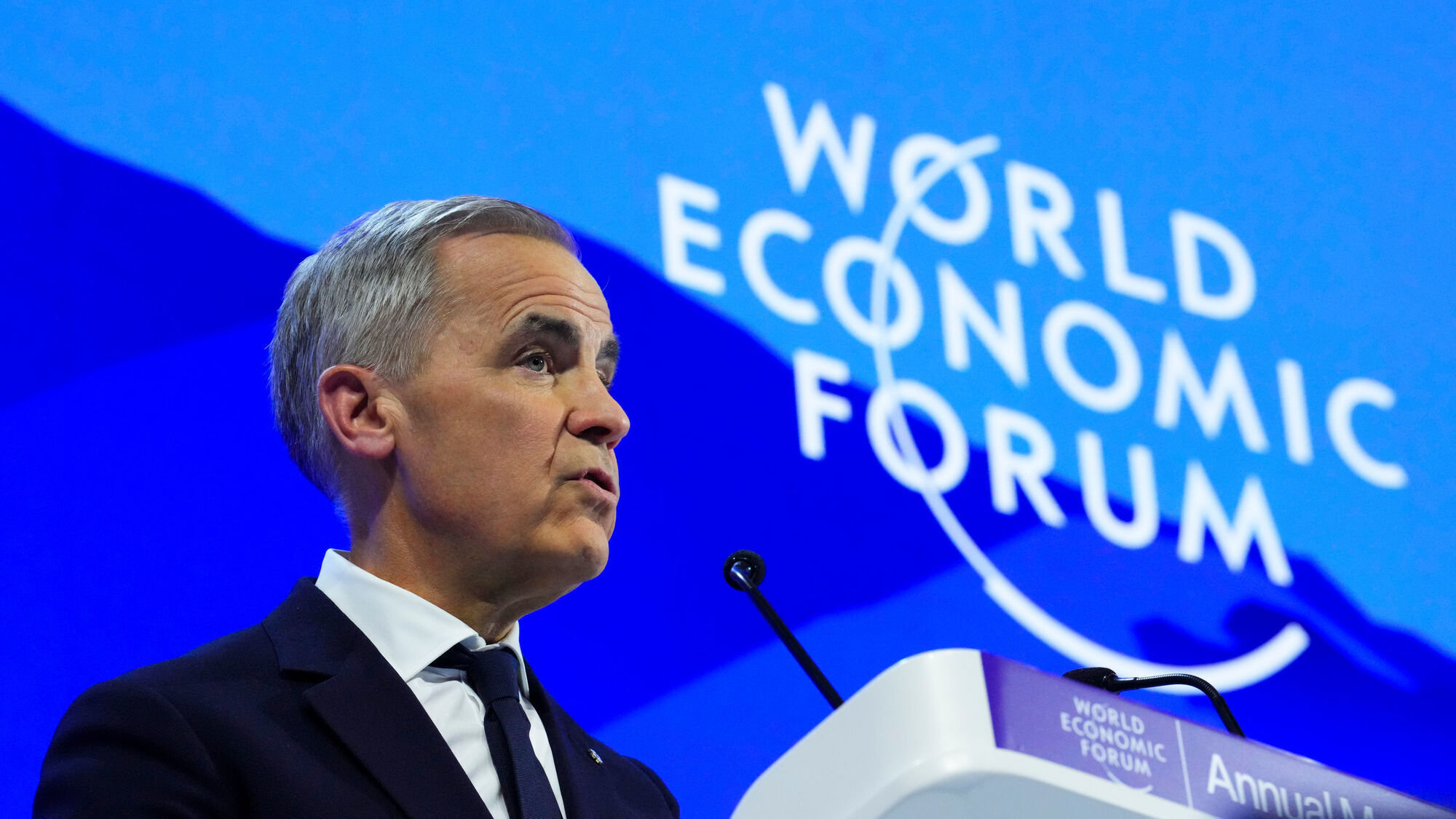
Canadian prime minister Mark Carney delivering a speech at the World Economic Forum in Davos, Switzerland. Picture: Seán Kilpatrick/The Canadian Press via AP

The words of Canadian prime minister Mark Carney in Davos two weeks ago were significant. 

His speech was centred around the reality that global double standards are in fact how the rules work, and ‘the weak must suffer’. 

He did not say anything new. 

Countries of the Global South have long known the rules of the game are rigged against them. 

The significance came because he, as a leader of a Global North country, said this out loud.

This selective application of international law tells the world that rules matter only when enforced against the “right” actors. 

It confirms the view that the so-called rules-based international order is anything but. 

And it erodes the credibility of institutions that were designed to protect civilians and restrain power.

These very double standards are most evident when it comes to Israel and Palestine. 

Since 2011 the European Union has in place a sanctions regime against Iran, renewed annually and expanded last week to add Iran’s Revolutionary Guard to its terrorist list. 

Likewise for Russia sanctions followed swiftly and decisively following the illegal invasion of Ukraine. 

Yet when Israel wages genocide in Gaza, accelerates violence and illegal occupation with near total impunity in the West Bank, and violates international humanitarian law in full view of the world, there are statements of concern, calls for restraint, and little meaningful sanction.

The pretence of the so-called Gaza ceasefire shows these double standards in full view. 

More than 500 people have been killed since October. 

Even Israel now admits that an utterly shameful number of over 70,000 have been killed in Gaza. 

Today, children are sleeping in freezing conditions amid rubble that was once their homes. 

The reality on the ground is that Gaza stays unchanged, with almost 2m people suffering from lack of food, health services, and a secure roof over their heads. 

Many are desperately injured and in agony.

Ceasefires that don’t provide safety and a mechanism to rebuild a shattered land are not steps toward peace and justice.

For most Palestinians in Gaza, there is still no meaningful way out, no reliable way in for food, medicine or fuel, and no sense that tomorrow will be safer than today. 

This is life lived under constant terror. It is not a ceasefire, its genocide continued.

The restricted opening of the Rafah crossing risks becoming another tool of ethnic cleansing, unless its reopening guarantees safe movement in both directions, facilitates medical evacuations at scale, and allows unhindered entry of vital aid. 

Palestinians must also have full rights to return to their land. 

The reopening of Rafah, in its current form, is not a breakthrough. It is a reminder of how low the bar has fallen.

This opening of Rafah is supposed to signal phase two of the American brokered ceasefire. 

There are over 20,000 people in absolute agony awaiting medical treatment. 

The reopening of Rafah comes with such severe restrictions that it barely registers against the scale of need. 

Much has been made of ceasefire talks, Trumps outrageous Board of Peace, road maps and frameworks. 

But these are deadly, lethal and cruel ruses, designed to confuse us and stop us demanding justice.

For decades, the language of peace has been used to manage the occupation rather than end it. 

Meanwhile settlements have expanded, borders blurred, and Palestinian land fragmented beyond recognition. 

Palestinians look at the destruction after an Israeli strike in Rafah, southern Gaza Strip. Picture: Fatima Shbair/AP

Each failed process has left the occupation more entrenched, not less.

In the West Bank killings, settler violence, land seizures, and mass arrests continue with near total impunity. 

Homes are demolished, families displaced, and entire communities placed under military lockdown.

To speak of Gaza without the West Bank is to miss the wider occupation that has defined Palestinian life for decades. 

The reality is of an occupied people facing overwhelming force, systematic dispossession and the steady erosion of their basic rights.

Carney spoke of this period of geopolitical change, of might is right as not a transition, but a rupture. 

We are witnessing the fight of our lives for some semblance of global justice, international law and multilateralism. It is only lost if we concede it as so.

But as Carney warned, when smaller countries fail to stand up for themselves, they do not gain safety, they simply make themselves expendable.

He said: “Middle powers must act together because if we are not at the table we’re on the menu.” 

What is missing now is the political imagination Carney spoke of: the ability to envision a future beyond managed injustice. 

That means concrete action including supporting international accountability mechanisms, ending arms transfers that risk complicity in war crimes, recognising Palestinian statehood not as a symbolic gesture but as part of a broader push for equal rights and self-determination.

European states are reluctant to alienate the United States, whose political protection of Israel remains unwavering. 

Trade, investment, security cooperation all loom large in diplomatic calculations.

Political imagination will mean not narrowly looking at ‘economic interests’ for Ireland, above justice in the face of genocide, occupation, and apartheid. 

This is why the government should fulfil the promise it made to the Irish electorate during the last general election to enact the long-awaited Occupied Territories Bill. 

It cannot be stressed enough what a minimal step this is, relating to only trade with illegal settlements in the West Bank, and not the entire illegality of the whole occupation.

If Ireland truly believes in a multilateral world governed by law rather than force, then it must demand more not only from Israel, but from our allies and from itself.

Ireland regards itself as a champion of multilateralism, human rights, and international law. 

This is who we should be. It is now the fight of our lives to hold dear to these things in a vicious and self-interested world. 

Inaction carries its own costs. Irish people have been marching in their tens of thousands for the people of Palestine, demanding action. 

At a time of farright politics and tumult, can’t the Government see the longer-term risk of losing the trust of their own citizens by not following through with some form of action?

Failing to defend international law weakens it for everyone, including small states like Ireland. 

If powerful countries can ignore rules with impunity, what protection remains for those without power?

Our credibility on the world stage comes not from our economic size, but from our willingness to speak when silence is easier. 

We are more than an economy, we are a society of people who care.

Inaction may feel safe in the short term, but history is unkind to those who confuse caution with principle.

More in this section

Revoiced

Newsletter

Sign up to the best reads of the week from irishexaminer.com selected just for you.

Cookie Policy Privacy Policy Brand Safety FAQ Help Contact Us Terms and Conditions

© Examiner Echo Group Limited