'Relationships are not just about capital cities,' says the British ambassador on his visit to Cork
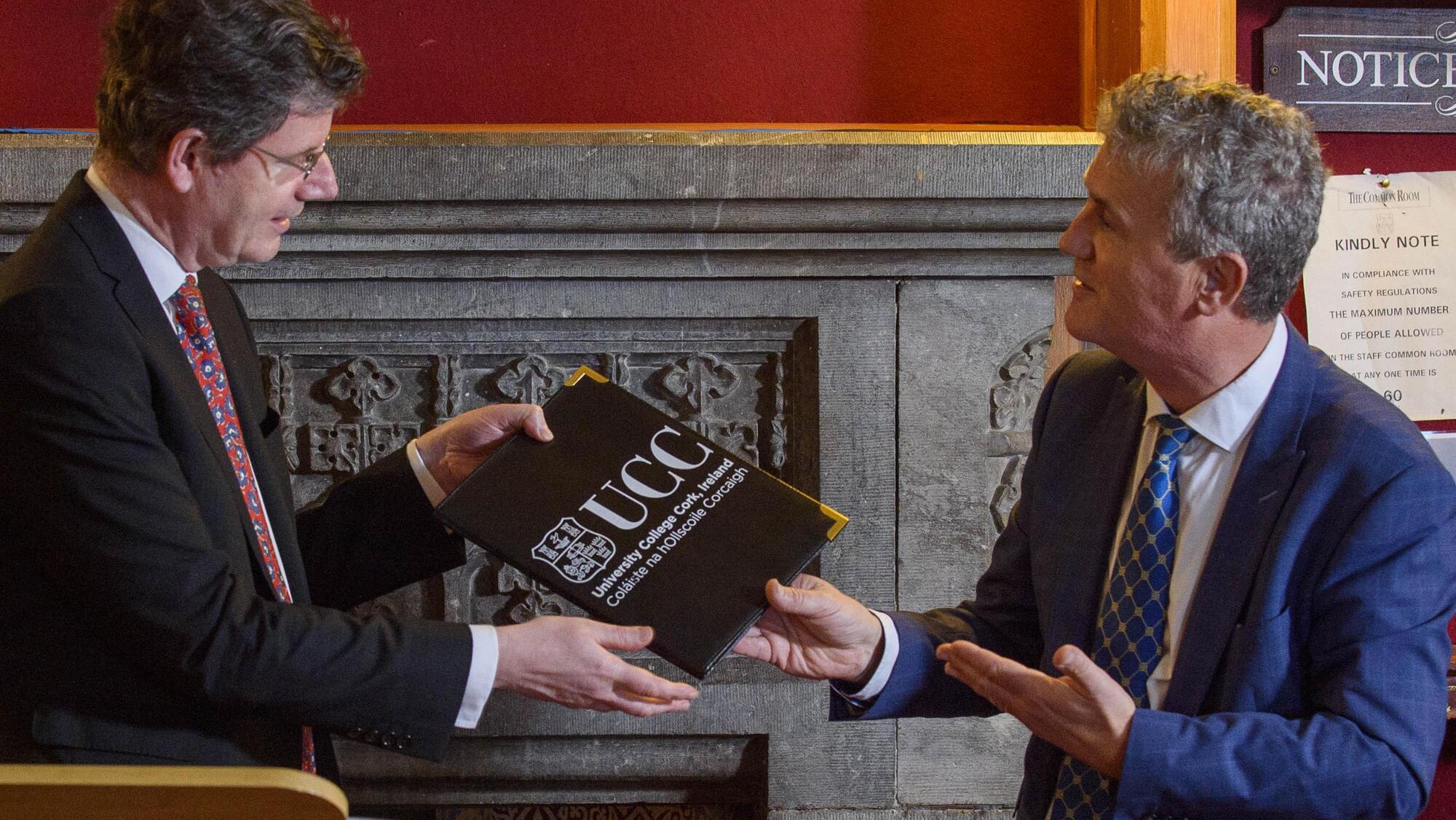
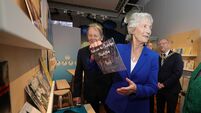
The president of University College Cork, Professor John O'Halloran, right, presenting a copy of UCC's Cop26 climate change declaration to the British ambassador to Ireland, Paul Johnston, during his visit to Cork yesterday. Picture: Daragh McSweeney/Provision
"Under the rainbow of Cop26, there is an underlying common goal of trying to create new partnerships between cities and regions, and doing so in a way that is genuinely sustainable."
While Dublin and London bare their respective political teeth at each other in a Brexit standoff over the Northern Ireland Protocol British ambassador to Ireland, Paul Johnston, is in Cork to talk a good game on co-operation and collegiality.
There is life outside of the capital cities and political difficulties, as Mr Johnston — a Glaswegian — understands all too well. That means strengthening links between cities such as Cork and Coventry, and nurturing new academic and research links between Leeside and Plymouth in the southwest of England.
For a career diplomat who has seen postings in the likes of Bosnia, Kosovo, the United Nations, NATO, and Sweden, the posting in Ireland brings a whole new diplomatic challenge, with climate change high on the agenda:
Mr Johnston continues: "When I arrived in Sweden, I immediately started going to Gothenburg and Malmo and to the north of the country.
"When I came here, Cork was going to be my first visit outside of Dublin, and I was going to go to Limerick, Galway, Donegal, Belfast.
"I couldn’t do that for most of my first year, effectively — although it has been a pleasure delayed — I think this visit to Cork is going to be one of the first of many, because as someone who comes from a place a long, long way from London, I’m strongly of the view that relationships are not just about capital cities," Mr Johnston told the .
Brought around the city centre by a Cork City Council delegation led by chief executive Ann Doherty, Mr Johnston is convinced the best is yet to come for relationships between Britain and Ireland, despite the difficult history and current political tensions.
"My hope is to be able to foster new-age partnerships between Cork and cities in the UK," he said.
"My predecessor came here some years ago to inaugurate the Joining The Dots programme, and the whole idea of that was to get away from the exclusive focus on London and Dublin, and think about different parts of Ireland and different parts of the UK.
The two-week UN climate change summit in his native city means partnerships and good relations between Ireland and Britain are more important than ever, according to Mr Johnston.
"At an event in the embassy soon after I arrived — looking at renewable energy, offshore wind — one of the things I heard about was that UCC has a big emphasis on sustainability, ranked one of the highest universities in the world in terms of its sustainable impacts," he said.
"In a way, there can be no more suitable days in coming to Cork than on the day Cop26 is looking at the role of cities and regions in the longer-term sustainability.
"We are looking in cultural terms at building up the connections between Cork and Coventry, which is the UK City of Culture next year. We are also keen to build in the areas of science and innovation. I think that renewable energy, offshore wind, sustainability more generally, means I am really keen on meeting so many colleagues here. It’s a timely visit."
The UK has become a world leader in the offshore wind renewable energy sector, and there is "enormous potential" for working in partnership with Ireland in the ever-burgeoning sector, he said.
"One of the things I did when ambassador in Sweden was encourage Swedish investment in the UK renewable energy sector," he said. "The big Swedish energy companies were some of those in the early stage offshore wind in the UK.
"Even the last 10 or 15 years, it’s interesting — back in the early days, we had to as a government put a lot of money into subsidising that investment, because the technology was a bit unpredictable, the market wasn’t very clear.
"Some overseas investors really needed to be persuaded that there would be a guaranteed level of price for their electricity.
"Now the technology is advanced, the whole transition towards electric vehicles and decarbonising the economy has meant the market situation is very different and now, your renewable energy, while not selling itself, has become much more marketable as a proposition."
However, there is no getting away from the current political tension, he conceded. But it is solvable, the career diplomat is keen to stress.
"I think the two governments want to have a really strong relationship," he said.
"The societies, economies, and their people are so intertwined, that I think we see very common agendas. If you look at the emphasis on the Irish Government's National Development Plan, so much of it overlaps with what our government is trying to do in its Levelling Up agenda — spreading wealth and opportunity, connectivity across the countries.
"It is not a great secret that there are differences of approaches between the British and Irish governments in terms of aspects of the details but, as the Taoiseach has said in the Dáil, and our minister has said in the House of Lords, we both want to focus on trying to get a negotiated solution, because that would be the best and most sustainable way forward.
"The good thing about having a really strong established set of relationships, as between Britain and Ireland, is that you can have honest, candid conversations, you can have differences of opinion... I am confident we have shared medium- and long-term objectives: We sometimes differ over the short-term strategy or tactics.
"If you stand back a bit and look at the wider world, we as European democracies have so much in common, obviously in terms of Northern Ireland and preserving the gains in the Good Friday Agreement.
"But if you look at some of the challenges that liberal democracies face in other parts of the world, from state and non-state actors, it is really important that countries like Ireland and the UK work together, as we do on the UN Security Council, as we’re doing this week in climate change negotiations, and some of the agendas of the future, such as renewable energy, digital health — there are tremendous possibilities."
Cop26 must be a turning point for Ireland and Britain and the wider world when it comes to forging lasting partnerships for sustainable living, economies, and societies, Mr Johnston said.
"If we have learned anything in the last few years, it’s the value of a more healthy lifestyle, walking, trying to use more public transport, trying to innovate in how we live," he said.
"I was reflecting on Armistice Day at Glasnevin Cemetery, and one of the former soldiers read out the famous words: 'For your tomorrow, we gave our today'. What everyone at Cop26 should be doing is something today, and the day after, for the whole planet."
CLIMATE & SUSTAINABILITY HUB
CONNECT WITH US TODAY



Be the first to know the latest news and updates