Osgur Breatnach's wrongful conviction for Sallins train robbery declared a miscarriage of justice
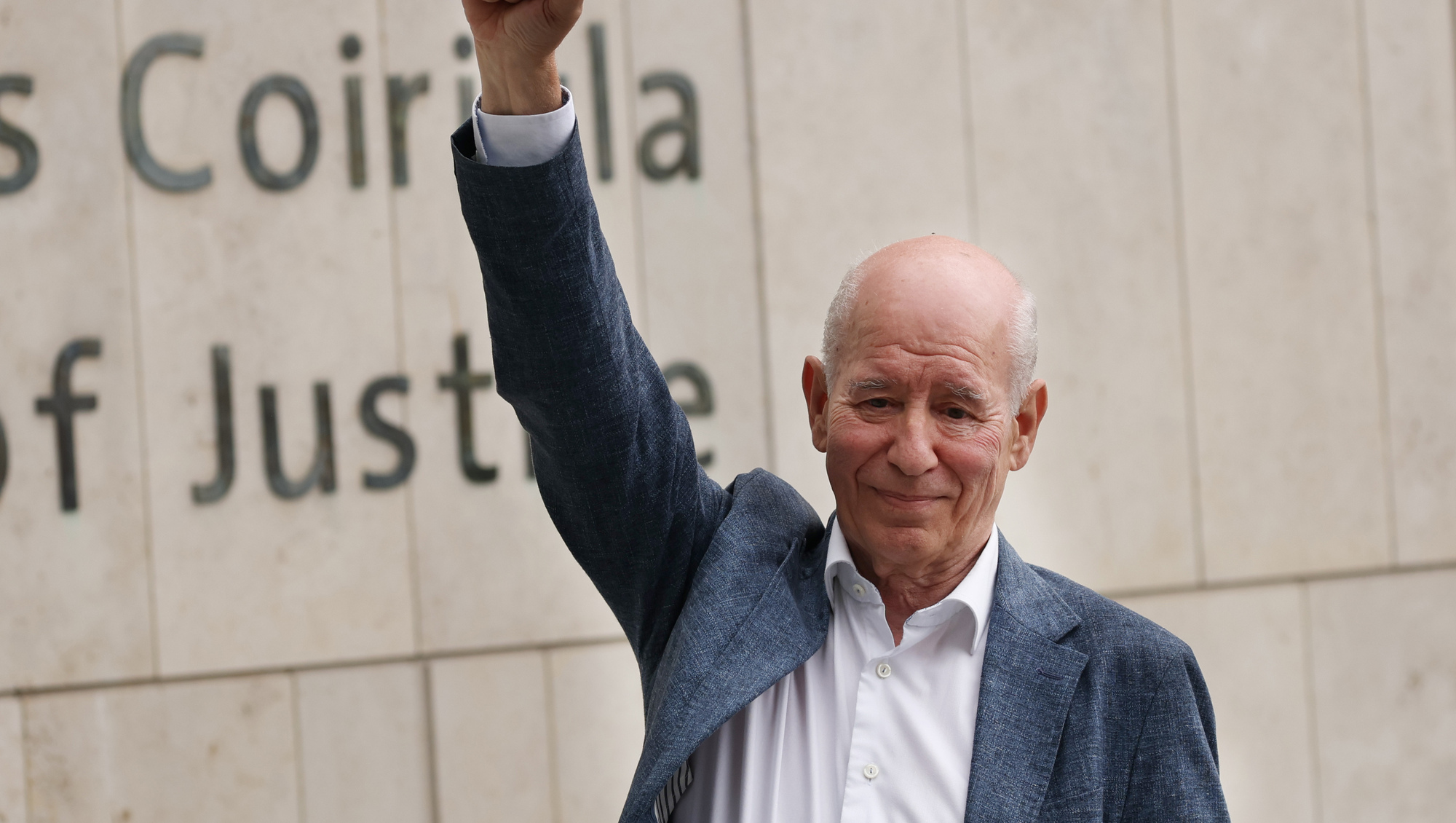
Osgur Breatnach outside the Criminal Courts of Justice in Dublin, after he had his conviction for the Sallins train robbery declared a miscarriage of justice. Photo: Collins Courts
Osgur Breatnach has had his conviction for the Sallins train robbery declared a miscarriage of justice.
On March 31, 1976, an estimated £200,000 (€234,595) was stolen from a mail train near the Co Kildare town.
Following a trial at the Special Criminal Court, the now 75-year-old was sentenced to 12 years for participating in the robbery.
He served 18 months before his conviction was quashed in 1980.
On Tuesday, the Court of Appeal sitting in the Central Criminal Court in Dublin heard how “newly discovered facts” concerning alibi evidence meant the threshold to issue a Certificate of Miscarriage of Justice had been reached.

Reading the decision of the three-judge panel, Ms Justice Isobel Kennedy outlined how the original case hinged on admissions given to Gardaí during interrogation.
She said the court was “not satisfied the admissions were voluntary” and that a decision to prosecute would be “unlikely” to have been taken if the case was happening now.
The court also heard how the Director of Public Prosecutions (DPP) accepted Mr Breatnach’s assertion in an affidavit from last year that he had “no hand, act or part” in the event.
The DPP also did not dispute the alibi evidence constituted a “newly discovered fact”.
Mr Breatnach was one of six men arrested following the robbery who alleged abuse by the gardaí during their detention; three were tried and found guilty, and later acquitted or pardoned.
Known as the Sallins Men, they have been campaigning for a public inquiry.
Speaking on the steps of the court following the hearing, Mr Breatnach said: “This certificate is another step closer to an independent public inquiry”.
He said he had attended the funeral of one of the other men, Brian McNally, six weeks ago, who “did not live long enough to even witness the measure of vindication I received today”.
What had happened to the men had “destroyed our families in every way you can think of”, he added.
His solicitor Kevin Winters said he had never heard “such a short, succinct judgment, but with such resonance for the Irish justice system”, describing it as a “massive day of justice”.
He said: “I don’t often find myself saying this, but I want to commend the prosecution for the flexibility and the expedition with which they responded to our very detailed arguments.
“I think commendation is very much due because it gave a route map to the court today to make the absolute right and proper judgment.”
Human rights groups, including the Irish Centre for Civil Liberties, have welcomed the decision.
Speaking outside the court, its executive director Joe O’Brien said the decision had taken “too long”, adding: “It shouldn’t have taken decades”, and should not have needed the involvement of groups such as his.
“This is also going to give energy to our ongoing calls for public inquiry,” he said.
“We need the daylight for public inquiry to shed light on this murky chapter in Irish political life and in the history of An Garda Síochána.”