Riad Bouchaker trial: Girl stabbed on Parnell Square will require 24-hour care for rest of her life
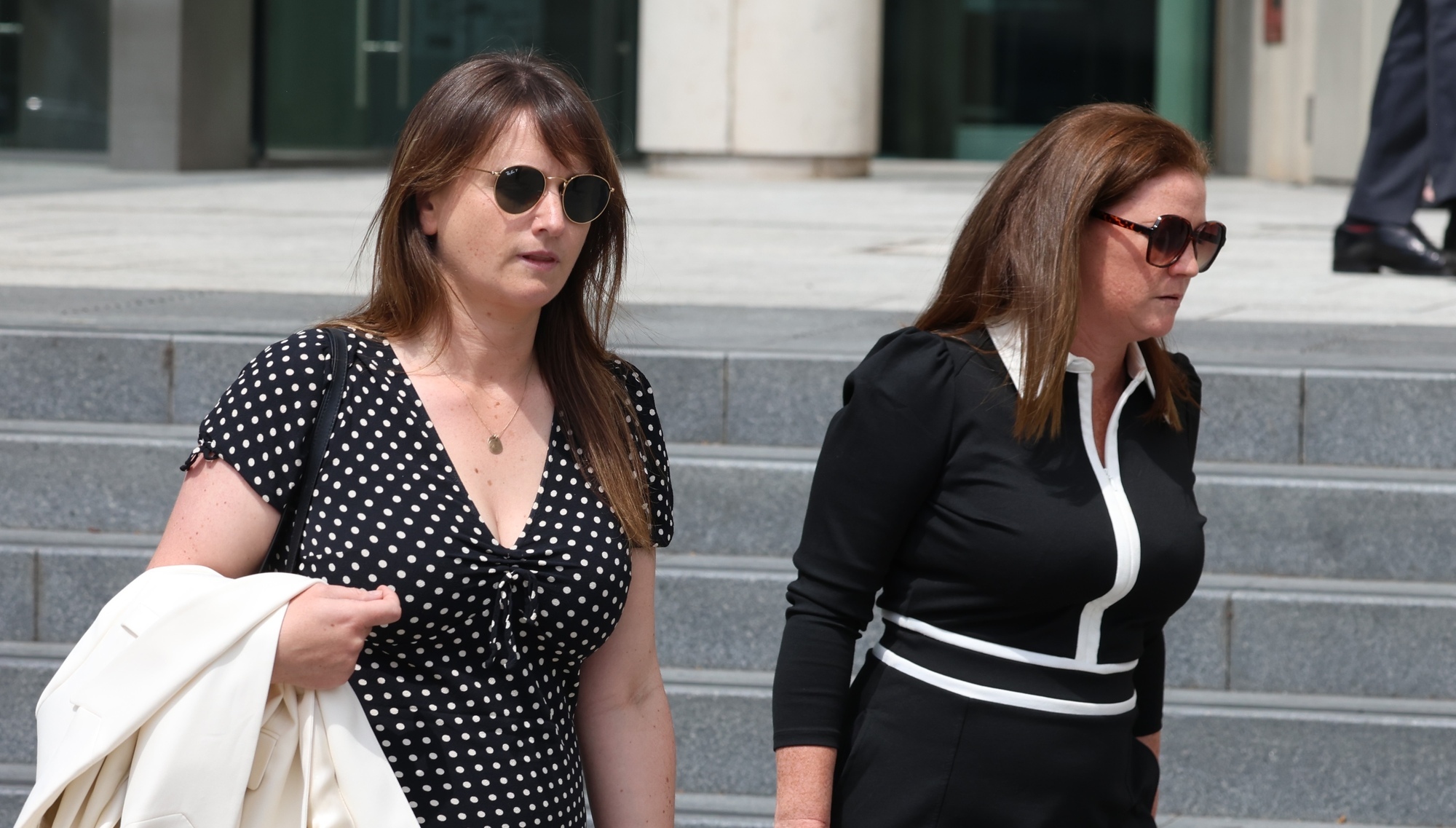
Dr Aoife Mahoney and Dr Louise Baker who gave evidence in the trial of 52-year-old Riad Bouchaker on Thursday. Picture: Collins Courts
The girl who was stabbed on Parnell Square three years ago will require 24-hour care for the rest of her life, does not have control over her limbs, and remains at risk of scoliosis and painful muscular spasms, the Central Criminal Court heard on Thursday.
Dr Louise Baker has been the girl's paediatrician in Temple Street Children's Hospital since an ambulance brought her in for emergency surgery on November 23, 2023.
She said the girl, who had recently turned five when she suffered the injury and is now seven, was previously healthy and had reached all her milestones. Following the knife wound to her heart, she suffered a lack of blood and oxygen supply to the brain during a 40-minute cardiac arrest.
Dr Baker said the girl will require ongoing medical help and 24-hour care for the rest of her life.
The doctor was among the final three witnesses who gave evidence on Thursday in the trial of Riad Bouchaker, aged 52, who denies attempting to murder the girl and two other children.
He further denies causing serious harm to creche worker Leanne Flynn and assault causing harm to two other children and a teenager.
The prosecution has called all its witnesses and will formally close its case next week.
Dr Baker told Karl Finnegan, prosecuting, that when the girl arrived at Temple Street Hospital, she was brought immediately to theatre. Surgeons opened her chest to carry out a cardiac massage and to close the incision from the knife wound.
Within 24 hours of the surgery, she suffered seizures which showed that her brain had suffered severe damage, she said.
The brain damage was later confirmed by an MRI scan. She remained in the intensive care unit until January 2024. As she began to awake, Dr Baker said she showed obvious signs of "severe dystonia", which she described as an "extremely painful" condition causing contraction of the muscles.
The muscles in her gut were also affected, causing her such extreme pain during feeding that she was twice more admitted to the ICU.
To this day, she has no control over her hands, arms, or legs and finds the difficulty in communicating between her brain and her limbs distressing. She is now being fed through a tube into her stomach because she cannot swallow safely on her own.
Her family has moved home to be nearer to a disability network team and to find suitable accessible accommodation for the girl's ongoing needs. She requires multiple mobility aids, a hoist, a wheelchair, and a "huge amount of equipment" going forward, Dr Baker said.
The witness said the girl has a lifelong, limiting severe physical disability. She is at risk of ongoing painful muscle contractions, spinal curve, scoliosis, gut dystonia, and pain. She is non-verbal and communicates only by blinking.
She is going to have a learning disability and difficulties for the rest of her life and is unable to sleep without medication.
Dr Aoife Mahony told Mr Finnegan that she is a consultant paediatrician with Children's Network Ireland. She said the little girl suffered a severe neurological disorder as a result of her injuries. Her dystonia causes her to struggle with motor movements and causes pain. She cannot stand or bear her own wait or walk independently.
Dr Mahony said she has struggled to carry out a full neuropsychology assessment because of the girl's difficulties with communication. She said she does understand some things and her "eyes light up and she smiles" when she sees something she likes, but she finds detailed communication difficult.
She said there is a mismatch between her ability to understand things and her ability to express herself. Dr Mahony said doctors are trying out new technologies, particularly to do with the eyes, that might help her to communicate. However, she said that is slow and nobody is sure how successful it will be.
She is now attending a school for children with complex needs and for the rest of her life she will require regular physiotherapy, occupational and language therapy along with psychological support.
Dr Mahony said further rehabilitation gains are possible, but research shows that the most significant gains following a brain injury occur in the first year.
Professor Ann Brannigan is a consultant surgeon in the Mater Hospital. She said that Ms Flynn, the creche worker, was brought to the hospital by ambulance with severe trauma having suffered a major stab wound to her lower back. Her lungs had collapsed and were filled with blood. Her diaphragm had been burst and she had a laceration to her spleen which was causing significant blood loss.
Prof Brannigan said she took the decision to remove Ms Flynn's spleen, adding that if she had not done so, the patient would have gone into cardiac arrest.
Surgeons also repaired the damage to her stomach before moving her to the intensive care unit. She remained in hospital until December 20 and remains at increased risk of infectious disease due to the loss of her spleen.
Mr Justice Tony Hunt told the jury of nine men and three women that they will hear the next phase of the trial next week. He said there are issues that he needs to deal with in their absence and in the meantime he asked them not to discuss the case with anyone over the weekend.
CONNECT WITH US TODAY



Be the first to know the latest news and updates