Venomous snakes much likelier to have bright colours than harmless counterparts, Galway researchers find
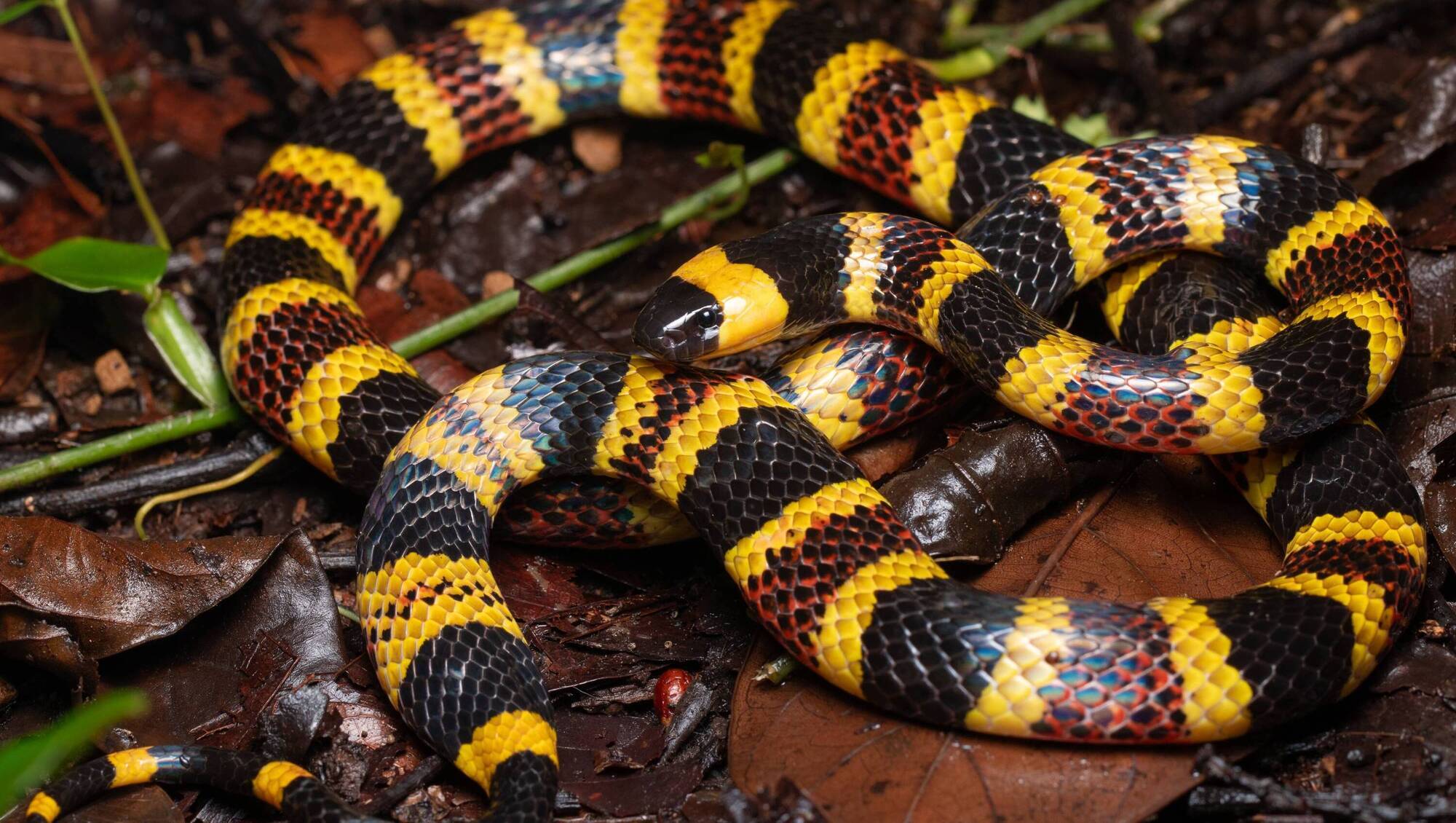
A Central American Coral Snake (Micrurus nigrocinctus), a venomous species displaying its distinctive colouration.
Poisonous snakes are far more likely to have striking colours in order to ward off predators than their non-venomous relatives, researchers at the University of Galway have concluded.
A new study in the Journal of Animal Ecology and carried out by academics within NUIG's school of natural sciences found that red and yellow as a colouring in particular helps venomous snakes to stand out against their background, supporting the theory that some snakes have evolved their colours to warn predators they are dangerous.
The research saw the report's authors analyse more than 450 snake species using thousands of photographs uploaded to the citizen science platform iNaturalist to discern the patterns surrounding how snakes' colourings appear against the background of their natural habitats.
Animals using bright colours to warn other species of the dangers of attacking them is not new – wasps, for example, use bright colours to indicate danger, while a ladybird's bright red and black spots warn hunters that they are both toxic and foul-tasting to eat. The phenomenon is known as aposematism.
However, the researchers explained, it has not before been established if eye-catching colouring in snakes bears any relation to whether or not the species is venomous.
The paper's writers examined whether or not venomous snakes are more visually distinct from their backgrounds than non-poisonous varieties, focusing particularly on red-and-yellow colouration, which is typically associated with warning signals in nature.
It found that while many poisonous snakes are not brightly coloured, a large number of them have evolved distinctive colours and patterns, suggesting a link between poisonous venom and warning colouration.
The authors said that their findings suggest that venom and warning symbolism may have evolved together in some snakes, with the possibility that being easily seen may have been a survival strategy, electing to warn predators directly of the hazards of attacking an animal with a sophisticated defence system.
"Rather than hiding from predators, some venomous snakes appear to advertise that they're dangerous. Their striking colours likely evolved as warning signals that discourage attacks before they happen," Amy Duclaux, lead researcher on the project and an academic with the university's school of natural sciences, said.
She added that the researchers found that red and yellow colouration is "particularly effective" at helping snakes stand out against their background, suggesting those colours in particular "play an important role in visual signalling".
Head of the macroecology laboratory at the school, Dr Kevin Healy, meanwhile, said that the research shows that for some snakes, the adoption of conspicuous colouring is less about blending into the background and more about "making sure they are seen".
Dr Healy lauded iNaturalist also, saying that it serves to provide images of animals in their natural habitats "at a scale that would otherwise be impossible for individual research teams to achieve".
"Photographs taken in the wild are essential for understanding how those colours appear in the environments where they evolved," he said, adding that the research showcases how citizen science platforms are "transforming the study of evolution".


CONNECT WITH US TODAY



Be the first to know the latest news and updates