Richard Collins: We have an ancestral fear of snakes — the feeling is mutual
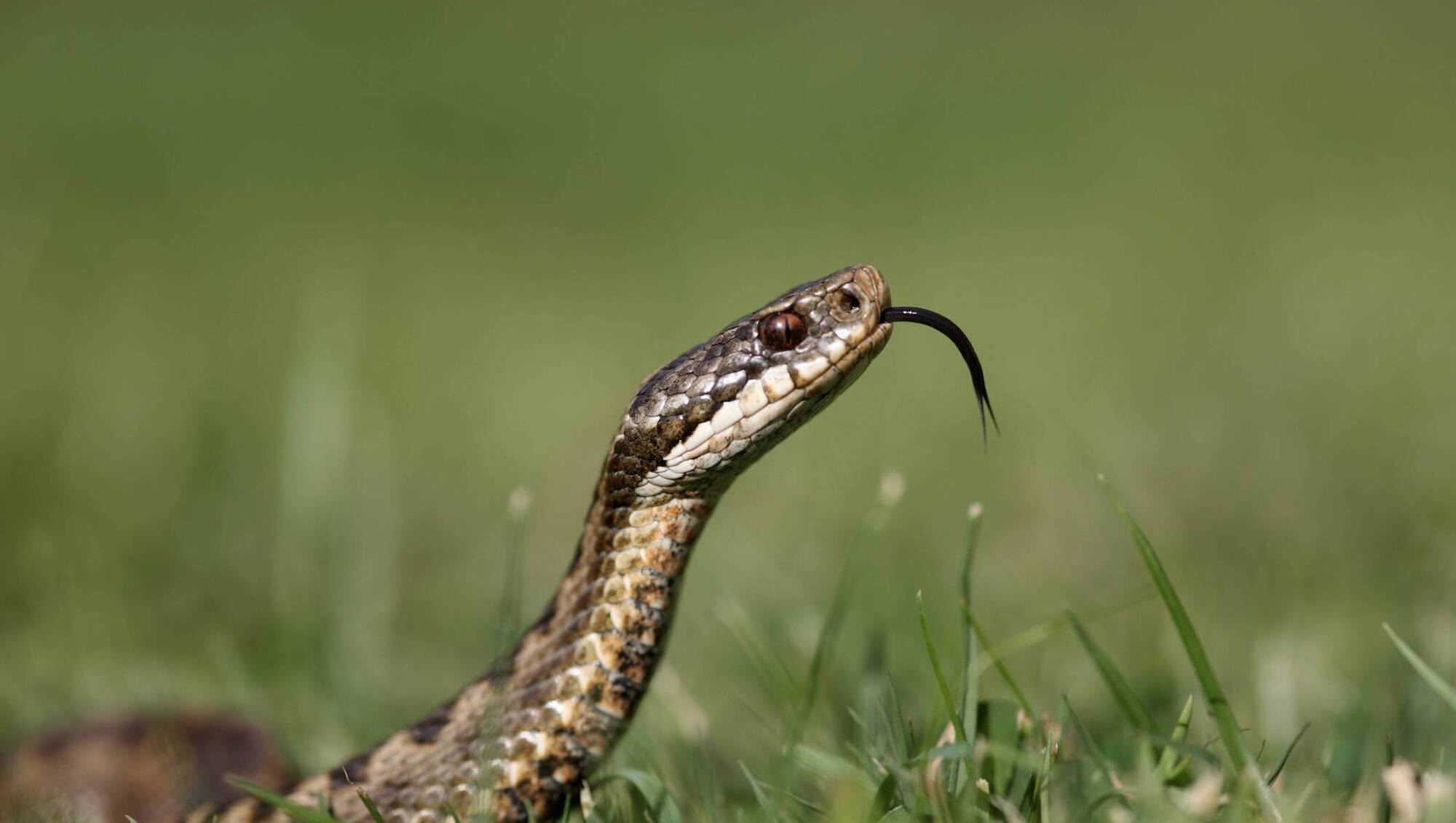
I encountered a snake swimming in the French Basque region’s Huchet River last month. We have an ancestral fear of snakes; the fixed stare of a serpent’s cold eye spooks us
Richard Collins: "Snakes evolved from lizard-like reptiles which took to living underground in burrows. Their legs, impeding movement in the confined conditions, became a liability, so they gradually lost them." Picture: iStock.

Richard Collins: "Snakes evolved from lizard-like reptiles which took to living underground in burrows. Their legs, impeding movement in the confined conditions, became a liability, so they gradually lost them." Picture: iStock.

Christopher Nolan's film The Odyssey has captivated the entertainment world. Odysseus and his men, returning from the Trojan War, visit an island where they become trapped in a cave. Their captor, Polyphemus, eats soldiers. He has a single eye in the centre of his face.

In a paper just published, George Kafetzis and colleagues from the Universities of Lund and Sussex, claim that an ancient ancestor of ours was also one-eyed. The strange creature, a forebear of all back-boned animals, lived almost 600 million years ago.

A single cluster of light-sensitive cells adorned its head, but there the comparison with Homer’s epic tale ends. This was no monster. A tiny worm-like ocean-dweller, it fed on plankton.

A remnant of the creature’s primitive sensory organ is still with us today: The pineal gland bears ‘striking cell-like similarities’ to it, the researchers say. The gland also features in a modern myth; René Descartes thought that the pineal was the ‘seat of the soul’. It was where consciousness, a spiritual entity, interacted with the physical body. Producer of melatonin, the gland still has a light-sensing function. It regulates the transition to sleep as darkness falls.

Eyes evolved independently in differing creatures; natural selection giving rise to many varieties of light-sensitive organ. Those of insects and creepy crawlies, for example, differ radically from vertebrate ones. But even among the back-boned group, to which we humans belong, there are huge variations in eye configuration.

I encountered a snake swimming in the French Basque region’s Huchet River last month. We have an ancestral fear of snakes; the fixed stare of a serpent’s cold eye spooks us. The fear is mutual; the harmless creature gave our punt a wide berth.

Snakes evolved from lizard-like reptiles which took to living underground in burrows. Their legs, impeding movement in the confined conditions, became a liability, so they gradually lost them. ‘On thy belly shalt thou go and dust shalt thou eat’ etc. Eyes, likewise, were of little use in the darkness, so the snakes lost them too. They also dispensed with hearing.

When, in time, some of their descendants began venturing above ground again, they had to evolve entirely new eyes, which is why snake eyes differ so greatly from ours. Nor do snakes have eyelids; they sleep with their eyes open. Oddly, they did not re-evolve hearing but have remained deaf, choosing to respond instead to vibrations in the ground. The snake charmers’ serpent reacts to the waving of the flute, not to its sound.

‘Vertebrate vision’, the researchers say, ‘emerged by repurposing pre-existing circuits’. The one-eyed creature had forebears with pairs of light-sensitive organs. Having two eyes enables a creature to estimate the distances separating it from other objects, such as predators. The one-eyed ancestor, however, was sedentary. Not moving about, it didn’t need a second eye. In time, only one of these light-sensitive organs remained.

When its evolutionary descendants began moving above ground again, natural selection restored the two-eyed configuration found in vertebrates today.

  • George Kafetzis et al. Evolution of the vertebrate retina by repurposing of a composite ancestral median eye. Current Biology. 2026

x

More in this section

Revoiced

Newsletter

Had a busy week? Sign up for some of the best reads from the week gone by. Selected just for you.

Cookie Policy Privacy Policy Brand Safety FAQ Help Contact Us Terms and Conditions

© Examiner Echo Group Limited