Former Waterford Crystal workers still fighting for pension, 35 years on
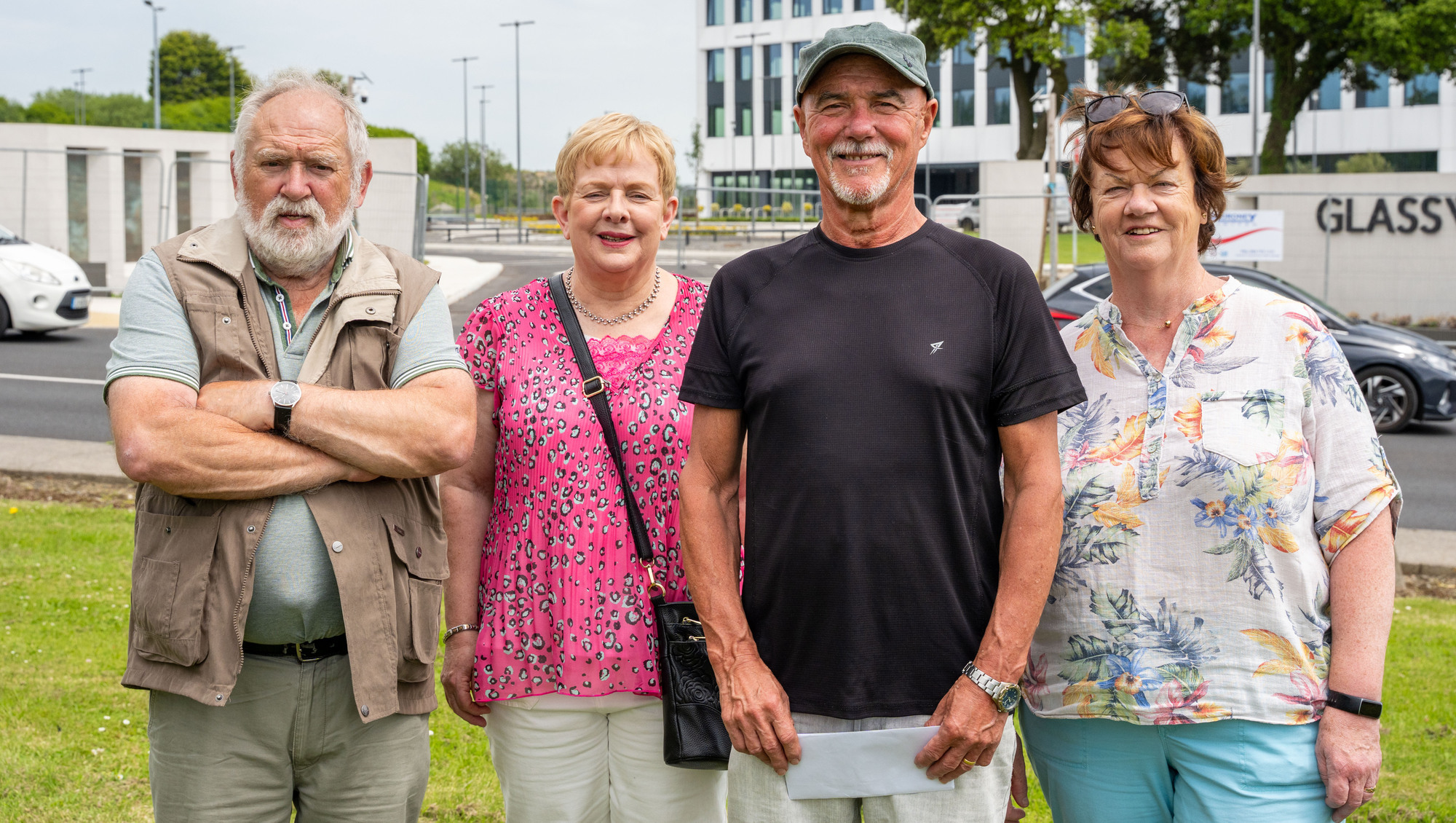
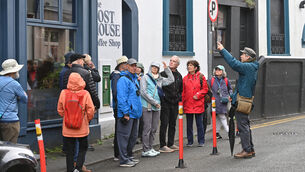
Edward Lacey, Mary Cheasty, Walter Croke, and Anne Hammond near the former Waterford Crystal site, known today as Glassworks. Picture: Noel Sweeney
Thirty-four years later, the hands Walter Croke used to make the finest glass in the land have wrinkled with age.
Mr Croke, 77, left Waterford Crystal in 1992.
Thirty-five years later, he is still campaigning for redress on an alleged injustice that left him €180,000 out of pocket.
He has spent the summer in and out of hospital with arthritis.
There is a cruel reminder that time isn’t on his side.
Around 400 former workers, now known as the Waterford Crystal Pension Action Group (WCPAG), had once joined him in the fight.
They, too, are slowly whittling away.
“None of us has immortality… you realise that we can continue this fight and we can continue trying to talk to this person, that person, and the other, but it’s not really getting us anywhere,” says Mr Croke.
“In ten years’ time, I can’t see there being any individuals left alive of our group, that’s when you sit down and try and face up to the situation... On a monthly basis, we’re losing members. In over a year, we will lose 20 or 30 members.”
When Mr Croke took voluntary redundancy in 1992, he was contractually obligated to receive a pension form with three options: A transfer of the value of his pension to another account, a deferred pension, or an immediate return of his pension contributions.
The crux of the former Waterford Crystal workers’ fight is that they claim they were only presented with one option — the immediate refund of their contributions.
The pension contributions, which had only begun a few years prior, were small — £3,078 in old pounds.
Mr Croke was also given statutory redundancy and an ex gratia lump payment of £29,410, leaving him with a take-home sum of £34,338 after tax.
According to an actuarial report carried out by Joseph G Byrnes and Sons, the decision, or non-decision, that Mr Croke believes he was forced into ended up costing him €179,100 in the long run.
Other workers who were made redundant from Waterford Crystal in the early 1990s say they were also put in the same precarious position.
Read More
Anne Hammond’s husband, Tosh, worked as a glassblower for 24 years before his ill health from Ankylosing spondylitis meant he could no longer continue his work.
He passed away 10 years after he took redundancy.
She says the debacle came at a grave personal cost, with her children and ailing husband left without a social security net.
“I sewed into the night, came home at midnight, knackered, and got up at four in the morning… I couldn’t leave one job until the other made me permanent,” she says.
“I lost out a lot on my kids’ young years. We had no protection at all, so I had to work. And when in work, I realised, because I had to build into a pension to secure the future for me, and my kids, I realised how badly my husband was dealt with.
“I had to do that for 12 months and look after three children and look after somebody whose health was failing. And that’s what kept me motivated. And the fact that Tosh passed away 12 years later, I didn’t get any justice there.”
Many of the workers began their jobs at the factory young.
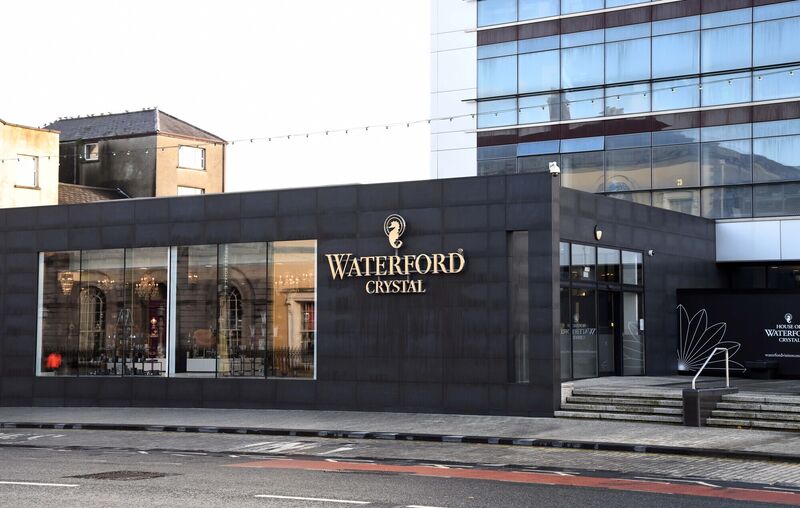
Mr Croke was 15 in 1965 when he first started working at the crown jewel of Waterford’s industrial heartland.
Hailing from the working-class edge of Tycor in Waterford, he graduated to a ‘master glassblower’ who shaped the jugs of the world-renowned glassmaker and installed the handles onto them under molten heat.
The glassmaker once employed over 3,000 workers in the 1970s and early 80s.
John Tebay, who was employed as a bench master, began working in the factory just after his Inter Cert.
“It was a great place to work, great wages. We all had holidays, we were all young at the time, and we were all free and single,” he recalls.
But by the early 1990s, market forces and threats of undercutting from Eastern Europe led to cost-cutting.
In 1990, workers went on the first of a series of strikes.
Even when strike action paused, work was unstable.
It could have been a week in the factory, before a week off.
Workers with mortgages were beginning to feel the squeeze.
“There was an unbelievable reduction in the earning potential of people there. People who walked past you while you were on picket line were now your supervisors. There were a lot of bad feelings,” Mr Croke says.
Ms Hammond’s late husband Tosh had also taken part in the strikes.
“I remember saying to Tosh about the union representation, and he said that a union member told him that he wouldn’t represent a rat leaving a sinking ship.”
In that context, the voluntary redundancies took place.
Six months before Mr Croke took his redundancy in October 1992, his union rang alarm bells on the manner in which redundancies were being carried out.
“It would appear that the company are using a refund of pension contributions as part of a redundancy package,” representatives from the
Amalgamated Transport and General Workers' Union wrote to Irish Pensions Trust.
“We believe that the company and the [Irish Pensions Trust] as trustees are not fulfilling their obligations in informing members of the options available to them on leaving the scheme.”
An account of the Irish Pensions Trust wrote to the company emphasising the need to “fully notify members of their leaving service options under the Pension scheme”.
The signed letter with options was to be held by the worker, the company, and the pension trustees.
The relevant workers believe they were wronged, not by administrative oversight, but by deliberate collusion on behalf of the company and the pension providers (Irish Pensions Trust).
The workers have said if there were signed records with their names on the pension forms with three options, they would walk away from the table.
Nobody has since been able to produce them.
The Department of Social Protection has acknowledged it does not hold the relevant records.
Both Revenue and the Irish Pensions Authority declined to comment to the
In 2009, Mr Croke reached a settlement with the Irish Pensions Trust based on Crystal’s depleted pension funds.
He received €22,000, significantly less than the amount lost in his actuarial report.
Taoiseach Micheál Martin has described the situation as "complex" and one that the State does not feel it’s right to step into.
Sources privy to decision-making on the subject say the Department of Social Protection does not see a feasible way in which to intervene in the matter, and believes the State has no responsibility to step into a dispute between private workers and a private company.
What Mr Croke has called for has been an inquiry into the pension fallout, amid what he deems State "stonewalling."
Following a meeting with then taoiseach Simon Harris and minister for social protection Heather Humphreys, a review by attorney general Rossa Fanning was commissioned.
No case for State intervention was outlined.
“The alleged failures arose in the context of a private pension scheme. Any consequences arising from these alleged failures are issues between the members concerned and Waterford Crystal Ltd, and/or the Irish Pensions Trust Ltd, and do not give rise to any State liability,” minister for social protection Dara Calleary wrote to Waterford Crystal Pension Action Group member John Hearne.
“Where litigation was taken by members against these parties, and settled, this was in the context of private litigation and again does not give rise to a liability against the State.
“In these circumstances, it would be wrong for the State to intervene in cases where there is no legal liability or obligation and where the issues and facts at play are in respect of private contractual arrangements.
“Accordingly, while I understand the sense of grievance felt by members of the WCPAG, I must advise that the State will not be intervening in this matter.”
Workers say they should have been included in a State redress measure that compensated a host of Crystal workers when the company eventually went bust in 2009.
But because the workers had taken a refund of their pension options — which workers allege was the only option presented to them — they were deemed ineligible for the redress.
There is now a humdrum to their campaign.
Every few months, they meet in the Roanmore GAA club in Tycor, where they talk about their fight.
There are increasingly fewer and fewer attendees.
Opposition TDs from Sinn Féin, Labour, and the Social Democrats occasionally take the stand to plead their case.
Sometimes there are breakthroughs, such as a meeting with a taoiseach.
At the moment, it feels like there is no concrete movement in place.
The group members have grown increasingly cynical.
Mr Hearne, who holds a PhD in history, says he has lost complete faith in the political system.
“We fight against injustice, basically, and there is no justice. I’ve lost our faith in practice. I wouldn’t vote again.
“The minions will do what their master will tell them. I know the guys here, no vote, no depth of politicians, but they’ll do what they do. They will sell their soul to the left to get on in politics.”
Referring to Mr Harris, Ms Hammond said: “I’m sorry to this day that I left him shake my hand.”
They now ponder action in Europe.
But there is a cruel preface to an opposition TDs’ pleas whenever they take the stand in the Dáil: The former workers are now in their 70s and 80s, and time is running out.
“I think that’s why the Government is in a position to continue with that fight and with the stonewalling,” Mr Croke says.
“The last 16 years, I would have been entitled to my pension when I was 61.
"But I can’t see us being successful, 100% there... I believe personally that we’d have done well if the Government, the department, and the State accepted that something was not done right back then.”


CONNECT WITH US TODAY



Be the first to know the latest news and updates