Viewing events across Ireland for ‘deepest eclipse until 2090’
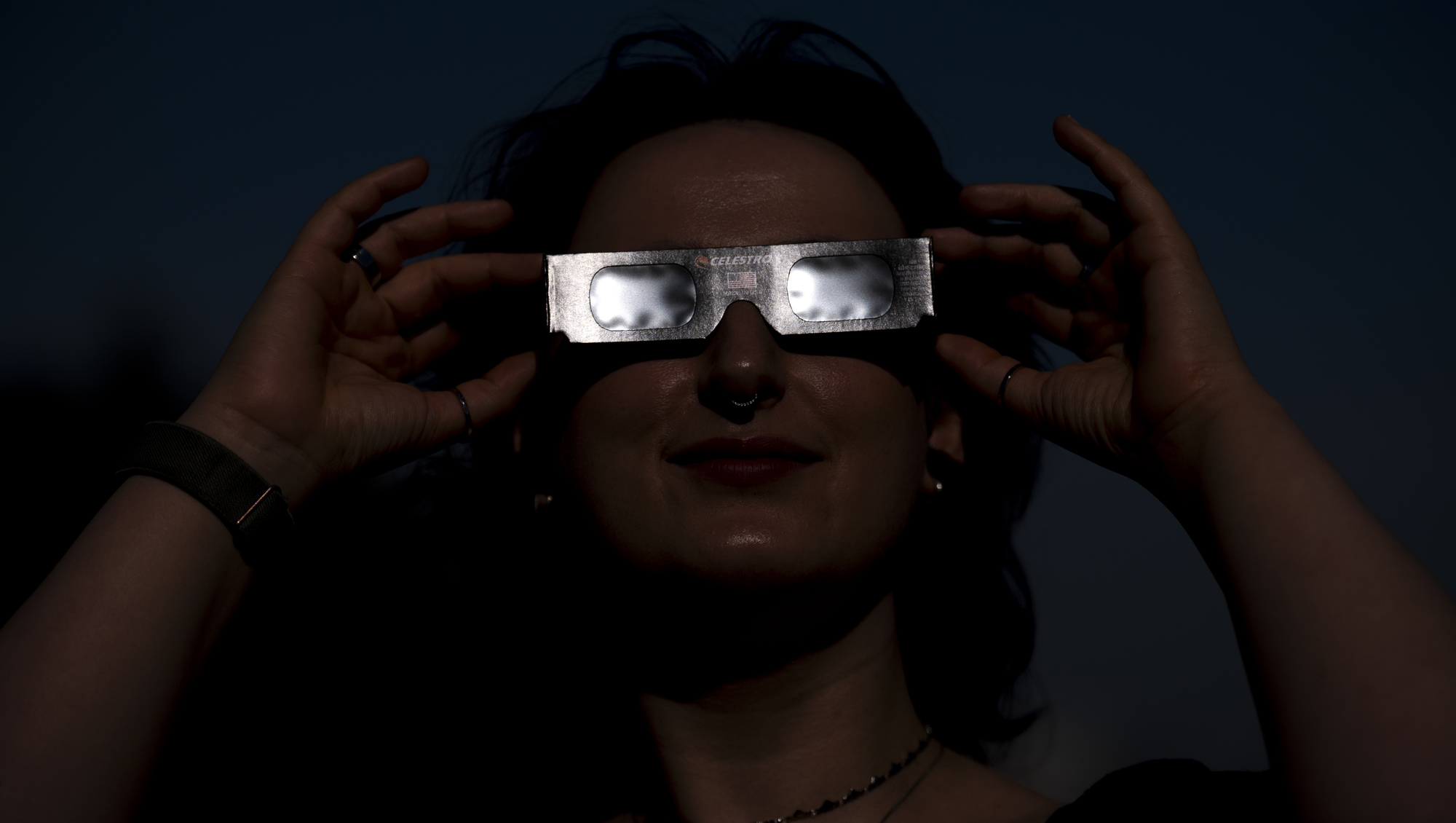
Planetarium astronomer Dr Carys Herbert demonstrates wearing Celestron solar eclipse glasses (Jordan Pettitt/PA)
Viewing events have been planned to take place across the island of Ireland ahead of what is expected to be the “deepest eclipse” over local skies until 2090.
The Moon is set to cover more than 90% of the Sun in a partial solar eclipse on Wednesday evening.
It is described as likely to be the deepest eclipse seen from the region since the total eclipse of August 1999 and the last time that such an eclipse will be seen here until 2090
The west and south of Ireland are to see 98% coverage of the Sun, while this is expected to be around 94% in the east and north of the island.
Some areas of the world are expected to see a total eclipse, including parts of Spain, Greenland and Iceland.
Observatories at Armagh, Dunsink, in Dublin, and Blackrock Castle in Cork have organised viewing events, and public events have been planned at Maynooth University in Co Kildare, Queen’s University Belfast and at the Phoenix Park in Dublin.
Director of Armagh Observatory and Planetarium, Professor Michael Burton, described one of the most eagerly awaited eclipses for decades.
“While we won’t encounter totality here – only a narrow path across Greenland, Iceland and northern Spain will be fortunate enough to encounter this – a 94% partial eclipse is an extraordinary sight in its own right,” he said.
“At its peak, the Sun will be reduced to the thinnest sliver of light, low over the western horizon. It is going to be a beautiful and quite eerie spectacle.”
Read More
He said the eclipse will begin at approximately 6.10pm, reaching its maximum at around 7.08pm and concluding shortly after 8pm.
Observers can expect to see a striking scene, with the crescent Sun glowing low in the evening sky.
Prof Burton added: “The last time skies over Ireland darkened to this extent was in 1999. On that occasion people travelled from all over to stand under the path of totality in Cornwall.
“You don’t need to travel anywhere this time – history is coming to us.”
He reminded viewers to never look directly at the Sun during the partial eclipse.
“The Sun is never safe to look at directly with the naked eye, binoculars or a camera, no matter how much of it is covered by the Moon,” he said.
“Sunlight contains strong and harmful ultraviolet (UV) light which will damage your eyes. Use eclipse glasses, solar filters or make a pinhole projector using a cardboard box, tin foil and white paper.”
Armagh Observatory and Planetarium is hosting a day of activities from 10am to 8pm, including hands-on science demonstrations, dome shows and eclipse-themed events for all ages.
It will also provide solar viewing opportunities and answer questions about the eclipse and the wider universe.

CONNECT WITH US TODAY



Be the first to know the latest news and updates