Teenage Defence Forces apprentice's death in 1991 was regarded as suicide within his platoon, tribunal hears
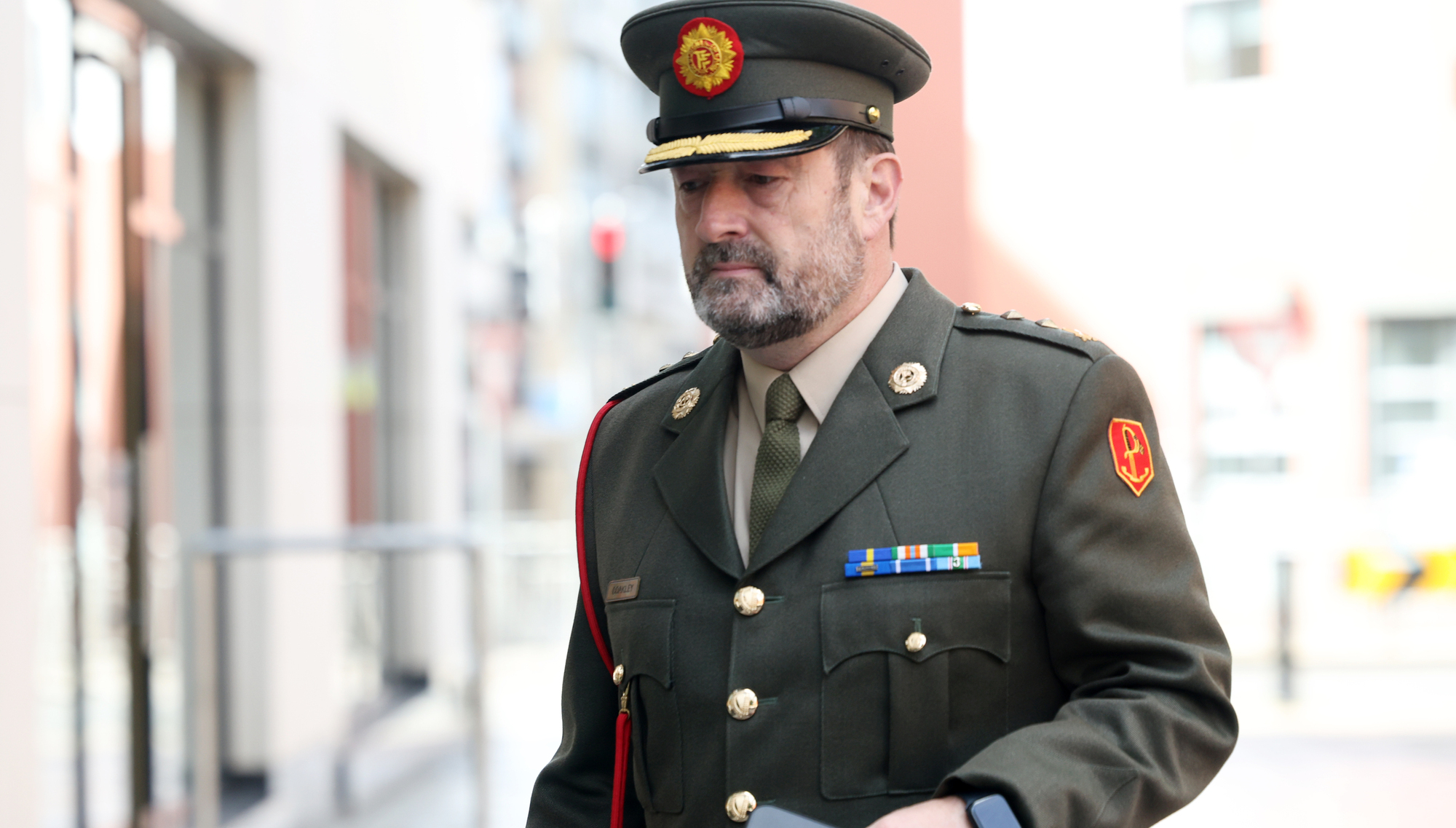
Colonel Damien Coakley arriving at the Defence Forces tribunal on Thursday. Picture: Leah Farrell/RollingNews.ie
A teenage Defence Forces apprentice’s death in 1991, treated officially as an “accident”, was regarded as suicide within his platoon, it has been revealed.
It has also emerged that, as well as investigating his death, the Defence Forces had also investigated a complaint Oliver Mullaney had been mistreated by a superior officer just days before he died.
The head of the Defence Force’s military police revealed the existence of the two investigations into Mr Mullaney’s death to tribunal lawyers when they interviewed him last month.
The revelation by Colonel Damien Coakley is the first time it has ever been made public there were two Defence Forces investigations into Mr Mullaney’s death and that it could have been caused by anything other than an accident.
Under cross examination by the tribunal’s senior counsel Michael Cush, the Irish forces provost marshal and director of military police told tribunal investigators he had become aware of “certain issues” around the death of Mr Mullaney in 1991.
He said he discovered there were two investigations into the 19-year-old’s death.
He found this out after he had been instructed by the tribunal to look into the investigation of Mr Mullaney’s death.
Mr Cush said: “In assisting the Defence Forces prepare for this tribunal, you became aware there were, in fact, two separate military police investigations in relation to the death of [Mr Mullaney]”.
Col Coakley replied: “Correct.” Mr Cush said: “One was in relation to the circumstances of his death on Saturday, June 22?” He replied: “Correct."
Mr Cush then said: “Another was held in relation to alleged, and I stress, alleged bullying and abusive behaviour of him and maybe others by one or perhaps more superior officers on the previous Thursday, June 20.”
He replied: “Yes.”
Mr Cush then asked Colonel Coakley: “You’ve become aware of the widely held view within the platoon is that Mr Mullaney’ death was in fact a suicide? Are you aware of that widely held view that it was a suicide and that the events of the previous Thursday caused or contributed to his alleged suicide. You're aware of that being a held view at the time?”
He replied: “I’m not aware of what the platoon's view is, but I understand there was a connection to both incidents.”
Mr Mullaney, from just outside Leitrim town, was just 20 months into his apprenticeship in the Defence Forces and was training to be a motor mechanic when he died on the evening of June 22, 1991.
At the time, he had been on armed sentry duty at Devoy Barracks and was found dead at about 9.15pm after three shots had been fired from his semi-automatic service rifle.
He had been killed with bullets from his own weapon.
His death was treated by the Defence Forces, which launched an internal investigation into it, as an accident.
But details of the investigation had never been made public.
Meanwhile, the tribunal was told the Defence Forces had never had so many support services as it did now.
The head of the Defence Forces' personnel support service (PSS), Commandant David Lyons, said there had never been “so many avenues”.
The change has, he said, been “enormous”.
He was responding to a comment from one of the minister for defence’s senior counsels Sinead McGrath that since 2021, there has been a “dramatic shift” in the way the Defence Forces handled complaints.
He also said the culture in the Defence Forces now was very much around not regarding “service above self” or “misguided loyalty” to the Defence Forces, but now one of “not trying to hide things”.
He said soldiers were now constantly reminded that “if you see something, you say something”.
He also said there a review under way of the “organisational culture and how effective our [complaints] processes are”.
However, he admitted he did not know what percentage of complaints go through the personnel support service, and how many are actually resolved.
He said this could be because an approach to the personnel support service might just be “a discreet conversation over a cup of tea” and that might not be recorded.
Earlier, however, Aedan McGovern, one of the tribunal’s senior councils, had put it to him the personnel support service was not actually confidential and that staff who work there “are part of the chain of command".
He replied: “I wouldn’t agree.”
He explained information could not always be considered to be held in complete confidence in certain circumstances, like where there is a risk of harm to the person seeking help from the personnel support service or other personnel, to children or vulnerable people, and where the Defence Forces is required to comply with the law.
Documents around the work of the personnel support service were shown to the tribunal on the request of Ms McGrath.
One thing stated in them was: “All PSS services are predicated on the core principle of confidentiality.
“There are limits to that confidentiality. The disclosure of confidential information may be necessary in certain circumstances.”
The first module of public hearings at The Infinity Building, Smithfield, Dublin, will investigate whether complaints of abuse were “actively deterred or whether there was a culture that discouraged the making of complaints of abuse”.
As the tribunal team’s investigations are still ongoing, hearings will operate in tandem and be held periodically in various modules.
A total of 58 witnesses will give evidence in the first module, which started on Wednesday. Six of these are those who suffered from the side effects of the anti-malarial drug, Lariam (mefloquine).

CONNECT WITH US TODAY



Be the first to know the latest news and updates