Handling of unidentified human remains shows 'lack of dignity', says sister of missing woman
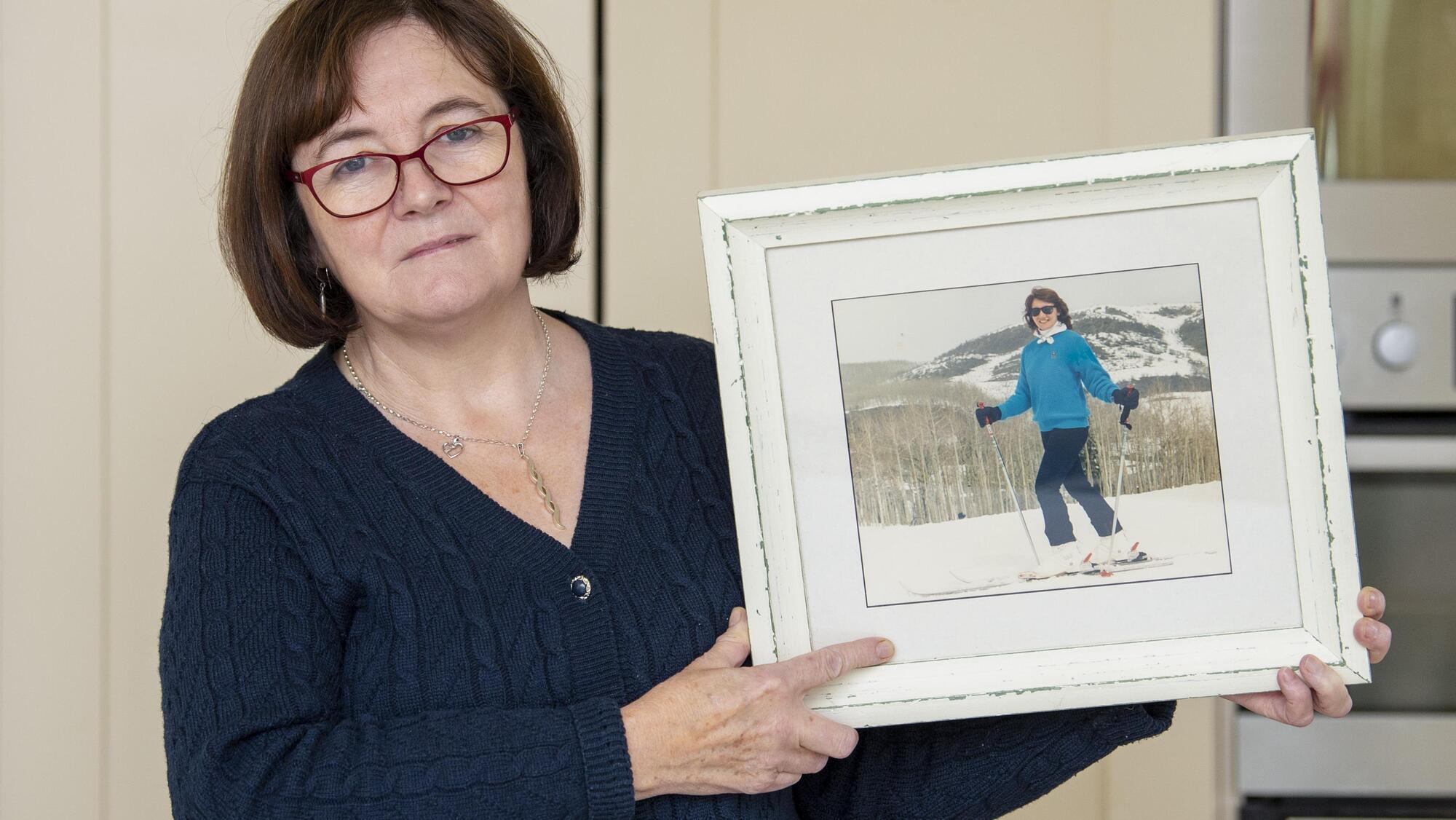
Claire Clarke holding a picture of her sister Priscilla who disappeared after going horse-riding with her employer Lynda Kavanagh in Wicklow in 1988.
The sister of a woman missing for almost 30 years says unidentified human remains should be stored in a central location, after it emerged that a skull found off the Dublin coast in 2006 has been lost.
Gardaí have confirmed that the whereabouts of the skull found off Lambay Island in fishing nets in February 2006 are unknown after it was brought back from Scotland where it had been used to develop a clay model of what the person would have looked like.
Read More
The revealed in September 2024 that the case was not included on the Government’s human remains database, despite being included on a US database and despite a garda investigation into the 2006 discovery remaining open.
The case has since been added to the database, and says that no details were “provided” in relation to where the remains are interred, if interred. Journalist Barry Cummins reported on RTÉ on Tuesday that the whereabouts of the skull are unknown.
HISTORY HUB
If you are interested in this article then no doubt you will enjoy exploring the various history collections and content in our history hub. Check it out HERE and happy reading
A garda statement said: “The location of the skull is presently unknown after it was returned by a third party. It was returned to a garda station not connected to the investigation. Balbriggan Garda Station remains in possession of a facial reconstruction model. A DNA analysis was previously carried out and the DNA profile exists.”
Claire Clarke’s sister Priscilla disappeared after going horse-riding with her employer Lynda Kavanagh in Wicklow in 1988. Ms Kavanagh’s body was recovered from the River Dargle two days later but Priscilla has never been found.
Ms Clarke said: “What strikes me about this is that there is a family somewhere getting up every day wondering if their loved one has been found. Even though this is not the full remains of someone, it is still very significant.”
“We don’t have a central location where remains are sent to, which we should have.”
She said people forget that even partial remains are a crucial piece of information.
"Even with the 9/11 remains, there was a building where every piece of human remains were brought and the smallest piece of DNA was tested for returning the remains to families."

She said there is a “lack of dignity” in how remains are currently handled in Ireland.
In relation to the skull, she said: “This is something that has no value for other people but for a family, it has.”
In its statement, An Garda Síochána said: “A thorough investigation was conducted which included the creation of a clay model head of what the person would have looked like when alive.
"A DNA profile was generated and a number of persons came forward and volunteered their DNA for comparison. Unfortunately, all DNA comparisons were negative and to date he has never been identified.
"In the course of a case review, Professor Caroline Wilkinson of Liverpool John Moores University generated an enhanced digital image of what the person may have looked like when alive. Investigating gardaí at Balbriggan subsequently issued a renewed appeal for assistance from the public in identifying the deceased from this new enhanced digital image.”
The case of the Lambay Island skull is listed on the US-based online Doe Network, which features unidentified remains from across the world, and includes the computer-generated image.
It notes that the man is estimated to have been between 25 and 45 years of age, possibly of North African origin. No reference is made to the man’s possible ethnicity on the Irish database.

CONNECT WITH US TODAY



Be the first to know the latest news and updates