'My son is gone and he is never coming back'
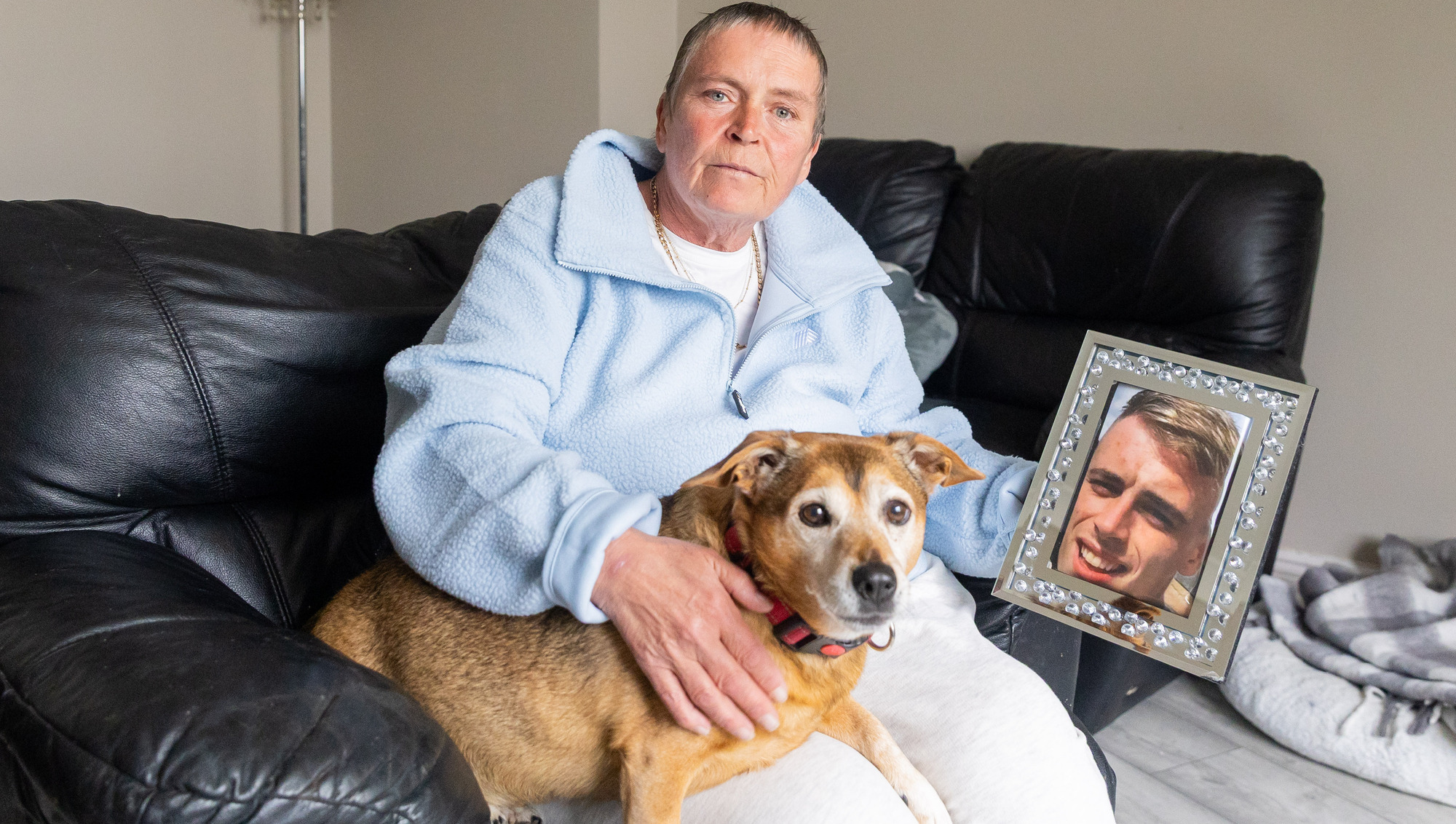
Rose Osborne with her dog Cesar and a photo of her son Glen at her home in Ballybough, Dublin. Picture: Gareth Chaney
Rose Osborne sat in court 16 of the High Court in Dublin, her eyes fixed on the young man who murdered her only child, Glen.
As she listened to legal arguments about whether his life sentence should be reconsidered, Rose was confronting a very different reality: She is living with stage four cancer.

In the years since Glen’s death, she has also buried her mother Rosaleen, her sister and best friend Catherine, her brother George, and her nephew David.
Loss has come in huge waves, each one compounding the last.
Yet she continues to show up to courtrooms, to hearings, to a justice process that, she says, forces her to relive the worst day of her life, again and again.
“I hate being here,” she said.
“But I have to for my son. It just leaves you feeling so anxious all the time. I didn’t sleep for three nights before the hearing."
There is no mistaking the depth of her anger, or her sense of betrayal, devastation, and hurt.
“I took him into my house, fed him, and washed his clothes,” she says of the young man who took her son’s life, who cannot be named because he was under the age of 18 at the time of the murder.
For three nights, the teenager, then just 16, slept in her home in Ballybough, north Dublin.
He ate with the family. He sat in their living room watching TV. He was Glen’s friend.
A few days later, on April 15, 2020, he murdered Glen, close to his home during a row, stabbing him in the heart with a knife he brought from his home.
"He took the only thing I ever loved and now he is bringing me back through it all again with this appeal, while I’m fighting for my life at the same time."

Across the courtroom, lawyers spoke of remorse, of youth, of the possibility of change.
They pointed to the killer’s age at the time and to legal developments that may now alter the sentence imposed in December 2020.
The young man is seeking to have that sentence reconsidered, following a Supreme Court ruling that life sentences for children should be reserved for exceptional circumstances.
The defendant’s barrister Mark Thompson argued that many of the factors warranting the imposition of a life sentence for a youth offender were not present in this case.
That included the absence of evidence of planned efforts to conceal guilt, and that the youth did not intend to kill his friend.
While the legal argument will be decided by the appeals court at a future date, Rose is forced to measure the passage of time in hearings and appeals and haunting memories, while her own time feels increasingly fragile.
For the heartbroken mother-of-one, those arguments exist in a different world, so far removed from the darkness she tries to shake every day and push through until bedtime, where she sometimes finds solace from her suffering, on the nights that she can actually fall asleep.
“He can stand in any court room as many times as he likes and his legal team can say what they want,” she says.
“But my son is gone and he is never coming back”.

What remains in Rose’s life is what she holds onto now, her grandson, Glen’s only child Zion, and the quiet, everyday determination to keep going for him.
Glen’s fiancée Lauren Cray gave birth to their only child Zion two months after his death, sadly without her partner by her side.
“He is so precious and he makes me very happy,” she says.
“He’s the reason I get up every day; I want to be strong for him. He lights up my life when he comes to visit”.
It is that resolve that brings her back into court, even as her own health battle intensifies.
Away from the legal world, life for Rose is measured in quieter, more personal rituals.
Inside her home, Glen’s presence is everywhere. His room upstairs is still kept, carefully tended to, not frozen in time but not let go either.
It is a space that sits somewhere between memory and now, just as she does. Rose’s own bedroom is a few feet away.
“I say goodnight to him every night,” she said.
Each morning, Rose steps outside and looks out at a tree that was decorated by her community for her son, and she says good morning to him.
It began with something small, she said, someone hanging a nightlight.
Then others followed.
Now the branches carry trinkets and ribbons, flowers, windchimes, dreamcatchers, and flashes of red tribute to Glen’s love of Liverpool FC.
Nearby, a wooden bench in Rose’s front garden carries a message that stops people in their tracks.
“Every time the robin is near, my dad is here.”

On the wall outside her home, Glen’s name is written in white and neatly screwed letter by letter to the wall.
Rose moves between these spaces gently, as if in conversation with him.
But memory is only part of what keeps her going, the rest is her grandson, and her beloved dog.
Now five years old, Zion is the light of her life.
“He’s the image of him,” she says.
Zion is not a replacement, nothing could be, but he is a continuation. A reason for Rose to get up every day.
The past year has tested her strength in ways few could imagine.
She has undergone gruelling treatment for cancer, but she brushes off any sympathy.
Her daily routines are important, walks to nearby Fairview Park with Caesar, Glen’s dog, at her side.
On this street, Rose, or ‘Rosie’, is known by everyone in her area.
People pass constantly and stop without hesitation.
“How are you, Rose?”
“You’re looking well.”
There are hugs, kisses on the cheek, quiet encouragement.
No one asks questions. They don’t need to, they all know. There is a deep respect for a woman who has endured more than most.
Friends say you would hear her laugh before you would see her. That it could carry down the road.
“If you can’t laugh, you’d be crying all the time” she said.
“I don’t want that, but don’t get me wrong, I do cry, and I do find it hard sometimes just to get up but I make myself."
Rose marked the sixth anniversary of Glen’s death recently, in the way she always does, with cakes, sweets, and a small gathering. Not a day of mourning, but of remembrance.
Glen’s memory has always been kept alive for Zion who is joined by his mother Lauren at every event.
“It’s about celebrating Glen. I have done it for the past six years and I will keep doing it."
And yet, even in those moments, the reality of what happened is never far away.
In April 2020, as the country adjusted to the early days of covid-19 restrictions, Glen Osborne was killed in Ballybough — just a few yards from his front door.

The court would later hear that a row escalated, and what followed was sudden, violent, and irreversible.
“He lay dying on that road over at Ballybough flats,” said Rose.
“He told his friend to tell me he loves me," she pauses for a moment.
“'Tell me ma I love her' he said."
Words that no doubt ring in her mind all the time.
In handing down his sentence, Justice Paul McDermott noted that the attack bore “hallmarks of immaturity and stupidity” rather than a meticulously planned killing but concluded that the gravity of the crime warranted a life sentence, with a review after 10 years.
At the Court of Appeal last month, his counsel, Mr Thompson, argued that he had shown remorse and entered an early guilty plea.
However, the court also heard evidence of more recent offences committed while in custody, including the sale of heroin and an assault on a female prison officer.
Detective Inspector Kenneth Hoare gave evidence of two convictions the defendant had received since he was jailed for murder.
He received a six-month prison sentence at Dublin District Court in May 2024 for having heroin with a value of approximately €280 for sale or supply within the prison on February 16, 2023.
He had also received a five-month prison sentence in January 2023 for assaulting a female prison officer at Mountjoy on April 19, 2022. The woman was kicked in the stomach and elbowed in the head, the court was told.
“He hasn’t learned his lesson,” said Rose.
“If I had heard he is studying and on his best behaviour as a prisoner I might have felt some sort of peace that there was some learning, but not when you hear he has been convicted of assaulting a female prison officer and drug dealing.
The betrayal still cuts deeply.
There is a growing conversation around forgiveness, about its power, its necessity and its role in healing.
Rose’s voice tightens as she speaks about forgiveness and she is clear that she does not subscribe to it.
“I’ll never forgive him. Never.”
For her, forgiveness is not something to aspire to and it is not something she believes would bring peace.
Some losses, she makes clear, do not allow for it.
“I had one child, a planned baby, and he was taken from me. We were best friends and now he is gone. But I want to live, and I want to be here for Zion. I love Zion and he loves me. He is a beautiful child."
And so, she continues as she is, between courtrooms and quiet mornings, between memory and survival, she is very close to her siblings, and her community rallies around her.
Rose wants to stay here for as long as she can, for Zion, for Glen and for her dog.
“I’m trying to stay strong,” she says.