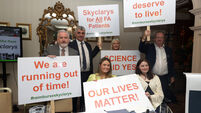
Public patients waiting up to two years for newly-approved medicines

Analysis by the Irish Pharmaceutical Healthcare Association shows for cancer medicines, the average wait last year between new medicine becoming available and use by the HSE was 651 days.
A "two-tier" health system means public patients including those with cancer are having to wait up to two years for newly-approved medicines to which private patients get swifter access, the Irish Pharmaceutical Healthcare Association (IPHA) has warned.
The HSE has however, defended its approach, saying it is obliged to assess new medicines robustly and “deliver improved value for money” across patientcare.
Analysis by the IPHA shows for cancer medicines, the average wait last year between new medicine becoming available and use by the HSE was 651 days.
The delay was longer for medicines targeting rare diseases — orphan drugs — at 759 days.
Across 23 medicines newly available to public patients last year, the IPHA said the average time involved was 729 days.
In some cases which required further evaluation by the National Centre for Pharmacoeconomics through a health technology assessment, the IPHA said the average time involved was over 1,000 days.
“While a robust clinical and economic evaluation is needed, the Irish reimbursement system can have approximately 20 to 30 separate steps, depending on the medicine concerned,” the IPHA said.
It said this can have a particular impact on patients whose care is through the public health system only.
"An increasing consequence of the lengthy timelines is that some private patients can avail of cancer treatments under health insurance, immediately on the granting of a licence by the European Commission.
"Public patients, typically wait two years after this point before accessing the same medicine,” it said.
IPHA president Michael O’Connell said it wants to see “a faster and fairer” process for medicines’ approval.
“Patients need the system to work better; they deserve fundamental reform of the process,” he said ahead of the annual IPHA conference.
Health Minister Stephen Donnelly last year set up a working group to look at the reimbursement system.
Mr O’Connell said IPHA has provided information to that group.
He welcomed recent allocations of €20m in funding for new medicines and a commitment to find a further €10m through efficiency savings.
However, the HSE said it has a statutory obligation to have “robust assessment and commercial processes” in place for any new medicines.
It said if the first-proposed costs of new medicines approved last year had been accepted the bill would have “exceeded €400m over five years”.
Following assessment, the costs are “expected to exceed €200m over five years” instead.
“The intent of those processes is to provide access to as many new medicines or new uses of existing medicines as is possible from the budgets provided to the HSE whilst also providing assurance that the HSE is using the resources provided to it as efficiently as possible,” a spokeswoman said.
“The processes also challenge inappropriate costings from applicant companies and deliver improved value for money around new medicines.
"HSE decisions on which medicines are reimbursed by the taxpayer are made on objective, scientific, and economic grounds.”
Last year, the HSE approved 15 new medicines and 21 new uses of existing medicines, she said.
These are for a range of illnesses including cancer, heart failure, and rare diseases.
Last month, seven new drugs were approved for osteoporosis, antimicrobial-resistant infections, and several types of cancers.
CONNECT WITH US TODAY



Be the first to know the latest news and updates