Arlene Foster says Northern Ireland Protocol cannot work and must be replaced
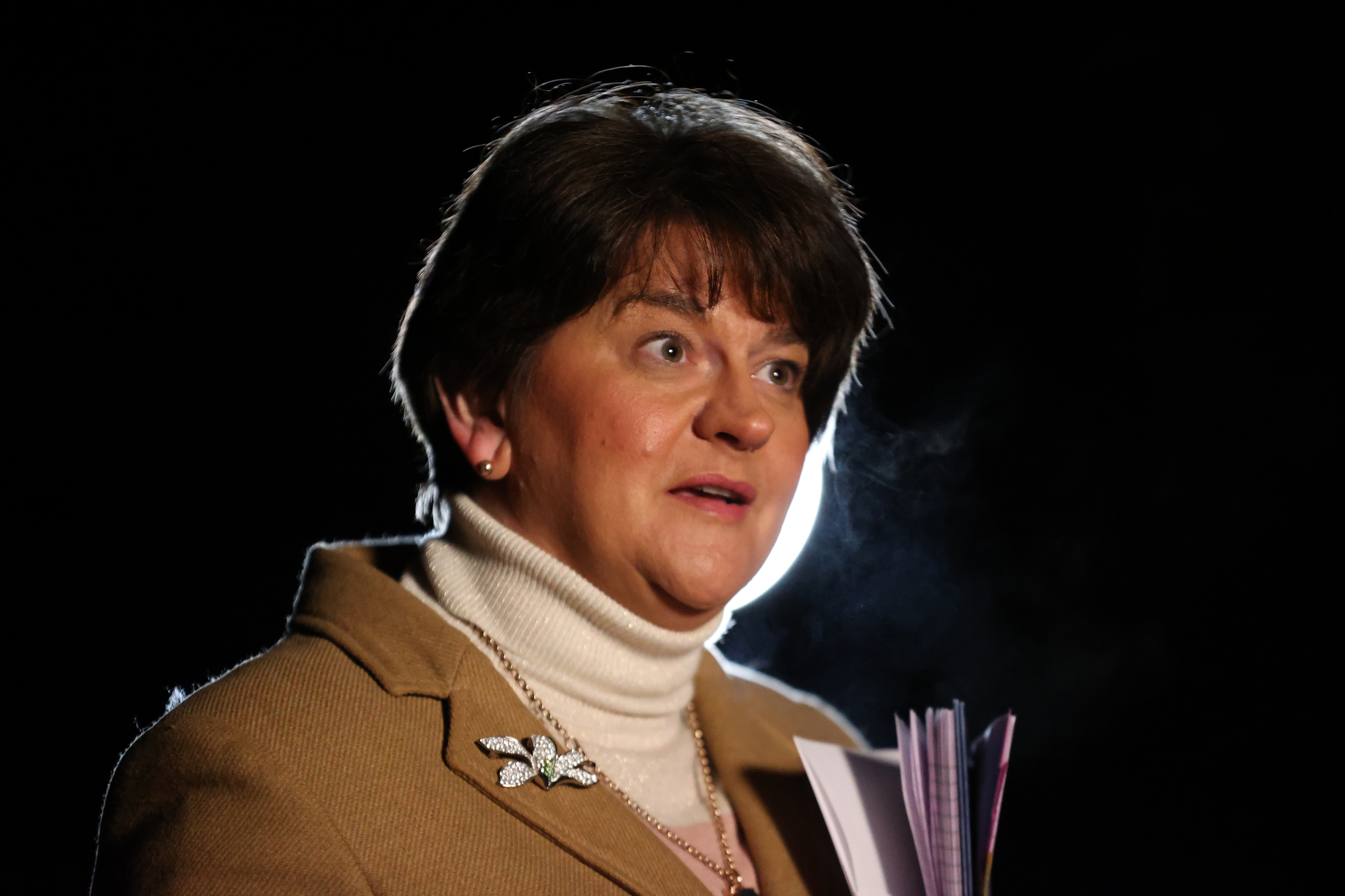
First Minister Arlene Foster has said the Northern Ireland Protocol âcannot workâ (Liam McBurney/PA)
Brexitâs contentious Northern Ireland Protocol âcannot workâ, and must be replaced, First Minister Arlene Foster has said.
Writing in Thursdayâs Daily Telegraph, Mrs Foster said the Prime Minister had committed to protecting the UK internal market by all legislative means necessary, including triggering Article 16 and that he âmust now back up those words with tangible actionsâ.
The DUP leader is quoted as saying: âThe Northern Ireland Protocol has not worked, cannot work and in light of our proposals to the Government, needs to be replaced.â
She warned that simply extending grace periods for businesses could not solve the âwholly disproportionateâ checks implemented since the withdrawal of the UK from the EU, and that the regionâs âpolitical and economic linksâ to the UK were at risk.
Mrs Foster made the remarks following crunch talks on the protocol between Northern Irelandâs leaders and the UK and EU.
Cabinet Office Minister Michael Gove and European Commission vice president Maros Sefcovic held a virtual meeting with Mrs Foster and Deputy First Minister Michelle OâNeill on Wednesday evening.
Physical inspections on goods entering Northern Ireland from Great Britain, which are required under the protocol, have been suspended amid threats and intimidation of staff.
Police have insisted there is no evidence that loyalist paramilitaries are involved in the sinister campaign, instead blaming disgruntled individuals and small groups.
Speaking after the meeting the DUPâs Jeffrey Donaldson said the protocol was damaging the relationship between Britain and Northern Ireland and that permanent solutions were needed to ensure the region has âunfettered accessâ to the UK market.
Mr Donaldson described the trade difficulties as not just short term, but long term.
âThatâs why we need not just a short-term fix or tinkering around the edges of this or kicking the can down the road,â he told RTE News.
âWe need a permanent solution that will ensure that we continue to have unfettered access to the UK market and that the EU is able to protect its market, and we need that accommodation reached as soon as possible.
Mr Donaldson said the Irish Government needed to recognise that the union has to be preserved as well as protecting the EU single market.
âIf weâre going to see the East-West, Great Britain-Northern Ireland relationship diminished then we canât be expected to see a situation where there are normal North-South relationships because the two are inter-twined â one impacts on the other,â he said.
âTherefore we need the Irish Government to recognise that it is the totality of the relationships here including the crucial relationship between Northern Ireland and the rest of the UK that has to be preserved and protected as well as protecting the EU single market.â
Sinn Feinâs Deputy First Minister Michelle OâNeill said the EU Commission vice-president was âvery forthrightâ and pressed the point that the protocol needed to be implemented âin its entiretyâ.
âHe said the EU expects rigorous implementation of the protocol,â she said.
Ms OâNeill called for calm heads and leadership from all quarters at the meeting.
Ms OâNeill said the vice president of the commission was âemphaticâ that there was no intention by the EU to cause difficulty when it moved to suspend part of the Northern Ireland Protocol last week.
âHe put his hands up and said they had made a mistake and that they moved to rectify that mistake very quickly,â she said.
Ms OâNeill said Mr Sefcovic apologised on behalf of the commission and asked the leaders to judge the EU on its track record in terms of its support for the peace process both financially and politically.
âHe was very gracious in his apology around that and recognised that it caused some tensions,â she said.
âI accept that apology in the way in which it was intended,â she added.
The European Commission was forced to backtrack on a threat to suspend part of the protocol on Friday but the episode angered loyalists and unionists and emboldened them to press their demands for an end to the protocol.
Ms OâNeill also said Mr Sefcovic was focused on finding solutions.
She said: âThere are flexibilities inbuilt [in the protocol] which he thinks havenât even had a chance to work out yet.â
Ms OâNeill welcomed his commitment to travel to the UK to find ways to resolve the issues that have emerged, adding that she believed it was a âvery pragmatic and very constructive wayâ to move forward.
The EU Commission vice president is to travel to London for further talks on the matter next week.
Mr Sefcovic said if all aspects of the Northern Ireland Protocol were put into practice he believed the issues raised at the meeting could be resolved.
Earlier the DUP rejected claims it is whipping up tensions over Irish Sea trade in an effort to get the protocol ditched.
Mrs Foster said it was âabsolutely ridiculousâ to suggest her party was inflating concerns around trade disruption to pursue a political objective.
On Tuesday, the DUP announced a series of political moves aimed at frustrating the operation of the protocol amid mounting unionist and loyalist concerns that Northern Irelandâs place within the UK is being undermined.
Its strategy includes opposing any protocol-related legislation at the Stormont Assembly and refusing to participate in any exchanges with the Irish Government related to the operation of the protocol.
Ms OâNeill has accused the DUP of reckless behaviour, claiming political unionism was trying to whip up âtension and fearâ.
Mrs Foster and senior DUP colleagues had a separate virtual call with Prime Minister Boris Johnson on Wednesday ahead of the engagement with Mr Gove and Mr Sefcovic.
Mr Gove and Mr Sefcovic chair the UK/EU Joint Committee tasked with implementation of the protocol.
The protocol is a mechanism agreed by the UK and EU as part of the withdrawal talks to ensure a free-flowing Irish border.
Unionists and loyalists are deeply unhappy with the new arrangements, which came into force on December 31, believing the protocol has created a barrier between the region and the rest of the UK.