Major overhaul proposed as GAA seeks to streamline development structures and tackle player drop-off
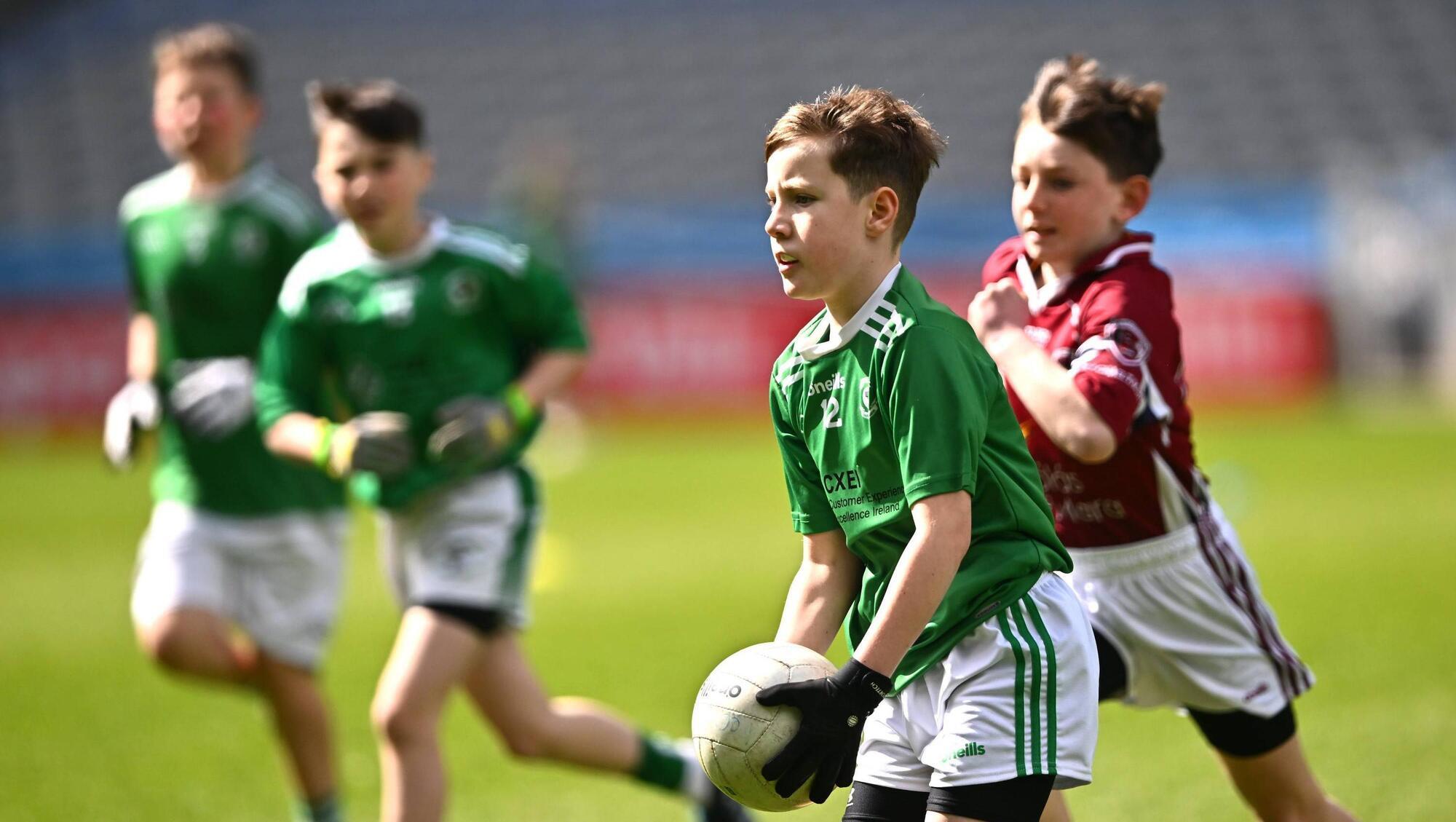
Action between An Ghaeltacht, Port Láirge, and Naomh Muire, Dún na nGall, during the Go Games at Croke Park in Dublin. Pic: Piaras Ó Mídheach/Sportsfile
A review aimed at making transformative changes to the GAA’s games development sector will be presented to Central Council next week.
The report recommends a streamlining of structures at national, provincial and county level, staffing reviews and a new funding mechanism to address “a participation crisis” in adolescence and “a volunteer crisis”.
“Games Development – Cohesion, Clarity and Consistency”, produced by a workgroup led by national games development chairman Micheál Martin, makes some frank acknowledgements.
“While Games Development continues to deliver strong participation at child level – particularly through Go Games – significant structural challenges remain,” it reads. “These include weak alignment between national strategy and local delivery, inconsistent governance standards, duplication of roles, and limited systems for measuring impact and learning from experience.
“Despite Games Development being widely recognised as central to the future of the Association, it is often marginalised within national structures and insufficiently supported through coordinated leadership and cross-departmental ownership.
“While financial resources exist, fragmented decision-making, unclear accountability and weak communication have reduced the overall effectiveness of investment and, in some cases, limited value for money.
“At the same time, the growing reliance on staff – intended to support volunteers – has in many instances accelerated volunteer withdrawal rather than strengthened volunteer leadership. This raises fundamental questions about whether the current system can genuinely be described as volunteer-led.”
The report has been produced to coincide with the conclusion of a four-year funding cycle at the end of this month. In 2025, outside of projects the GAA’s central spend on coaching and games was €12.965m, €2.39m of which came from the Government and their contribution increases to €3.2m this year.
It is envisaged the central games development expenditure will rise to €13.1m by 2030 with an innovation fund set up for counties who identify special projects like those in urban area or hurling.
Earlier this week, former Wexford chairman Martin met with Minister of State at the Department of Culture, Communications and Sport Charlie McConalogue. Improving Government funding is an objective of the report. “We're by a long way the biggest investors in grassroots sports, really,” remarks Martin.
Read More
“The scale of it is probably overlooked sometimes. It’s not being critical but that is not primarily government-funded. The level of government support to FAI and League of Ireland academies is far greater.
“We made our case on Tuesday. What we are saying is that while we've increased the investment and propose to continue that commitment, we're really looking at driving change and accountability in relation to what we're investing ourselves.”
The use of digital team-sheets will be a key factor in determining just how many players they are in each county and therefore adjusting funding accordingly. “It will be a great help in measuring participation as well as the load that is on players,” says Martin.
Drop-off in the mid to late teens remains a major concern for the GAA. The report highlights that it is “intensified by competitive structures, academy pressures, and scheduling conflicts”.
Development squads are a bugbear for some, a Godsend for others. Martin sees both arguments and a review of how they operate will take place early in 2027.
“We do recognise there's a lot of good work actually takes place in talent academies, but we need to be absolutely clear about their purpose and the experience that we want those players in that bracket to have.
“The question isn’t whether we should or shouldn’t have them. The question is are they developmentally appropriate? What are they intended to achieve? The purpose of a development squad was never that they should not play with their club.
“There is no such thing as an U14 county team. We see clubs on social media congratulating youngsters for being selected. It’s not selection, it’s an opportunity for them to develop. I think it was Des Ryan, who’s part of our group, that said it’s not a prediction of future success.
“We’ve had a look at the likes of Clare in a hurling context and an awful lot of what they’re doing is really excellent. A huge amount of 14-year-olds are being upskilled and kept in the system.
“We often hear from our units about what other sports are doing but that shouldn’t influence our approach. Talent academies should complement clubs and schools not compete with them.” Adaptability to the country’s extensive demographical changes is also important for the workgroup. There are plans to expand the use of full-sized mobile goalposts to cater for smaller number games.
“If you’re playing U16 football in south Kerry, there might be a need to shorten the pitch because of numbers,” says Martin. “Those 15 and 16-year-olds don't want to be playing with U12 goalposts on the 21s. If we could have adult-sized goalposts for 11 or 12-a-side games, it would be preferable. They’ve already been rolled out in Connacht and Longford where there are demographic challenges.”
Reporting and performance oversight are also big-ticket items for the workgroup. “The goal is clarity of purpose, everyone working together rather than in silos, which is natural in an organisation this size,” accepts Martin. “But we want to try and reduce that.
“Finding a consistency in our expectations and standards doesn't mean that we expect every county to be the same because we know we have 32 very different units from dual counties to those who are focused on one code.
“Gaelic games are sustained in the clubs and communities by the volunteers and they are now under more time pressure than ever before. I think Covid probably gave people a sense that their time is valuable. Volunteers shouldn't exist to sustain our structures or programmes; it should be the other way around.”

Check out the entire podcast series HERE as, and when, they are published.
CONNECT WITH US TODAY



Be the first to know the latest news and updates