‘Incredible to see Mosul coming back to life’, says Cork photographer
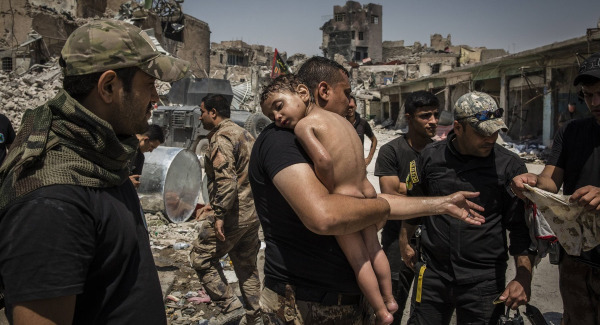
Last month Ivor Pickett took first prize in the news photographer category at the 2018 World Press Photographers of the Year contest for his New York Times series ‘Battle for Mosul’.
The fight to drive IS out of Mosul left 600,000 of the population of three million displaced and much of the old part of the city in ruins but Cork-born Mr Pickett has just returned there and says he is heartened by the resilience of the people.
This time round he will bear witness to efforts to rebuild the city and to record parliamentary elections in Iraq on Saturday.
“It is quite incredible to see the country and Mosul, in particular, coming back to life,” he told Ryan Tubridy on RTÉ radio.
Based in the Middle East since 2009, Ivor documented the Arab Spring uprisings in Egypt and Libya as well as the Syrian refugee crisis before travelling to Mosul in October 2016 as Iraqi troops began a major offensive to re-take the city which had been under IS control since 2014. It took them more than a year.

“The Iraqi government announced the official defeat of ISIS in December and the country is trying to get back on its feet after the most difficult urban combats since World War II.
"There are huge obstacles in the wake of that yet to be overcome but I am back here since yesterday for the first time in a couple of months and every time you come back it’s bustling that little bit more.”
It is a far cry from his time embedded with Iraqi counter-terrorism forces who were spearheading the operation to defeat IS in Mosul throughout 2016 and 2017.
“I made multiple trips working for The New York Times. It was incredibly dangerous. ISIS were pioneering ways of fighting we had never seen before. The use of commercial drones that they had weaponised to both drop ordnance and to guide suicide car bombers.”
Through it all, he sought to record the toll the fighting was taking on civilians, photographing lines of people queueing for food and capturing the despair of a local woman sitting in the middle of what was once a road as she watched the bodies of her sister and niece being dug from the ruins of her house.

“The focus of a lot of my work was the fact that there were hundreds of thousands of civilians stuck in Mosul when this was going on.”
One of Mr Pickett’s prizewinning photos was of a boy who had survived the siege of the last IS-controlled area in the Old City of Mosul.
“That was towards the end of the battle for Mosul last summer, in July 2017. This young boy was carried by a soldier.
"He had been carried across the front line by a man who was suspected of being an ISIS fighter who had picked up the boy to use as a human shield so the soldiers wouldn’t shoot at him.
“They did not know anything about him. He was probably about two or three years old. He didn’t speak because he was so young and traumatised.

"He was one of the last children I saw coming out of that area that was being destroyed. Most people in there were ultimately killed.”
What happened next was incredible, said Mr Pickett.
“The soldiers took the boy and cared for him. After they washed him and his tattered clothing. He closed his eyes and rested his head on the soldier’s shoulder. That’s when I took the picture.
“It was an incredible moment to witness and to watch these battle-hardened men put down their weapons for a second to care for this young boy. It was as if he had made them forget what they were still going through.
"He became a symbol for me of the cost the battle had taken on the civilians of Mosul.”