Ideals and courage of Cork Volunteers recalled at 1916 commemoration
Unlike Easter Monday 1916, when rain covered the city, the sun shone brightly as hundreds of civic, political, and military guests attended the state commemoration at the National Monument.
Mayor of County Cork John Paul O’Shea said that for many people in 1916, Ireland was a country worth dying for.
“The aspirations of those who went before us live through us, and through our actions we owe it to ourselves as Irish people, and here today as Cork people, to ensure that the lives we live and the actions we take, are done with honesty, integrity, and inclusivity in mind,” he said.
“The Proclamation is many things but one thing I take very strongly from it is the call for togetherness. Together we are gathered here today to commemorate the Easter Rising and 1916, and together we will walk the path of Ireland’s future. Let us never forget our way.”
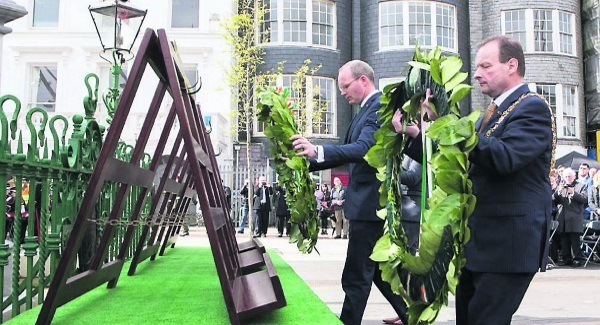
The Proclamation was later read to the assembled guests by Lt Cian Clancy, before wreaths were laid at the National Monument by Mr O’Shea, Lord Mayor of Cork City Chris O’Leary, and Defence Minister Simon Coveney. Following a minute’s silence and the Last Post by buglers of the Army 1st Brigade Band, Lt Diarmuid Barry raised the National Flag.
As threatened showers held off and as the band struck up Ámhrán na bhFiann, four Air Corps Cessna 172H aircraft flew over, impressing the guests and thousands more who watched proceedings on big screens further along Grand Parade.
Earlier, Mr O’Leary reminded those who gathered that, while the men and women who bore arms are rightly regarded as heroes and heroines, they were no different to Irish people today. For, as well as being mothers and fathers, sons and daughters, loving sports, or being poets and writers, he said, it was a love of their country that drove them to sacrifice all that was beautiful in their lives for Irish freedom.
“An abiding patriotism that could not rest until the country that they loved was in charge of its own future. It’s true that these extraordinary people were no different from us except perhaps in that one respect,” said the lord mayor.
Cork did not take part in the 1916 Rising despite more than 1,000 Irish Volunteers mobilising around the county on Easter Sunday, largely due to confused orders from Dublin around that weekend in 1916.
But, said Mr O’Leary, it was reasonable to suggest a strong connection between the so-called failure of the Volunteers to engage in armed conflict that week, and Cork’s central role in the military campaign against British rule during the War of Independence.
For regular updates on news and features (as well as twitter action action as it may have happened 100 years ago) to mark the revolutionary period follow @theirishrev HERE
He acknowledged the presence of the relatives of his predecessors as lord mayor of Cork — Tomás MacCurtain and Terence MacSwiney, who both died in 1920 while holding that office —among others who he said were patriots whose bravery carved a new and proud nation. Others who died or who took part in the conflict, including the Kent brothers, Richard and Thomas (killed fleeing police and executed, respectively, in May 1916), Seán Hurley from Drinagh who died in Dublin during the Rising, and Diarmuid Lynch from Tracton who helped organise the Rising, were also represented by family members.
Mr Coveney said it was an occasion to remember the courage and vision of a generation filled with idealism, whose self-sacrifice and determination helped to create a free Ireland.
“We are rightly remembering all of those who fought, and many of whom died, for Irish freedom in 1916. But while we commemorate them, we are mindful that the Rising also resulted in the deaths of many British army and police personnel, many of whom were Irish too, and that the majority of those who died during the conflict were civilians, children,” he said.
While this weekend and the whole year have been about reflecting on events of 1916, he said, the centenary year should not be remembered for commemorating conflict alone, but rather a year in which we embrace the meaning of the word freedom and what it means to be in control of our own destiny.
“I am reminded that we now live in a country that 100 years ago, while we had revolution on our streets... we now have the longest unbroken service in international peacekeeping of any country in the world,” the minister said.
“We have seen 64,000 tours of duty protecting people in other parts of the world that need protection, that need our professionalism and courage and idealism and standards, and that reminds me of the extraordinary journey that this country has taken.”
The wreaths were laid at 1.15pm — the time the first shots of the Rising are believed to have been fired on Easter Monday a century ago — and at the same time as similar ceremonies in Dublin, and other locations.
In Ashbourne, Co Meath, where eight members of the Royal Irish Constabulary and two Volunteers of the Fingal Battalion died, the battle was re-enacted.
The ceremony in Enniscorthy commemorated events there 100 years ago, when Irish Volunteers seized the town a few days after the Rising began in Dublin, occupying the Athenaeum building and only surrendering when word came from the capital do to so.