Court quashes Anglo executives’ convictions
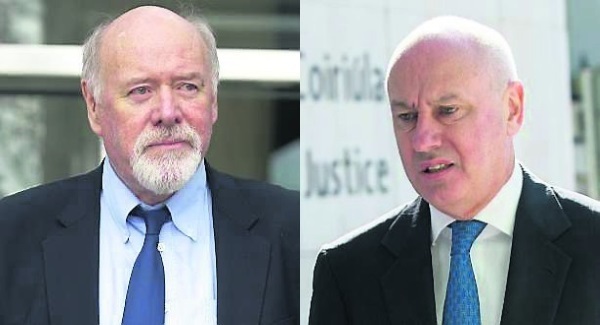
Tiarnan O’Mahoney, aged 56, of Glen Pines, Enniskerry, Co Wicklow, and Bernard Daly, aged 67, of Collins Avenue, Whitehall, Dublin, had denied knowingly furnishing false information and conspiring to defraud the Revenue as well as conspiring to have accounts deleted from the bank’s internal system.
Having been found guilty by a jury at Dublin Circuit Criminal Court, Judge Patrick McCartan jailed O’Mahoney for three years and Daly for two years on July 31, 2015.
The Court of Appeal quashed these convictions yesterday on a number of grounds.
Giving judgment, Mr Justice George Birmingham said they “should not have had to stand trial” on the charge of furnishing false information because the proceedings were not commenced within the 10-year time limit.
The decision to reformulate the charges after they were formally charged was made because the prosecution found there would be a complete defence to the charge presented originally, the judge said.
Because of the reformulation, the proceedings for which Mr Daly and Mr O’Mahoney stood trial were not commenced within the 10-year limit, the judge said.
In addition, the charges originally proffered alleged that, as officers of the company, they consented to the commission of the offence but the offences on which they stood trial saw them charged as principles, the judge said.
They successfully contended that a substantial number of documents were wrongly admitted in evidence.
Mr Justice Birmingham said the documents, which the trial judge ruled admissible, were “vital to the prosecution case”. These documents allowed the witness — a fraud investigator within Anglo, Patrick Peake — to trace for the jury and to explain and illustrate the means by which Anglo accounts were opened, kept, how ownership was designated, how funds were sourced and moved between different accounts, and how the names of different accounts were changed or re-designated at various times.
In circumstances where crucial documentary evidence was admitted in breach of the hearsay rule, Mr Justice Birmingham said they could uphold this ground of appeal.
Furthermore, the court held that the conspiracy counts as alleged against Mr Daly ought to have been withdrawn from the jury.
Seán Guerin, for Mr Daly, said the prosecution case against his client rested “almost entirely” on the bank’s former head of compliance, Brian Gillespie.
The evidence available to the prosecution was thin, tenuous, and, in those circumstances, the court feels that “notwithstanding the level of suspicion that existed”, it would have been appropriate to withdraw the conspiracy case against Mr Daly from the jury.
Mr Justice Birmingham said the conclusions reached by the court meant their convictions “must be quashed”.
The question of a retrial did not arise for Mr Daly because, the court concluded, there was insufficient evidence to go before the jury.
Mr O’Mahoney’s position is different. His “omnibus” ground of appeal concerning multiple complaints related to the trial in summer 2015 and did not affect questions of a retrial, the judge said.
Mr O’Mahoney was released on bail until April 14, when the court will hear submissions on whether he should face a retrial.