VIDEO: This Cork woman is fighting for her life — and for a home
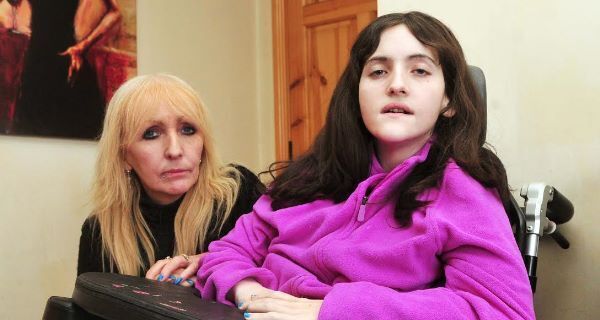
The King of Pop had just played Cork when Barbara Mulhare’s daughter was born on August 1, 1988.
While the city was still buzzing in the aftermath of two sizzling Michael Jackson performances, Barbara was in the more sombre surroundings of a maternity hospital dealing with a very premature child.
Elizabeth, her first baby, had arrived at just 25 weeks’ gestation.
“She weighed 2lbs 5oz and dropped down to 1lb 5oz. Her nickname around the northside was ‘Little Lizzy’ and everyone was praying for her,” Barbara says.

To add to the complications, Elizabeth subsequently suffered an intracerebral bleed, Barbara says, and the tragic upshot was cerebral palsy.
Elizabeth’s lifelong doctor, Noel O’Regan, of Meadow Park Surgery, Ballyvolane, says that as the little girl grew and developed, she “never achieved any physical independence and has always been dependent on her mother for 100% of all her life functions”.
“Elizabeth survived physically because of the dedication of her mother, Barbara, to her complete care,” Dr O’Regan says, adding that she is “completely happy and content in her mother’s care and this is the ideal situation for this family”.

However, Elizabeth’s housing situation is far from ideal. Throughout her 26 years, she and her mother have moved from pillar to post more times than either would care to remember.
They’ve availed of local authority housing in both Cork city and county, they’ve stayed in private rented accommodation both with and without rent allowance, and even, on occasion, homeless shelters. There were a few nights in Rathcormac when Barbara she slept in a car because of a rodent infestation.
Fortunately, Elizabeth was in a respite home at the time.
Elizabeth has a folder labelled ‘My Dream Home’ put together with the help of a therapist. It is a house beyond many of our expectations, based on cutouts from glossy magazines.
There was a time, though, when she believed they had landed their dream home.
They had been renting in the Ballyvolane area of the city — near their GP — and Barbara says she thought “all my dreams had come true” when the city council gave them a house in Meadow Park.
“It was the nicest house in the area,” she says. “It looked like a showhouse. We were delighted, thrilled. I felt we could leave all [of the uncertainty of previous house moves] behind us.”

Barbara claims to have been repeatedly assured over the years that the council would provide a house suitably adapted to meet her daughter’s needs and she was hopeful the Meadow Park home would do that.
She was happy to accept it, she says. She wanted to be near their GP in Ballyvolane, but says she had no input into the selection of the house they were given.
Barbara claims that while the house “looked fantastic”, “big underlying problems” began to surface before long.
She says the gradient in the drive was too steep for a wheelchair and that attempts by the council to rectify it didn’t resolve the issue. She says a bathroom and shower built on to the main house for Elizabeth didn’t meet the dimensions for someone in a wheelchair and that she ended up “sending Elizabeth away to be washed” in respite care.
Barbara says the house flooded during a major storm and that the fire chief who arrived said it was too dangerous to live in. She says there were ongoing problems with the sewerage system. In the end, she left the house.
“I very reluctantly had to get out of there for Elizabeth’s health,” she says.
That was 2007.

There have been many moves since. Barbara claims there were occasions when she had to sell her possessions to pay rent. She moved to Rathcormac.
“Elizabeth was still being sent away to be washed,” she says.
After Rathcormac there was a house in Glanmire, but the rent was too expensive.
Barbara says she had been advised, while in Rathcormac, to put her name down for a house in Fermoy. She enlisted the help of some local representatives, mentioning Independent senator Paul Bradford and Labour Party TD Seán Sherlock.
She rented in Clondulane, Fermoy, for a while and says it was wheelchair-accessible “to a degree” but that “there were heating problems”. She says their rent allowance was reduced.
She moved to Rathcormac again. There were more problems with rodents. She says that, at one point, she was “given the number for Edel House”.
She borrowed money from friends for rent.
Barbara had problems being housed by the county council, she says, because she had never been given a letter of surrender for the city council property in Ballyvolane. She says that, after many requests, she finally got one in August 2010.
The letter says the house was returned to the council “by peaceable possession”. She says that letter meant she could now go on the county council waiting list.
Today, Barbara and Elizabeth live in a small semi-detached bungalow at Lios Oir, Pyke Rd, Fermoy, supplied by the county council. It’s inoffensive from the outside and while the drive may not pose a problem to an ablebodied person, for Elizabeth, the slope and slightly uneven surface make it difficult to manoeuvre her into a car.
Inside, the doors just about accommodate a wheelchair — except for the back door — and fungal spores are evident on the walls. Dr O’Regan, who has visited the house, says the spores increase the risk to Elizabeth of allergic airways disease and asthma.
“Her mother is terrified she will get pneumonia,” he says.

In fact, Elizabeth’s health has deteriorated significantly in the past few years, Barbara says — her daughter has had repeated respiratory infections and is now on a nebuliser.
Having not been hospitalised for 11 years, she has found herself in hospital about three times a year since their move to Fermoy.
Her weight has dropped from 13 stone to seven since she underwent major bowel surgery in January 2014. That surgery resulted in her having a colostomy bag fitted, which Barbara says necessitates regular trips to the stoma clinic at Cork University Hospital, a 90km round trip.
Round trips to their GP in Ballyvolane are about 80km. Barbara had the front seat in her own car converted into a makeshift swivel seat so that Elizabeth could be lowered in, but the wheelchair won’t fit in the boot.
They depend on taxis, she says, which can cost €100 for a round trip to CUH.
The day I visit, a towel is sitting in a pool of water in the hall. On a second visit, the situation has not changed. Barbara says there are leaks and points to cracks in the ceiling.
She shows me Elizabeth’s bedroom, where her bed is accessible from one side only.
The room is small, too small to facilitate easy use of the manually operated hoist, but Barbara claims she had to switch her daughter out of a bigger bedroom which has a large exterior wall and was constantly damp.
Elizabeth, a shadow of the girl she used to be judging from old photos, says very little during the visit except to ask me if I think she will get a new home.

Her GP is furious that Elizabeth had never been given a home fully adapted to her needs.
“It’s something that makes me very angry,” says Dr O’Regan. “She hasn’t got a fair crack of the whip. She is a severely disabled young person with many and complex needs. What she needs is a house designed by a team of experts.”
Dr O’Regan concedes that while they “have been given some good houses along the way, none has been adequate to meet her needs”.
“To date, she had never been given accommodation to suit her basic human needs.”
Almost a year ago, a public health nurse wrote to the HSE asking that there be an urgent review of her accommodation or that she be provided with suitable housing.
Barbara says an occupational therapist visited towards the end of last year to carry out an assessment on behalf of the county council and recommended that either the existing property be adapted or that Elizabeth be rehoused closer to the city, nearer to her GP.
According to Barbara, the therapist noted the mould on the walls and the dampness; the inappropriately small size of Elizabeth’s bedroom; the marks on the doors from her manual wheelchair; and the fact that her wheelchair will not fit through the back door, thus preventing her using the back garden.
But still, they remain in the house on Pyke Rd.

Dr O’Regan said the ideal care situation for Elizabeth going forward is a “family unit intact with assistance from all of the relevant agencies”.
These include “GP and specialist services [when required], education, publichealth nursing, social work, occupational therapy, local housing authority, and access to respite services, when required”.
“While the city and county councils have placed this at-risk family in housing down through the years, and Mrs Barbara Mulhare has provided private accommodation with rent allowance, the fact remains that no suitable unit has ever been provided,” Dr O’Regan says.
In his opinion, suitable housing equates to “a residence in a suitable location, near to all services, close to the GP of choice and hospitals, shops, church, [and] local health centres”.
“It should ideally be designed by an architect [with an interest or qualification in the needs of a disabled adult] in full collaboration with the occupational therapy services, taking all of the needs that a severely physically disabled adult requires for basic human living,” Dr O’Regan says.
When the Irish Examiner contacted Cork County Council to ask why Elizabeth had been housed in a home not fully adapted to her needs, we received the following response: “The council is aware of issues relating to the condition of the property at 4 Lisore, Pike Rd, Fermoy, and is working closely with representatives of the tenant with a view to resolving the issues in a timely and satisfactory manner.”
Barbara and Elizabeth have been living in the property for close to four years.
“She had never been given accommodation to suit her basic human needs.”