Comet the hour as Rosetta phones home
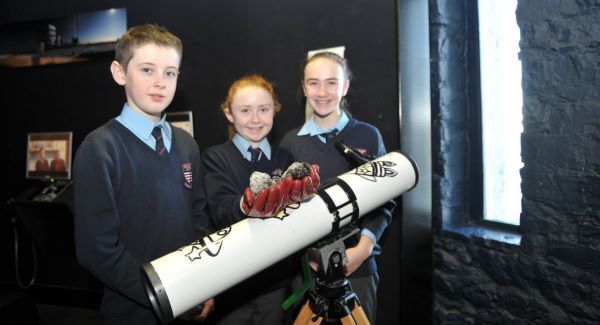
Students from St Lachteen’s NS in Donoughmore, Co Cork, were among several schools at CIT’s Blackrock Castle Observatory in Cork as part of an EU-wide public science event to mark the wake-up of the European Space Agency’s Rosetta spacecraft which is hurtling towards Jupiter.
They joined children in Greece and Portugal on a live weblink with engineers working on Rosetta, before making their own mini- comets with dry ice and dirt.
Rosetta technical manager Koen Geurts told the webcast, hosted from the US by astronomer Pamela Gay, that the mission — named after the Rosetta Stone — will help answer the big questions like how comets may have helped life form on Earth.
“The Rosetta Stone was the key to deciphering Egypt’s hieroglyphs,” Geurts said.
“And what we hope from the Rosetta mission is that it will be the key to deciphering comets, and how water and life existed on Earth.”
Rosetta, about the size of a people carrier, was launched from Europe’s spaceport at Kourou, in French Guiana, on Mar 2, 2004, but was put into deep-space hibernation almost three years ago.
It was close to Jupiter’s orbit yesterday as it prepares to line up to intercept the enigmatic comet 67P/ Churyumov–Gerasimenko.
Scientists around the world watched anxiously from early yesterday as Rosetta’s internal alarm clock went off at 10am Irish time.
It took the spacecraft about seven hours to warm up its star tracking navigation gear, fire up rocket thrusters to slow its spin, turn on its transmitter, and beam a message back to Earth.
Its radio transmissions, travelling at the speed of light, took 45 minutes to reach listening stations in California and Australia.
The signal was received at Nasa’s Goldstone ground station in California at 6.18pm Irish time during the first window of opportunity the spacecraft had to communicate with Earth.
It was immediately confirmed in ESA’s space operations centre in Darmstadt and the successful wake-up announced via the @ESA_Rosetta twitter account, which tweeted: “Hello, World!”
“We have our comet- chaser back,” said Alvaro Giménez, ESA’s director of science and robotic exploration.
“With Rosetta, we will take comet exploration to a new level. This incredible mission continues our history of ‘firsts’ at comets, building on the technological and scientific achievements of our first deep space mission Giotto, which returned the first close-up images of a comet nucleus as it flew past Halley in 1986.”
Fred Jansen, ESA’s Rosetta mission manager, said: “This was one alarm clock not to hit snooze on, and after a tense day we are absolutely delighted to have our spacecraft awake and back online.”
The spacecraft, which carries a 2,100kg lander called Philae, is due to reach the 4km-diameter comet in August.
Rosetta will enter the comet’s orbit and scan its surface to identify a suitable landing site for Philae.
The lander will be deployed in November and will fire harpoons in to the comet to anchor itself to the surface.
Scientists hope to conduct organic chemistry experiments on samples drilled by Philae’s probes into the comet’s body.
Two Irish firms worked on mission-critical hardware and software.
Captec, a company based in Malahide, Co Dublin, worked on the software that helps Rosetta communicate with the lander. And Space Technology Ireland at NUI Maynooth built hardware to deal with data being returned by the lander.
Europe has spent about €1bn on the mission, which is due to run at least until the end of 2015.