Listen and Learn : Irish phone tapping
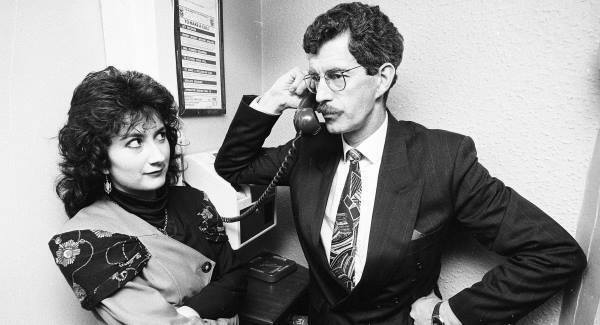
In the early 1980s, when I was researching a book on Charles Haughey, I found that there was almost paranoia about using the telephone among politicians. A security official discreetly warned me that phone-tapping was extensive. Shortly afterwards, I discussed some matter with Dick Spring, who told me not use his phone for sensitive matters because he had been warned it might be tapped.
Garret FitzGerald was so suspicious of his telephone that he would not even hold a sensitive conversation in his home with a telephone in the room. He would disconnect the phone and move it into another room before returning to hold a confidential conversation.
Fine Gael general secretary Peter Prendergast had warned Mr Spring and Dr FitzGerald about their telephones. One day in 1980, Prendergast had been unable to complete a conversation with John Bruton, the Fine Gael spokesman for agriculture. They agreed to continue later on.
After getting home, Mr Prendergast completed the conversation on the telephone. Moments later, he picked up the phone again to make another call, only to hear people on the line discussing the two conversations. He became convinced that he was being bugged and warned leading members of Fine Gael and the Labour Party.
When Dr FitzGerald became taoiseach for the first time in June 1981, Mr Prendergast was appointed Government press secretary, and he promptly became enthralled with the telephone consoles in the taoiseach’s offices. The console had a speaker and an override button that could be used by the taoiseach or a secretary to engage in a conference call.
While the override was being used there should have been a bleep on the line every six seconds, but the consoles installed in the taoiseach’s inner and outer offices were programmed so that there was no bleep on the line. Mr Prendergast quickly learned that if he dialled another number in Government Buildings and that phone was busy, he could listen in undetected by turning on the loudspeaker, replacing the phone in the cradle and then pressing the override button.
He immediately demonstrated this capability for the taoiseach, who called for an investigation. The telephones were part of the Private Automatic Branch Exchange system installed in the office after Mr Haughey became taoiseach in Dec 1979.
Mr Haughey said it was “absolutely ludicrous” and preposterous to think that he was aware of the extraordinary capabilities of the telephone. “I never asked for an override facility,” he insisted, “and I didn’t even know the facility was there.
“I handed over those telephone consoles to the incoming taoiseach, Dr FitzGerald, and I think that speaks for itself,” Haughey added. In other words, if there had been anything sinister, he would not have been so foolish as to leave the evidence behind.
There were haunting similarities with Richard Nixon’s administration in the US. Nixon had “hot lines” installed in the offices of state governors so they could contact the White House directly in an emergency. One governor had his “hot line” checked to find that it remained live to the White House even when the telephone was in its cradle. As a result, the “hot line” amounted to a bug in the governor’s office. When the telephones of other governors were checked, 30 were found to have the same “fault”, which was attributed to the telephone company.
Maybe that was why Dr FitzGerald would not even have the telephone in the room. Nobody accused Mr Haughey of being behind the extraordinary capabilities of the override button, but Geraldine Kennedy of the Irish Times wrote that a majority of TDs thought he “would, at least, be capable of such an act”.
After Mr Haughey returned to power in 1982 his minister for justice, Sean Doherty, had taps placed on the telephones of Ms Kennedy and Bruce Arnold of the Irish Independent. Although some Fine Gael spokesmen liked to pretend that tapping journalists was unprecedented, it was not. The Fine Gael and Labour coalition had tapped Vincent Browne and Tim Pat Coogan in the 1970s.
While discussing this telephone tapping many years later with Dr FitzGerald and Mr Browne, I remarked people were forgetting the earlier tapping by the coalition government. “Sure, they tapped you, Vincent,” I said.
“Yeah, Garret, why did ye tap me?” he said, turning to Dr FitzGerald.
“Because you were in touch with —” Dr FitzGerald replied without hesitation. I did not recognise the name that he mentioned.
After thinking for a moment, Mr Browne said that he was no longer in contact with that person at the time. “Yes,” Dr FitzGerald acknowledged, “but we thought you might get back in touch with him.” Was it really justifiable to tap somebody’s phone on the chance that somebody might call him?
Mr Prendergast got caught up in the bugging again in late Sept 1982 after he tipped off Ms Kennedy that there was something brewing within Fianna Fáil. She made inquiries and phoned him to say that Charlie McCreevy planned to table a motion of no confidence in Haughey’s leadership for a parliamentary party meeting the following week.
Mr Doherty was promptly informed about her call, as a result of the tap on her telephone. He requested extra copies of the transcript of her conversation. Ten years later, he essentially ended Mr Haughey’s political career by divulging that he gave the transcript to Haughey at the time.
The Fianna Fáil Parliamentary Party meeting on Oct 6, 1982, was a particularly acrimonious affair, followed by some the nastiest scenes ever witnessed on television within the precincts of Leinster House. Mr McCreevy had to be protected by the gardaí as he left the building, while Jim Gibbons was assaulted.
About the same time, there was a curious incident involving Ms Kennedy as she was waiting for a press conference to start. Mr Haughey’s son, Ciarán, approached her. “I want to tell you one thing,” he said. “You’ll be hearing from us.”
Was that a threat, she asked “You can take it as such,” he replied.
Why did Ciarán Haughey single her out? Did he know about her telephone conversation with Mr Prendergast? Charles Haughey denied that Mr Doherty had informed him of the tap, but nobody really believed him. He was forced to step down as taoiseach for the final time on Feb 11, 1992.
Enda Kenny was in politics throughout this period, and this possibly explains why he operates on the basis that somebody is listening to his calls.

CONNECT WITH US TODAY



Be the first to know the latest news and updates