Child’s play: Cracking the Humpty Dumpty code
NURSERY rhymes have long held a special place in many people’s childhood memories.
For most of us, the first thing we were taught once we learned how to talk were much-loved rhymes such as Jack and Jill, Humpty Dumpty or Little Miss Muffet.
For others, nursery rhymes were a source of comfort, used by parents to lull children to sleep.
However, the significance of nursery rhymes is often unknown to those who learned them by heart as children.
Some were written about historic events, and then used as a means of passing important news around the countryside by word of mouth.
Others were simply a cheerful means of teaching children some important life-lessons.
But some of the best-known and loved rhymes are not quite as innocent as they appear, with many harbouring sinister messages about illness, poverty and sexual deviance.
For instance Jack and Jill, one of the more popular supposedly nonsensical nursery rhymes, has been linked to a number of ill-fated events.
One theory for its origin is that it tells the story of the execution of the French royal family — Louis XVI and Marie Antoinette — in 1793, suggested by the verse where Jack “broke his crown” and “Jill came tumbling after”. However, a village in Somerset, England, has also laid claim to the origin of the rhyme.
According to villagers, it refers to a young unmarried couple from the village who often courted on a hill there. Jill became pregnant, but just prior to the birth of the baby Jack was killed by a rock that fell off the hill, and only days later Jill died during childbirth.
Another rhyme with a less than pleasant theory underlying it is the verse Jack be Nimble.
First published in the 18th century, one theory is based on the folk belief that the virus yellow fever, or ‘yellow Jack fever’, could be treated by having a source of heat nearby to draw out the illness. As a result, during outbreaks of yellow fever children were often put to bed with a candle beside their cots.
The seemingly innocent farmyard rhyme, Higgledy, Piggledy, My Black Hen may not immediately appear to contain immoral messages, but it is suggested that the verse is more likely to be describing a brothel than a hen house.
According to a number of theories, the narrator is a pimp, my black hen is a reference to a prostitute and the gentlemen are her clients.
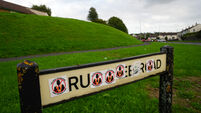
Rub-a-Dub-Dub is another rhyme that upon close inspection, connotes a very odd affair.
According to one theory, it is a reference to the increase in popularity of peep shows during Victorian times.
Entertainers and artists would present their shows in a large wooden box, and paying customers could watch through holes in the sides.
However this innocent fun soon developed into the perfect way of providing sexual entertainment for the public.
What exactly “the three men in a tub” were doing that was “enough to make a man stare” is, thankfully, left up to your own imagination.
* Pop Goes the Weasel by Albert Jack, is available now in bookshops.
The real Humpty Dumpty was a powerful cannon used during the 17th century English Civil War.
Positioned on top of a church tower, it was eventually sent crashing to the ground and buried in deep marshland when the tower was destroyed by the enemy.
A bitter reference to the royal tax placed on wool in England during the 13th century. One-third of the price of each sack went to the King (master) and one-third to the Church (dame), with the little boy referring to the shepherd himself.
The black sheep would also have been seen as an unlucky omen as it was less valuable than a white sheep.
It’s thought this was constructed as a Christian homily for children — Mary being Christ’s mother, the Lamb is a reference to Jesus and the fleece is a symbol of God’s purity.
Regarded by most as a gentle children’s rhyme, the lyrics actually poke fun at unfortunate orphans in the 19th century who often had to sing and beg for their food.
One theory is that this rhyme may have been created to remind children of the planting season in early spring.
Each creature or object refers to a star constellation that lines up with the moon around April, including Leo (the cat), Taurus (the cow) and the Plough (the spoon).
Often considered to be a description of symptoms of the plague, beginning with a description of the early stages of the disease — a rash similar to a wreath of roses — and ending with the infected person falling down dead soon after.

CONNECT WITH US TODAY



Be the first to know the latest news and updates