Kia Picanto ticks all the boxes and then some
They were designed as an afterthought largely for family people who needed a second car, not just to teach their 14-year-old brigands how to spin wheels. Or there were singles who barely needed a car at all, but had to get from A to B and still didn’t really mind that it only just came as standard with a steering wheel.
Most micro-minis were crude in the extreme, but they were cheap and also came with terrific engines. These were largely of the petrol variety — and usually came in the 800cc to 1200cc range. Is Examiner Motoring on a recurring theme here?
Many of the earliest micro-minis gestated from the Japanese ‘Kai car’ phenomenon which began after the Second World War which was aimed at promoting growth in the motor industry in the post-war era. Much as was Fiat and Volkswagen in Europe.
The Asian versions were also designed for crowded urban areas and built by Toyota, Suzuki, Nissan, Honda, Subaru, Daihatsu, and Mitsubishi in very large numbers.
Initially, Kai cars were only allowed have 360cc engines, although the regulations relaxed over the years to the point where manufacturers were allowed make them with engines of up to 660cc.
Cars, vans — check what became euphemistically know as the Suzuki Toaster — and small trucks all formed part of the Kai car deal.
Many innovations in engine building and design emanated from the Kai car scene particularly in the areas of turbocharging and emissions as well as innovations with four-wheel drive and creature comforts such as air conditioning. At the height of their popularity nearly 1m were sold on the Japanese market every year.
As the Europeans started to cotton on to the benefits of small city cars, popularity of the micro-mini started to grow and local manufacturers tried to get in on the act, although their Japanese rivals had an obvious head start in terms of design and engineering.
The popularity of the segment in these parts was accelerated by the fact that these vehicles not only served fruitfully for second school-run and shopping duties (long before the SUV era dawned) as well as being great starter cars for kids to learn to drive in.
Although the Italians, with their Fiat 500, and the Germans with various DKWs and Messerschmitt, also made many post-war small cars, the increasing sophistication of the buying customer saw most of these things die a death by the 1960s.
The Brits too used to have a raft of small cars, not least the Mini itself and others such as Rileys, Wolsleys, Sunbeams, and Hillmans, but they too faded in popularity in the face of changing customer dynamics.
However, the Japanese were on the way.
Among the first Kai to arrive in Ireland were such as the Daihatsu Domino which was a fantastic little thing with room for four adults or a raft of children, a smashing little engine (an 850cc unit for the European market) and even had room for the groceries. It was followed by such as two Suzuki, the Alto and the Vivio.
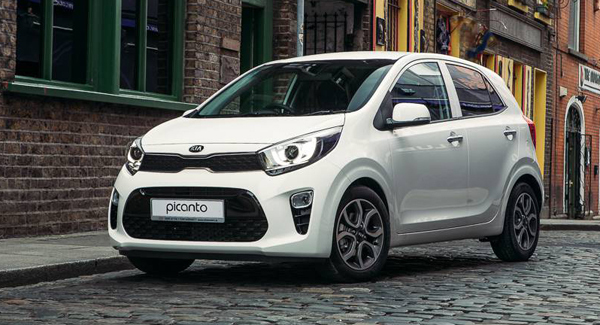
These cars laid down the template for cars such as our tester this week, the fantastic Kia Picanto, which saw the light of day at the 2003 Frankfurt Motor Show and which was a successful car although not being terribly good-looking.
Nothing like the sophisticate it is today, the original car lured people with a cost-effective combination of decent kit, huge economy, enormous practicality and a delightfully thrummy three pot engine. Those characteristics have largely been continued to this day,
although the latest machine is nevertheless still a beast of quite a different colour.
Under the guidance of chief designer Peter Schreyer, the car certainly has a raffish mien.
On looks alone, it is quite possibly the pick of the segment and sure makes the closely related Hyundai i20 look dull.
Picanto also now has a range of personalisation options which is de rigeur these days, as demanded by the ‘yoof’ market.
The interior has been spruced up too and the Kia is notable for the amount of soft-touch plastics which have been adopted and which make the inside of the car pleasant.
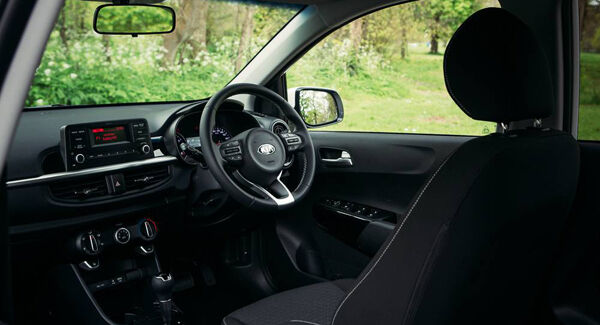
In the EX trim which we tested, the car has a standard kit, including rear privacy glass, which is a little astonishing.
LED daytime lights, leather steering wheel/ gear knob, all the connectivity stuff you need these days,
remote steering wheel controls, cruise control, and central locking.
The front seats are comfortable and multi-adjustable, the five-door access is excellent and the space in the back for adults is impressive.
On the road, the wheel-at-each-corner demeanour of the design means it is a very stable on-road proposition.
The one-litre three cylinder petrol engine is a little diamond.
Although it only outputs 67bhp, the power-to weight figures are high and allows for some very zippy wheeling about. The 14.3 seconds from 0kph to 100kph might not seem like much, but it is plenty. And the five speed ‘box is really good too.
The economy figures (4.4 l/100km — 64.2mpg) and the annual tax costs (€190) add to the appeal in what is a very neatly packaged and very worthy car for the money.
From €13,295 to €14,795 as tested.
Where it’s at — small capacity petrol engine.
You’ll be pleasantly surprised.
A diamond.
4/5





