Dearbhla Mescal: West Cork is my happy place, it's a gift I never thought I'd have
Sometimes, a photo just doesn’t capture a person. She smiles from newspapers, on the arm of her son Paul on a red carpet; at a book festival to discuss her bestselling poetry book, Finding Joy.
And then we chat, first on Zoom. Sitting in her living room, the family home behind her, fairy lights on the windows, there is an energy, even through the screen.
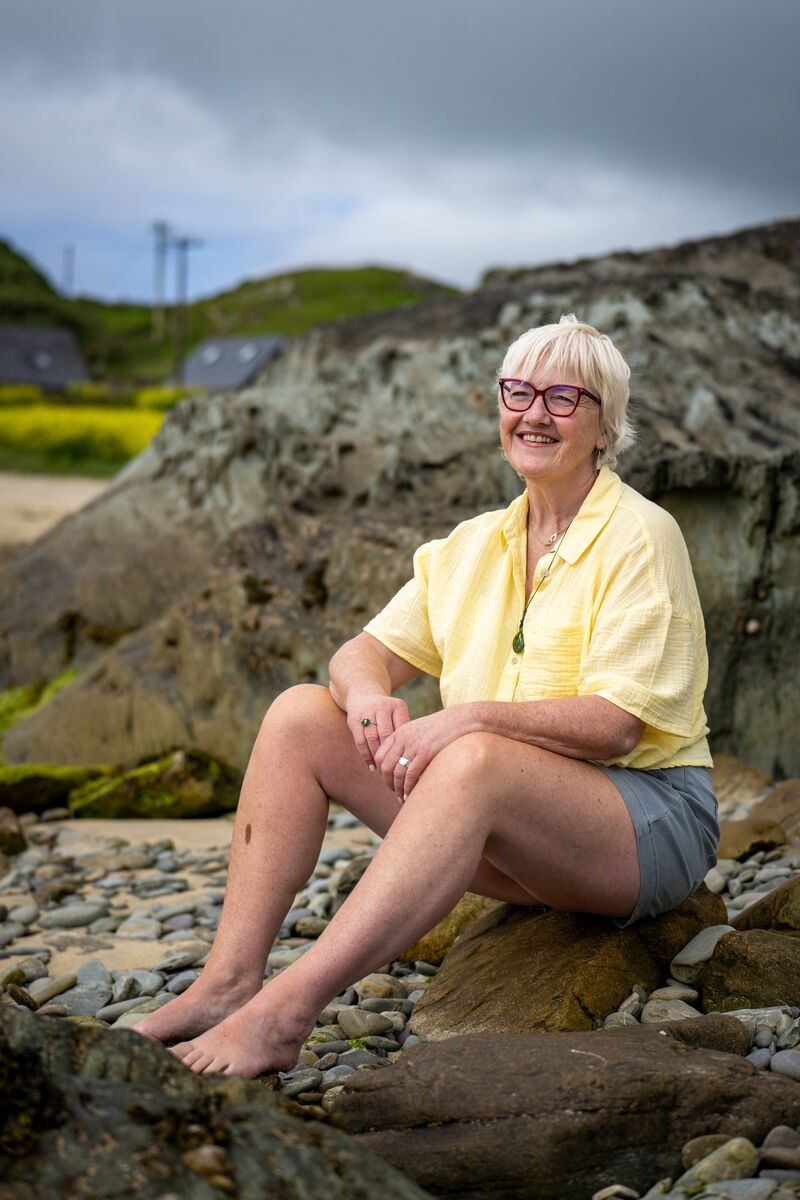
But when we finally come face to face, as our photographer meets her to capture her in her beloved West Cork, Dearbhla Mescal is, we agree, fully charged. In person, that energy is electric.
I join them at the end of the shoot and, as we sit on a bench just minutes from Mizen Head, she glows.
This is, she admits, her happy place. The West Cork home that has become her haven belongs to her son, the Oscar-nominated Paul Mescal.
He was the one to introduce his family to the area.
“He knew where he was looking to go,” she says. “He found this house.”
Dearbhla grew up in Greystones, so the sea and the water were central to her childhood. When Paul was 18 months old, they moved to Maynooth, to a semi-D with a green that gave the family a beautiful, grounded start to life. They are still there to this day.
“This is where everything has happened in our lives, everything,” she says on our Zoom chat, motioning to the living space behind her, from the cosy couch to the framed photos to the fairy lights that adorn the window. “Every communion, every confirmation, every debs — it was all here.
But much as she loves West Cork, and the sea that cocoons it, relocating is not on the cards.
“We’ve got a community here that supports us, and I think because I have the facility to go and disappear for a little while to a place like Cork, there’s a gift in that for me, a gift that I never thought [I’d have] because we would never have had a second place ever in our whole life.”
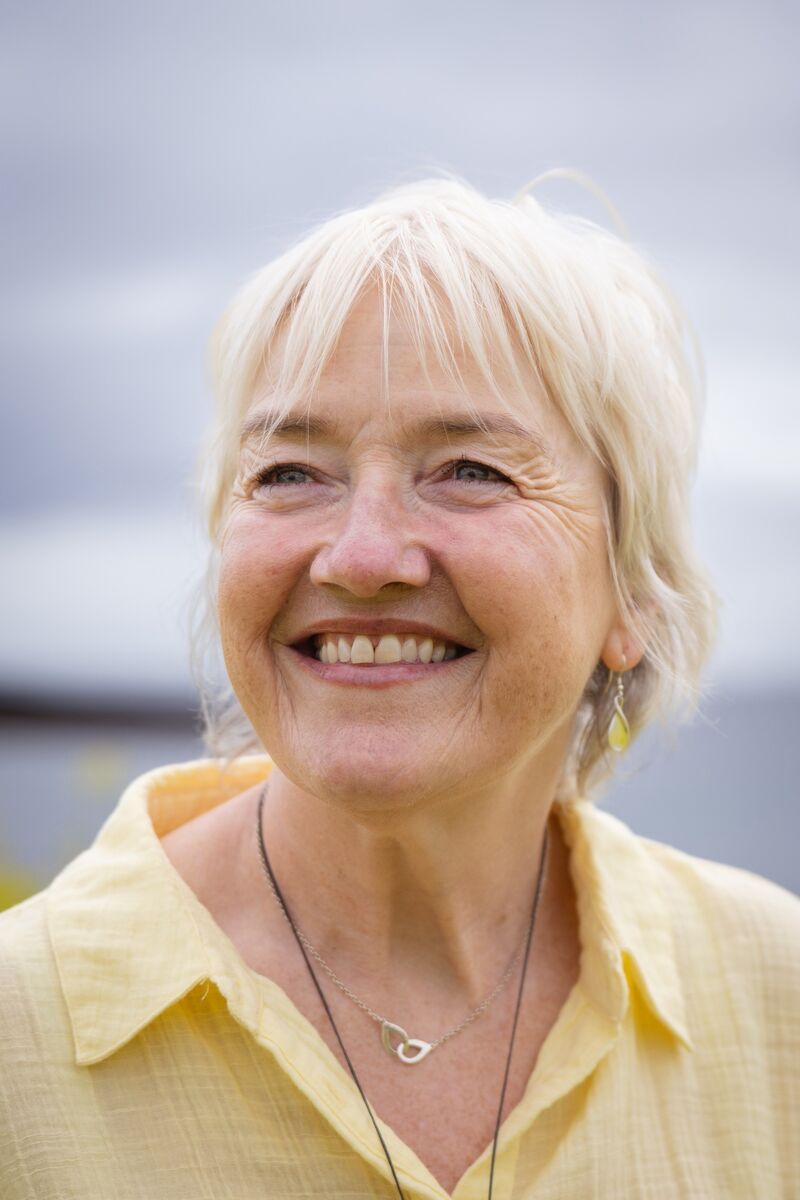
In West Cork, there is a chance to recharge.
“I open the gate, I close the gate, and I go down to the beach,” she says. “It’s just wild. I wear shorts and my bare feet.
“I’m completely in my element.” She pauses.
“In. My. Element,” she repeats, beaming as she emphasises each word for effect. West Cork will do that to you, we agree.
It will be her base in July again when she talks at the West Cork Literary Festival.
She only visits, she stresses, when Paul isn’t there. She respects, first and foremost, her children’s privacy.
Somehow, Dearbhla Mescal straddles this fine line — she is, she says, a natural sharer, and she talks with pride and ease about her three children — Paul, Donnacha, and Nell (currently carving out a successful music career in London).
But, understandably protective, she gives little away. “I think any mother knows that there is the off button, where we sort of kindly just say I’m just not going there. I mean, I’m obviously three children’s mothers, and my life was mothering, so it’s a bit silly to say you’re not going to talk about what it was like to be the mother of three children while you were working full-time, managing to be a wife, a sister, a daughter, all of the other things that are going in your life.”
We can be grateful for Dearbhla’s open personality. It’s thanks to the fact that she is a sharer that we have her beautiful book of poetry. This is the reason she’ll be visiting West Cork in July, to be interviewed as part of the West Cork Literary Festival.
The book began, she writes in her introduction, when she was on the sidelines of yet another match, supporting her children on the field.
She met another harried mum who asked in exhaustion, “When is it our time?” Her immediate response was to say “not now”, but she later chided herself. She decided to go in search of daily joys — she made it her focus for 28 days in the hope that it would become a habit. It became the focus of her Facebook page, later her Instagram account, and today, over 27,000 people follow @dearbhlam for a daily dose of positivity.
Ultimately, it was the springboard for Finding Joy, the book curated from decades of little notes made over the course of a busy life with three children and a full-time position with An Garda Síochána.
Her cancer diagnosis in 2022 adds another layer to her words, but this isn’t, she says, a book about cancer.
She laughs and talks openly about her treatment, about the fear, the claustrophobic feeling, as if her world had closed in and she was wearing horse blinkers in this strange new world of hospitals and consultants and treatment regimes.
“I’m still processing what cancer means to me,” she says. “I like to see the full vista, so the fact that my whole vista was narrowed down to just this was
really quite scary.” But this is not, she repeats, a book about cancer.
At its heart, she says, this is a book that is all about, as the title suggests, finding joy, and discovering it no matter what busy life stage you might be mired in.
During our conversation, she touches upon all of life’s milestones — motherhood, career, her three-decade-long marriage to husband Paul. There is a lightness of touch, and with it a lot of laughter, but there are also silences — often, in her search to find the right words, she closes her eyes. Every word is thoughtful, considered, sage.
In her introduction, she writes of pushing the front door open and stepping through a mire of football boots, sorting mounds of built-up washing.
I tell her this rings true for my life stage, and how the book sits beside my bed, her words of wisdom a balm at the end of yet another chaotic day.
“I’m sure you’re driving bedraggled and trying to figure out if there’s enough petrol in the car to get you to the arsehole of wherever you’re going,” she says, recalling her own days of GAA runs. “You drive in the car, and you’re willing it to go, and you’ve got a car full, because it’s your run date ... And then you see, as you’re driving through these villages, you see other families, and they’re sitting in coffee shops.”
Not that there are any regrets. Instead, she feels like the life they gave their kids instilled in them the life skills they needed to succeed.
“I don’t do shoulda, coulda, woulda,” she says. “I’m now at the stage where I’m seeing the results of the life that we created, and what I mean by that is ... Paul, he can take the director’s notes, he can take the criticisms, because he’s been on winning teams, he’s been on losing teams. He’s had managers he probably didn’t get on well with, who put him in different positions that he didn’t like to play, and part of our ethos was you play the position the manager gives you, and if the manager doesn’t choose you, you’re the best water boy there is on the team.”
She talks with pride about her middle son, Donnacha, and how, on a trip to Japan, he was surrounded by friends he had made on GAA pitches.
Dearbhla is savvy about the sudden interest in her family — she is circumspect, and yet remains open.
“I’m probably more cautious than ever to take on new friends, to take on new people in my life,” she says. “I have two children who live in a public space.
“I think when Paul did his interviews and talked about who his parents were, or who his family were, it made us interesting. And then me continuing on my little path of just writing away, people got interested. I suppose, initially, it was like, how do you create this child? There was no creating of the child. Each of my children chose their living as adults.”
Much of her poetry centres on the idea of letting go. She talks poignantly about an empty nest, of a match on TV in the background of a sport-obsessed house, with no one there to cheer.
“There’s a grief to a quiet house,” she says simply.
But letting go also gave her children freedom. There was never a traditional path they had to follow. Her daughter Nell left school to pursue her career in music, and, while a career in sport might have been taken for granted for Paul, an opportunity to act during transition year opened another door his parents made sure he was free to explore.
“I am a complete believer in transition year. I didn’t have it growing up,” she says. “It’s the making of your child.”
She is also a big believer in “duvet days, in days where you get to switch off and listen to your own head space”.
“I’m not a big exam person,” she continues. “I don’t get stressed about exams. I don’t get stressed for my children in exams, because my view is you’re going to graduate. Take the Junior Cert — I want you to do it so that you get to be part of the school community, with everybody getting all excited outside the class. I want them to have that part of life. But if you fail it, does it mean you’re not going into fifth year? Of course you’re going to fifth year.
“I think when Nell decided that she was going to walk away from school, she was making it as a very educated person in one way — she knew in her heart what she was going to be.
“For Paul, TY for me was where he was able to be two things — sport and find the stage. If he didn’t have that, I have no idea if he’d ever have found the stage. There’s the sliding door moment.
“If Paul’s school, Maynooth Post Primary, hadn’t said everybody attend, everybody auditions ... I mean, he went to his first audition in GAA shorts, and they took their dirty boots off. I literally dropped the gang from the pitch out. They left their boots in the car to do their first audition, and they ran in their socks. All these guys ... I was left in a car with smelly boots,” she says, laughing.
Through the smiles, I think of Dearbhla’s poem, A Hope, and the wisdom within its lines.
I hope
The whispers you make
To the universe
From your own heart
Blow gently
Across your soul
And let you roar
Into your dreams.
- is published by Eriu. Dearbhla Mescal will be at the West Cork Literary Festival on Saturday, July 11, at 4pm in the Maritime Hotel, where she will invite people to join her on a journey of reflection and renewal through a tender and uplifting collection of poems and heartfelt musings.

CONNECT WITH US TODAY



Be the first to know the latest news and updates