‘There’s a story behind everything that comes in here’: How repair cafés are leading in sustainable living
The rise of repair cafés is a sign that many people in Ireland are ready to ditch a throwaway economy that is the very opposite of sustainable, writes Ellie O’Byrne.
‘There’s a story behind everything that comes in here’: How repair cafés are leading in sustainable living

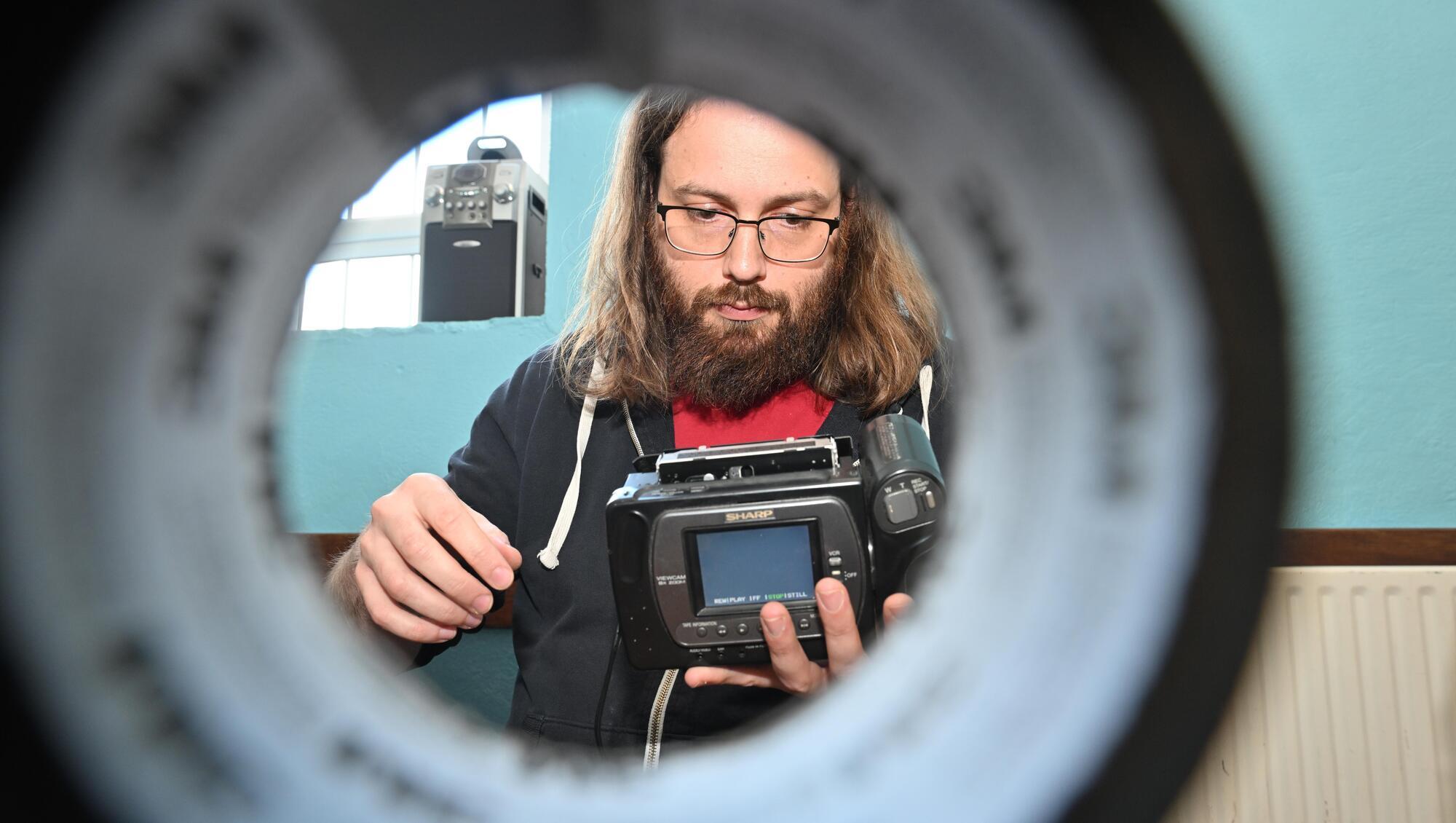
Florian Castel working on a video camera at the repair cafe in the Lough Community Centre, Cork. Picture: Dan Linehan

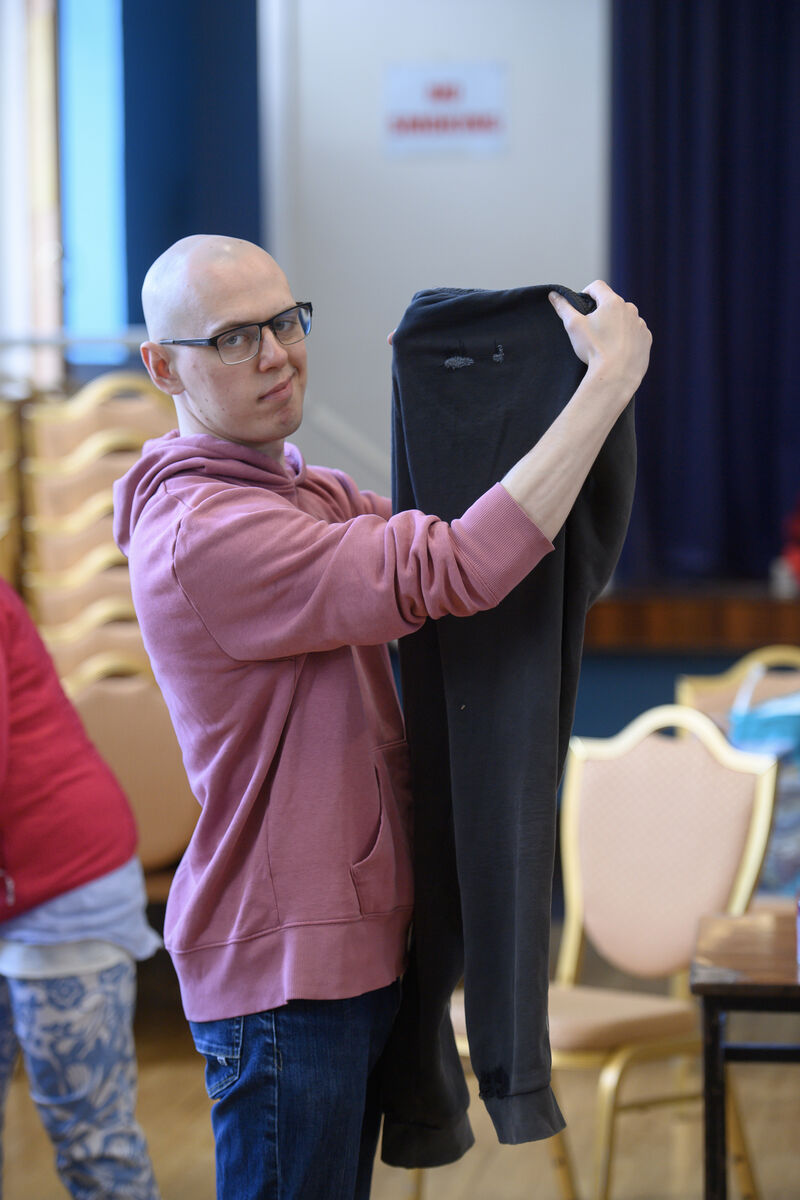
In the Lough Community Centre in Cork City, Adam Roe proudly holds up a pair of sweatpants that he’s just finished darning.

“I found out about this place through a friend and was like, yeah, why not,” Adam says. “This is my second time coming here, so I wouldn’t exactly be a grizzled veteran yet.”

At this monthly repair café, attendees like Adam get a little expert advice to repair items they bring in, all while having tea, coffee and chats. 

It’s partly a social event, but it’s rooted in the idea that every item that has its life extended through repair is one less piece of consumer goods destined for the trash heap.

In 2021, Ireland generated 17.6m tonnes of waste of all classes including building waste, according to the EPA. 

CLIMATE & SUSTAINABILITY HUB

That’s 3,450 kilos of waste per person each year, or almost nine and a half kilos of waste each, every single day. 

This includes 110,000 tonnes of garments and other textiles thrown away in Ireland each year. 

But Adam’s freshly darned trousers won’t be adding to that horrifying statistic any time soon. 

For him, repair isn’t only a way of keeping his comfiest pants out of the bin, though.

“I bought these for 20 quid,” he says. “They’re not exactly high quality, but I want to keep them for as long as possible. I’m saving myself some money too. Repairing these is almost free, going out and buying a new pair isn’t.”

At another table, Geraldine McCarthy is showing a 30-year-old radio and CD player to repair volunteer Florian Caster: Geraldine would like to keep using the radio, but it’s becoming increasingly unreliable.

“Fortunately, this was made a little before things were being designed to not be fixed,” Florian says, peering inside the radio and fiddling with one of the dials. 

When he’s finished, the radio is fixed, even if it is only going to function on FM from now on, which Geraldine is happy with.

Florian’s day job is fixing slot machines at an amusement arcade, so he is quite handy with electronics — a large proportion of the goods people bring to Cork Repair Café. 

Florian was involved with a repair café in his native Normandy for five years before he moved to Ireland. 

Today, he has his soldering iron with him, and a handy little toolkit from iFixit, an online repair community that dispenses free manuals for everything from mobile phones to cars to cameras. 

“If you can’t repair it, you don’t own it,” is their motto. Florian very much agrees.

But the problem is that it’s become profitable to make items destined for the bin. 

Manufacturers design so-called “planned obsolescence” into their products, deliberately ensure parts are incompatible with those of competitors, and use advertising to push “perceived obsolescence” through fashion trends or releasing near-identical consumer goods annually. 

The result is that consumer goods in affluent countries are being binned and replaced with new items at a shameful rate. 

 Adam Roe with his tracksuit, repaired at the repair cafe in the Lough Community Centre, Cork. Picture Dan Linehan
Adam Roe with his tracksuit, repaired at the repair cafe in the Lough Community Centre, Cork. Picture Dan Linehan

When pioneering US waste trafficking activist, Annie Leonard, made her The Story of Stuff film back in 2007, she warned that our global materials economy, from resource extraction to factories to shops to landfill and incinerators, was “a system in crisis”. 

In the US, she reported, 99% of all consumer goods were trashed within just six months. The EU has been trying to halt these ruinous practices. 

Last year, the European Commission adopted a “Proposal for a Directive on common rules promoting the repair of goods” to force manufacturers to provide repair manuals for products, and to stock parts for a minimum of ten years. 

Florian says France was ahead of the curve when it comes to so-called “right to repair” laws.

“In France, the law was passed a few years ago that makers of washing machines, phones, etc, by law must provide ten years of spares, five years of service, and service manuals,” he says. 

“This is very useful for independent repair shops as well as for repair cafés.”

The first repair café was started in the Netherlands in 2009 by Dutch journalist Martine Postma. Now there are an estimated 2,500 repair cafés worldwide, repairing 44,000 items each month.

Kim Anh Eastman, known simply as K to friends, founded Cork Repair Café. With seamstress skills herself, she reached out to Cork Community Bikes and others to provide mechanical expertise, but the timing of their first event was ill-fated. 

Cork’s first repair café happened right before Ireland’s first covid lockdown in 2020.

After that hiatus, K says the monthly meet-up has been going from strength to strength. “Now it’s grown to where we have a committee, volunteers, accounts,” she says with a smile.

“There were some times when nobody would show up, other times when I’d have a queue of 20 people with garments waiting to be mended. But consistency is really important, to just keep showing up every month.”

For K, repair means wellbeing for individual people as well as for the planet. As well as bringing a sense of achievement and empowerment, the objects we care for accrue meaning over time,

“There’s a story behind every single thing that comes in here,” she says. “I’m a sucker for a story. I love hearing those things, and they are emotionally significant. Repairing that old lamp that your grandpa read stories to you by keeps his memory alive.”

REDISCOVERY

As Ireland’s Centre for the Circular Economy, the Rediscovery Centre in Ballymun is now celebrating 20 years of being the Mecca for repair, reuse and repurposing in Ireland. 

Itself an example of reclaimed and reused materials, it is housed in the former boiler house for Ballymun flats and was architect-designed with re-use in mind, featuring materials including “hempcrete” and recycled windows.

“The building is what we call a 3D textbook, because as you walk around the building you are learning from it,” acting director Gráinne Lambert says.

The Rediscovery Centre started with a furniture project when Ballymun flats were being demolished in 2004. 

Today, they are a busy social enterprise with four strands: Rediscover Fashion, Rediscover Paint, Rediscover Cycling and Rediscover Furniture. Each strand takes on community employment scheme trainees to learn skills, bring items to new life and sell them in an on-site eco-store.

An impressive 92% of Rediscovery Centre trainees, who may have been distanced from the workplace for a variety of reasons, will go on to workplaces or further education. 

As well as courses and workshops in everything from willow weaving to furniture upcycling to garment alterations, The Rediscovery Centre hold repair cafés in conjunction with Dublin City Council four times a year. 

Their next event is coming up in June. For Gráinne, it’s the educational element of the repair cafés that’s most important: “People bring in their item and talk to an expert who will show them how to repair it, so that if it breaks again they will have the skills to make that repair themselves. It’s about passing on the knowledge, rather than fixing the item and handing it back.”

Re-learning to repair is a step back in time to a less wasteful materials economy of the past. As Gráinne points out, repair was innate, necessary, as recently as our grandparents’ generation.

“We lost our repair skills,” she says. “So a lot of what we do here is building confidence in skills. There’s an element of pride when someone has made or repaired something themselves. Once you learn how to repair things it just changes how you look at things. Repair suddenly becomes
possible.”

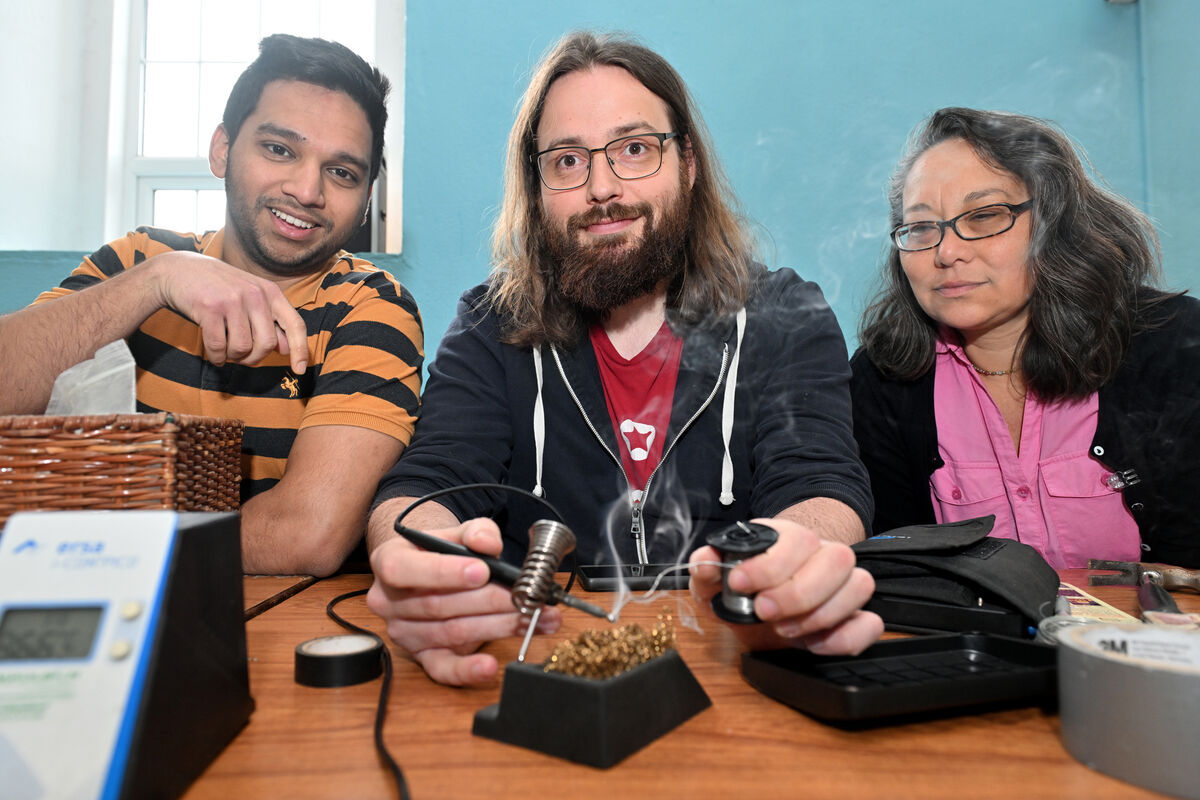
 Rajas Shinde, Adam Roe and Kim Anh Eastman at the repair cafe in the Lough Community Centre, Cork. Picture Dan Linehan
Rajas Shinde, Adam Roe and Kim Anh Eastman at the repair cafe in the Lough Community Centre, Cork. Picture Dan Linehan

Back at the Cork Repair Café, there are a lot of electronics coming through the door: A lamp, an electric toothbrush, a vacuum cleaner, a food processor. 

Electronic waste, or e-waste, is a growing global ecological catastrophe. And Europe is the worst offender. 

In 2019, EU residents generated 16kg of e-waste each, according to the International Telecommunication Union (ITU). 

E-waste is often hazardous waste, and even if it’s designated for “recycling,” this often means it is shipped to developing countries for dismantling. 

Raj Shinde is another volunteer and committee member with Cork Repair Café. 

Raj has seen first-hand the impacts of the developed world’s devastating throw-away consumer culture. 

Before he moved to Ireland to complete his PhD in Environmental Engineering, Raj traced waste electrical goods in his native India and witnessed people dismantling e-waste by hand in poor slum areas.

“It was a turning point for me,” he says. “It is a health issue, a human rights issue. It’s very unregulated and a lot of the waste recycling is informal. People are breaking down electronics with their bare hands.”

When Raj first arrived in Europe as an international student, he was shocked by the throwaway culture he encountered.

“Repairing is very difficult here,” he says. 

“In India, there are lots of repair shops and repair is cheap, so you wouldn’t buy a new thing when something is broken. When I realised that in Europe people will throw something away and buy a new one because that’s cheaper than repairing it, that was a very sad thing for me.”

So for Raj, the purpose of the repair cafés, over and above socialising, is the most fundamental purpose of all: To divert precious materials from landfill and to turn the tide on our habit of trashing the planet for profit.

Click through to browse more content from the Irish Examiner's Sustainability series.

More in this section

Lifestyle

Newsletter

The best food, health, entertainment and lifestyle content from the Irish Examiner, direct to your inbox.

Cookie Policy Privacy Policy Brand Safety FAQ Help Contact Us Terms and Conditions

© Examiner Echo Group Limited