'It helps having family close if you're in hospital,' says Paudie
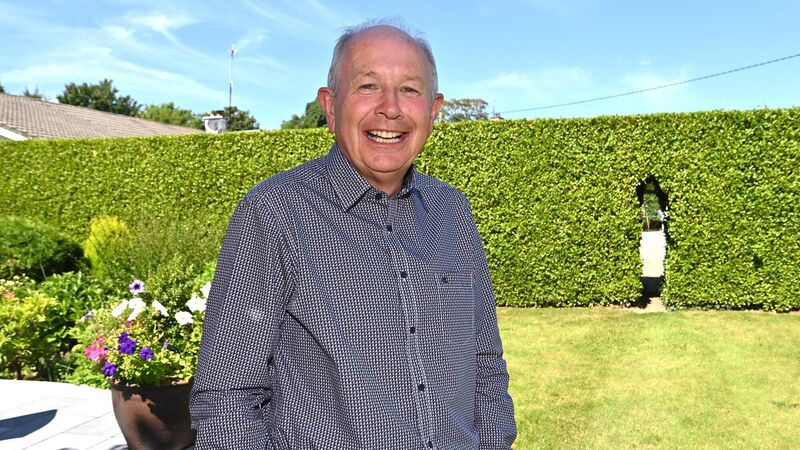
Paudie Palmer at his home near Innishannon village, Cork. Following a life-saving operation in Galway, he was lucky enough to get to recover in CUH with family nearby. Pictures: Dan Linehan
Paudie Palmer is a name you may know. The popular columnist and broadcaster has a strong following for his work at The Echo, The Opinion and at C103 radio station. It’s one that’s positively reflected in the social media following he has amassed down the years.
When he’s not penning opinions, raconteuring, or delivering GAA commentaries or reports, Palmer can be found at St Brogan’s College in Brandon, working in home school community liaison.
Given that this is how he spends his days, after retiring from 44 years of teaching, it’s fair to conclude that he’s a man who doesn’t give up. This is a trait that doubtless served him well when he was diagnosed with bone marrow cancer (multiple myeloma) back in March 2019.
He received the news at Cork University Hospital (CUH). Recalling how he felt about that, he says: “Going into the Dunmanway Day Unit on the first day, was a bit of a shock to the system. But after a while, being there at the Unit became as commonplace for me as being in a commentary box in Páirc Uí Rinn or in a classroom at St Brogan’s College.
When Palmer was told his condition was ‘incurable but treatable,’ he opted to remain positive: “I decided to hang my hat on the ‘treatable’ peg of that prognosis,” he says.
Speaking highly of CUH’s Dr Oonagh Gilligan, he says: “She and indeed all who work at the Dunmanway Day Unit were fabulous: the medical, nursing and care staff, the assistants, the cleaning and admin teams. I met them all on my journey and got to know them all. Wonderful people work there.
“Some shared their stories. All were kind, and before long I realised that in going into that Day Unit, I was going into a good place. I accepted then, that this had become part of my life, my new reality.”
Initially, Palmer had weekly treatment at CUH. Then in late October 2019, he underwent a stem cell transplant procedure at University Hospital Galway (UHG). He went to Galway because the procedure was not available in Cork.
He was well impressed with the care he received: “From my experience of those involved and indeed all at the UHG haematology department, I can’t speak more highly of them.”
Paudie describes the stem cell transplant procedure thus: “They harvest some of your cells on a day visit. It’s a bit like a blood transfusion. Then you return to have cells put back in. Your immune system is seriously compromised for a time after that, maybe for a period of two or three weeks. But before that happens there’s a window of about 48 hours straight after the transplant, after which you need to go into a sterile environment for a few weeks.”
While he might well have had to remain in Galway for three weeks or so after the procedure, he was fortunate to get back to Cork within 48 hours and before his immune system collapsed.
Timing was core in this, as he describes: “My being lucky enough to recover at CUH for the few weeks after the transplant, came down to the availability of a bed for me at the hospital, and an ambulance to transport me there from UHG, within the safe time frame.
“If I’d had any complications after the transplant, I would have had to stay in Galway, and my family would probably have moved there temporarily from Cork, so as to be near to me. For their sake, I was so glad I got home. It’s a massive bonus having family with you as you recover. It’s the familiarity, if you’ll excuse the pun.
“For me, home is only 12 miles from CUH, so I was so fortunate my recovery was able to happen in Cork, fortunate to have family with me, and nearby.”
He talks then about the support he received from his wife Colette, and daughters Claire and Emily, reminiscing about how invaluable their presence and adjacency was in helping him to recover his health during his weeks at CUH.
Palmer says he didn’t realise before his diagnosis, that while stem cell transplant procedures used to be carried out in Cork, they aren't any more.
“This makes no sense,” he says. “Given that Cork is Ireland’s biggest county, that so very many from here and from Munster and other regions, have to travel to Galway, Dublin or elsewhere for transplants. Also, that more often than not, they have to remain there, far from home, for weeks of recovery.
“Given all the patients being treated at Dunmanway Day Unit — from Munster and around the country, the advantage of stem cell transplant procedures being available in Cork would be immense,” he says, and his rallying call reminds me of the sporting cry, of ‘bringing it back home’.
When Palmer was back in CUH recovering from the stem cell transplant he had in UHG, Prof. Mary Cahill, consultant haematologist at CUH, used to visit him there.
His confidence in the professor helped give him hope: “While my immune system was down, she’d say: ‘You’ll feel better in a few days' time. You’ll be feeling a bit better all the time,’ and that helped and I did indeed continue to feel better.”
Palmer is known for his GAA commentaries and reports, column, opinions and broadcasts. But behind the public persona, he’s essentially private by nature.
He puts it this way: “I'm not a private person in terms of sport. But in other ways I am, and while I’m not comfortable talking about myself as I am here today, I’m doing it, so as to highlight here, the absolute necessity and my absolute knowledge that it would be hugely advantageous for people in the South of the country, to have a stem cell transplant unit back again in Cork.
“Along with Dr Oonagh Gilligan, who was my haematology consultant at CUH, there are a number of other eminent haematologists here, and having the unit in Cork, in CUH would be the final piece of the jigsaw.”
Originally from South Kerry, Palmer has been living in County Cork’s Innishannon for the past 40 years. “It’s a really lovely spot made up of all sorts of individuals and interesting characters," he says.
Elaborating, he shares that while ill, he received a card from the writer, Alice Taylor: “She wrote saying I’d brought a parish to its knees,” he says. “This was very kind of her of course, but she’s a great writer of fiction, so I bear that in mind.”
It’s clear that Palmer enjoys telling this story. It makes him laugh and reminds him of the good people and the goodwill to be found in his parish.
He tells then of another card he received, this one from a gentleman best left unnamed, who had kindly inscribed it — in reference to Palmer — with the words ‘He was a sound man’.
“Note the word ‘was’," he says with a smile. “Past tense. I’m keeping that card. The kindness. Also, because it’s ready to go into the memorial car whenever my time comes.”


CONNECT WITH US TODAY



Be the first to know the latest news and updates