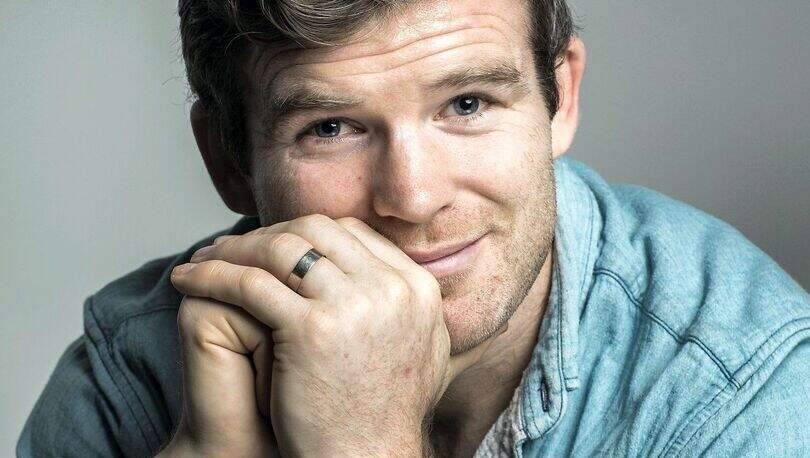
My Childhood with Gordon D'Arcy: I found trouble very easily, and trouble found me

D’Arcy spent his early childhood in Ferns, a rural village in Co Wexford
Gordan D'Arcy

Gordan D'Arcy

Gordon D'Arcy and his mother Peggy were recently watching his three young children playing with the family dog. When the retired rugby player marvelled at the children’s energy levels, his mother laughed and told him he was “worse than all of them combined”.

“I think I was a hurricane,” he says.

“I had so much energy and consistently managed to use it to do the wrong thing at the wrong time. Mam says I’m lucky, I had a nice smile. I could smile and say sorry, and I’d be off the hook in an instant.”

D’Arcy spent his early childhood in Ferns, a rural village in Co Wexford, before his father John’s job as a bank manager required the family to move to Enniscorthy and later to Coolree outside Wexford town. He has fond memories of those towns and villages.

“Wherever we lived, we were never far from open countryside, and my older brother Ian and I would swing off ropes hanging from trees, go swimming in reservoirs or just kill time with whatever fun we could find,” he says.

“We had lots of freedom.”

Gordon as a baby with his cousin Hilary

His earliest memory is of a neighbour called Mrs Loughman, who lived down the road from the family in Ferns. D’Arcy explains that she made brown bread to sell in local shops and how, at the age of five or six, he would “call into her back kitchen for chats. I’d help her make the bread, tell her all my news and then head off, only to call again a few days later”.

D’Arcy has three siblings: an older brother and sister, Ian and Shona, and a younger sister, Megan. All four would be sent to stay on their mother’s sister’s farm in Kildare for several weeks every summer.

He remembers it as “a brilliant way to spend the holidays. My aunt had kids our age and we’d all work on the farm, baling hay, collecting eggs, and dipping sheep. We’d spend our days outside and be exhausted by the time evening came”.

“My brother Ian was everything”

D’Arcy idolised his older brother growing up.

“Ian was everything,” he says. “He was five years older than me, and as soon as I was able to walk, I followed him everywhere.”

His brother didn’t always appreciate D’Arcy tagging along. He says: “There were many times when I’d come into the kitchen crying, telling mam that Ian had said or done something, but within minutes, Ian or one of his friends would be at the window saying they needed me for a game and I’d be gone in a heartbeat.”

It was only when Ian went away to boarding school that D’Arcy became closer to his older sister Shona. “But there came a point when she dropped me, too,” he says. “That’s when my attention turned to Megan. All four of us get on well now.”

D’Arcy followed Ian to boarding school in Clongowes Wood in Kildare. Aged 12, he remembers feeling “excited to be following in Ian’s footsteps” but says he found the first six months or so challenging.

Finding trouble

“I was desperate for people to like me. And because it’s easier to get attention for doing the wrong thing, I became a bit of a messer at school,” he says. “I found trouble very easily, and trouble found me. It was immaturity, really.”

However, he settled in time and now regards his time at Clongowes as critical to shaping the man he is today.

“I was so lucky in terms of the boys I went to school with,” he says. “There were 70-odd in our year, and I’m still in regular contact with well over half of them. We shared everything and helped each other grow up.”

His teachers were supportive too, and his English teacher left a particularly lasting impression.

“He encouraged me to write poetry and develop my writing,” says D’Arcy. “It’s thanks to him I went on to have newspaper columns and write children’s books.”

His potential as a rugby player was also developed at Clongowes. Before he went to boarding school, he had only played hurling but says his love for rugby was “instant”.

That was the year he was asked to join the Irish national team. He initially refused because he was focused on his exams. His parents hoped he would continue on the academic path by going to university, but D’Arcy now says: “There was no way they could get the genie back into the bottle. I turned professional two weeks after I did the Leaving [Cert] in 1998 and threw everything I had into rugby. They got their wish later, though, when I studied economics and business at college, at 27”.

Maintaining a strong relationship with his parents has always been important to D’Arcy. He says that his dad, who died in August 2025, was “the one I wanted to impress. Getting the nod from him always meant so much”.

His relationship with his mother has a different quality, with D’Arcy describing it as “the typical Irish mother and son dynamic. I go to her when I need a sympathetic ear and I know I can rely on her to give me a hug and tell me I’m great”.

The biggest gift he believes he got from his parents was their time and attention.

“They always showed up for us,” he says. “That’s what my wife Aoife and I are trying to do with our kids now. When all is said and done, life is about spending the time you have with the people you love.”

  • Gordon D’Arcy and Paul Howard have written a new picture book, Let’s Play Football. The interactive book puts young readers in the boots of a footballer competing for the championship cup while teaching them kicks, tackles, and techniques. It is published by Little Island Books, €11.99

More in this section

Cookie Policy Privacy Policy Brand Safety FAQ Help Contact Us Terms and Conditions

© Examiner Echo Group Limited