Too much of a good thing: Why sargassum has become such a problem
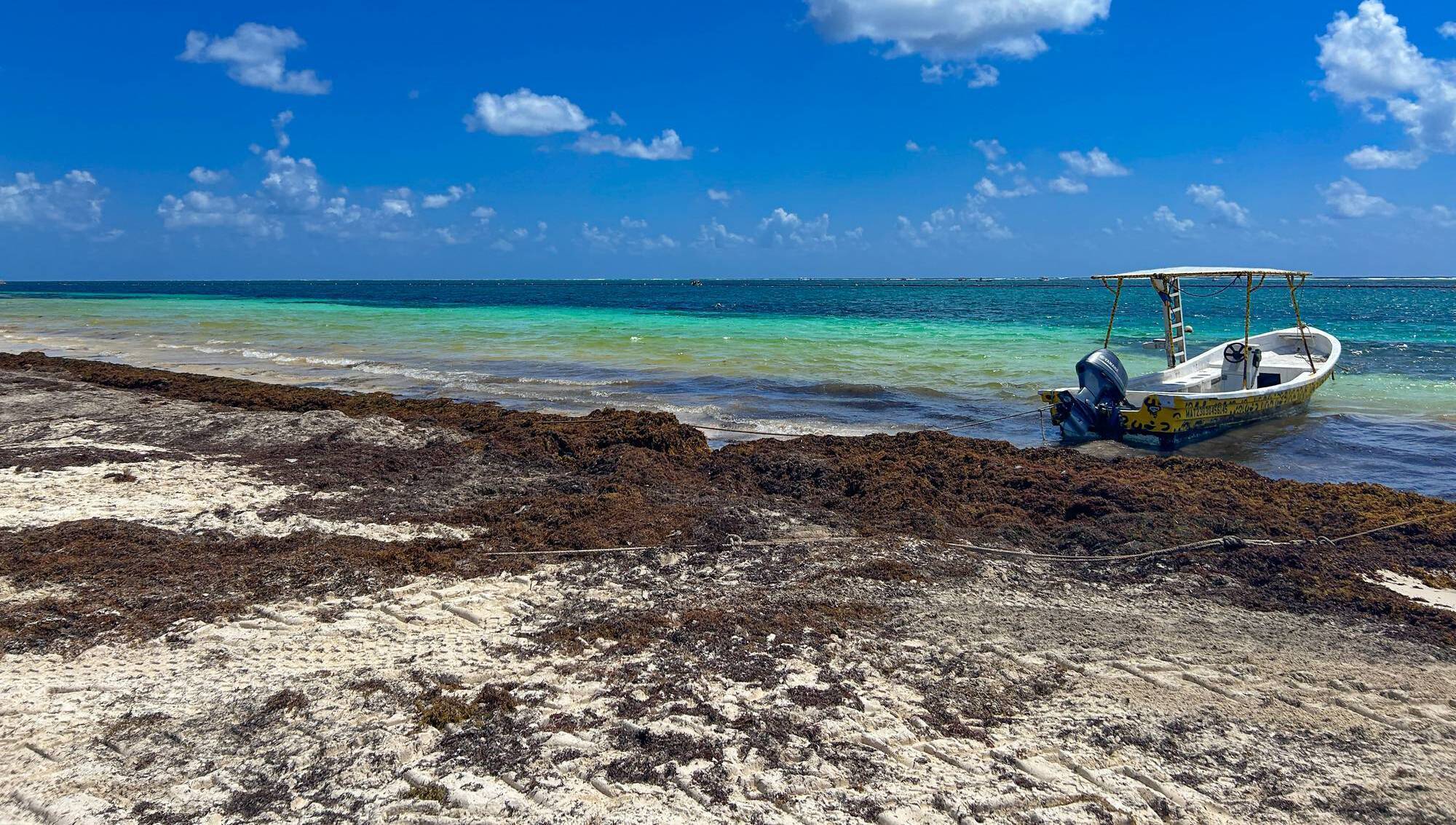
Across the Caribbean and Gulf of Mexico this summer, sargassum has again piled onto coastlines, turning clear water brown and decomposing in the heat with the unmistakable smell of rotten eggs. iStock
The Atlantic has produced rather too much of a good thing. Floating sargassum is, in the right place and in the right quantity, one of the ocean’s more useful bits of clutter. Great golden-brown rafts drift across the surface, providing shelter and food for fish, crabs, seabirds and young sea turtles. The US National Oceanic and Atmospheric Administration (NOAA) even designates Sargassum as essential fish habitat in parts of the Atlantic. But move millions of tonnes of it onto a tropical beach and the reviews become considerably less enthusiastic.
Across the Caribbean and Gulf of Mexico this summer, sargassum has again piled onto coastlines, turning clear water brown and decomposing in the heat with the unmistakable smell of rotten eggs. In June of this year, it brought around 34 million tonnes across the Atlantic, Caribbean and Gulf monitoring region. In the Gulf alone, five million tonnes were recorded, which is almost twice the previous June record. By July the total had fallen to around 27 million tonnes, but scientists still expect 2026 to become the second-largest sargassum year on record, behind only 2025. The really interesting part, however, is not that there is a lot of seaweed. It is why it keeps coming back. Before 2011, most Atlantic sargassum was associated with the Sargasso Sea. Then vast quantities began appearing farther south, forming what became known as the Great Atlantic Sargassum Belt, which is an enormous, seasonally recurring accumulation stretching from West Africa towards the Americas. At its monthly peak, it has exceeded 20 million tonnes every year since 2018. For years, explanations have ranged from fertiliser and river runoff to warmer seas, changing currents and ocean mixing. The temptation is to find one neat culprit, preferably one that fits comfortably into a headline. The ocean is rarely that cooperative.
Research published in this year suggests the story is more complicated, and arguably more worrying. The researchers traced the initial establishment of the belt partly to an unusually prolonged negative phase of the North Atlantic Oscillation around 2009-2010. Changes in winds transported sargassum southwards, while deeper winter mixing brought nutrients towards the ocean surface, creating favourable conditions for growth. Importantly, the authors found that warmer water alone cannot explain the extraordinary increase. But after the system became established, something changed. The sargassum community appears increasingly able to recycle its own nutrients. A floating mat is not just seaweed. It is a miniature ecosystem, which has been dubbed the Sargassumsphere, full of fish, shrimp, crabs, microorganisms and ageing algal material. Animals feed and excrete nutrients; old sargassum decomposes; those nutrients can then be reused. The article suggests this internal recycling has become increasingly important and is now a dominant influence on the enormous blooms seen in recent years. Put less elegantly, the Atlantic may have built itself a floating compost heap with a feedback loop.
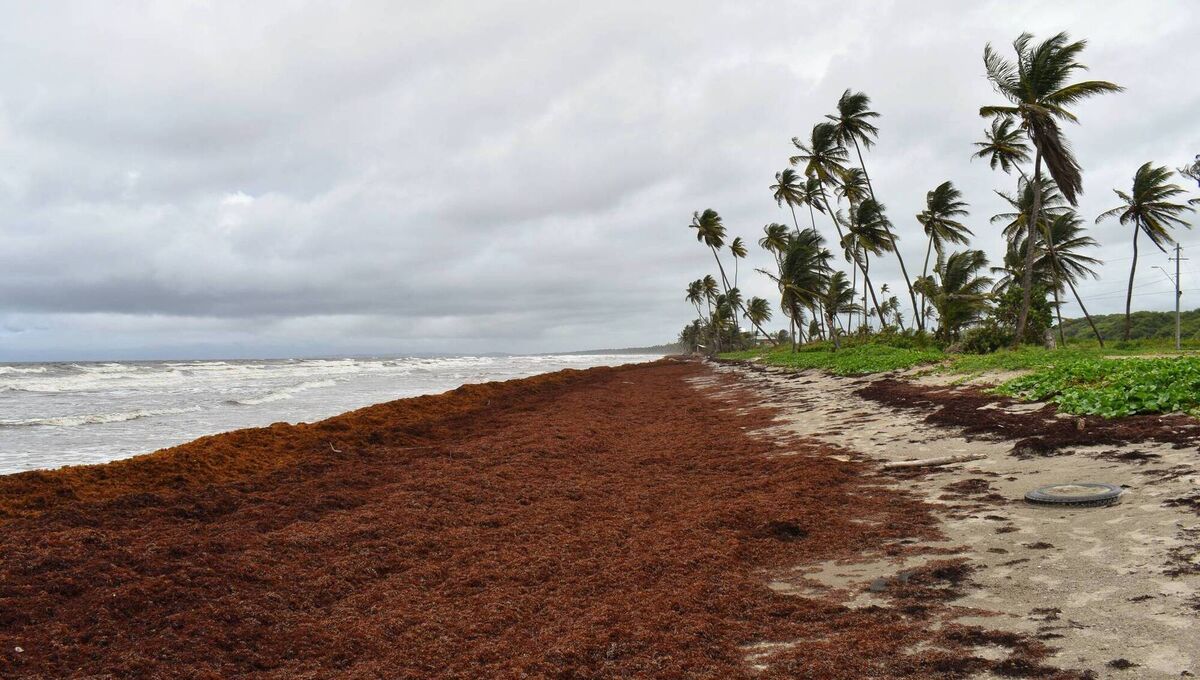
And there is an even more striking development in 2026. Researchers at the University of South Florida say they have, for the first time, observed large quantities of sargassum growing within the Caribbean and Gulf of Mexico rather than simply being carried there by currents. The record 2025 bloom was so large that enough material persisted to help seed new growth locally this year. That makes this less like an annual delivery and more like an unwanted house guest discovering the spare key. The ecological irony is that offshore sargassum is extremely valuable. At sea, those mats are nurseries and refuges. Near shore, excessive quantities can lower oxygen levels, block light and smother seagrass, corals and other marine life. Once stranded, decomposition releases gases including hydrogen sulphide, which can cause respiratory illness.
And the bill is becoming enormous. Mexico announced in July that it plans to invest $115 million (€98 million) tackling the problem. Authorities estimate that as much as 9,000 tonnes can reach its Caribbean coastline on the worst days, while current capacity allows around 1,200 tonnes to be collected daily. This is no longer simply about keeping seaweed out of holiday photographs. The issue has even reached the United Nations. In 2025, the UN Environment Assembly adopted a resolution specifically calling for a stronger global response to massive sargassum influxes, followed this April by discussions on monitoring, management and international cooperation. There is understandable enthusiasm for turning the problem into a resource, from fuels to compost and other products. But there is no magic circular-economy wand. Collection is expensive, disposal difficult, and sargassum can contain problematic contaminants, including arsenic. Even clearing beaches requires care because heavy machinery can damage wildlife and turtle nests.
Ireland, thankfully, is not about to wake up under a Caribbean-style blanket of tropical sargassum. But the story is not entirely remote. We already have our own sargassum: Japanese wireweed, sargassum muticum. It is a different species, which remains attached rather than permanently free-floating, and an invasive arrival to Irish waters. A 2025 study, led by Dr Marianela Zanolla at The University of Galway, surveyed 68 coastal locations around Ireland and found six invasive seaweed species, with S muticum reaching ~30-50% cover at some western and southern Irish sites. The comparison should not be overstated. Ireland’s Japanese wireweed and the Great Atlantic Sargassum Belt are very different ecological problems. But together they illustrate something worth remembering, in that marine ecosystems are dynamic, connected and capable of changing surprisingly quickly.
Perhaps that is the uncomfortable lesson from the great brown belt across the Atlantic. Environmental change does not always produce a simple, linear response. Sometimes a disturbance pushes an ecosystem in a new direction, feedbacks develop and yesterday’s unusual event starts looking increasingly like tomorrow’s normal. At which point, removing the seaweed is the easy part. Putting the ecosystem back where it was is considerably harder.
- References:
- Zanolla, M., Cara-Ortega, C.L., Sanz-Fernández, V. and Stengel, D.B. (2025) Distribution pattern and biochemical variability of Irish invasive seaweed across a spatial gradient, , 323, 109406.
- Zhou, X., Novi, L., Hay, M.E., Montoya, J.P., Aliu, A., Realff, M.J. and Bracco, A. (2026) Changing drivers of the Great Atlantic Sargassum Belt from physical forcing to ecological control, , 17, 4600.


CONNECT WITH US TODAY



Be the first to know the latest news and updates