Hikes and trails: Woodland walks celebrated in the poetry of Yeats
Lady Augusta Gregory’s Coole Park and its seven woodlands in Co Galway became the centre of the Literary Revival. Pictures: John G O'Dwyer
She was an unlikely nationalist. Born into the Protestant Ascendancy at Roxborough House, Co Galway, Isabella Persse was, like most of her landowning class, a staunch Unionist. Visiting the Aran Islands in 1893, after the death of her Loyalist husband Sir William Gregory of Coole Park, was a catalyst that profoundly changed her outlook. Exposed to the Irish language and culture, Lady Augusta Gregory, as she is better known, joined the newly founded Gaelic League, learned to speak Irish and began collecting stories and myths from the peasantry. Heavily influenced by her research into Irish history, her political views shifted towards nationalism and republicanism.
A chance meeting with WB Yeats at Tullira Castle, home of the playwright Edward Martyn, sparked a lifelong friendship that would be crucial to the early 20th-century Irish Literary Revival. Together, they co-founded the Abbey Theatre and co-wrote the play, Kathleen Ní Houlihan. In a drama that many saw as a call to arms, the Irish nation is personified as an old woman rejuvenated when a blood sacrifice is made on her behalf. Later, referring to this play, Yeats would write the famous lines, “Did that play of mine send out / Certain men the English shot?” The fact that Gregory’s stately home at Coole Park, Co Galway, became the centre of the Literary Revival was perhaps her biggest contribution to Ireland. Yeats, Shaw, Synge and O’ Casey came to stimulate their artistic imaginings among its tranquil waters and seven woodlands. Here, they, along with many other visiting writers and artists, carved their initials on the famous Autograph Tree, a copper beech standing sentinel in the walled garden.

Arriving to explore the Seven Woods Trail at Coole, I found the Visitor Centre was closed due to a water problem. Undeterred, I marched along woodland paths that were, as Yeats predicted in his poem, “The Wild Swans of Coole’, dry underfoot. Soon came a ‘wow moment’ as the trees parted to reveal an aquamarine lake of intense beauty in a basin of vivid green, for Coole Lough is one of Ireland’s foremost examples of a turlough; a lake where water levels rise and fall with startling rapidity. It was here Yeats immortalised in verse the whooper swans that arrive each October from Iceland to winter at Coole.
The charm of the lakeside immediately seduced me, so I laid claim to a convenient rock while wondering if Yeats sat in the same spot. Summer is not the time for migratory swans, which means there was no “bell-beat of their wings above my head” as there was for Yeats in October 1916. In compensation, a bevvy of mute swans, native to Ireland, glided imperiously past on still waters that did indeed “mirror a clear sky”. Like most poets, Yeats probably felt things a bit too deeply and so the “ Wild Swans” is a melancholic work that looks back to happier times, nineteen years earlier, when he first came to Coole.

Heading onwards, I now, in the manner of the poet, “trod with lighter a tread” the Rocky Field that forms the flood plain of the Coole River. Here, limestone peeps demurely above the surface to remind the wayfarer that the area lies on the edge of the Burren karstlands.
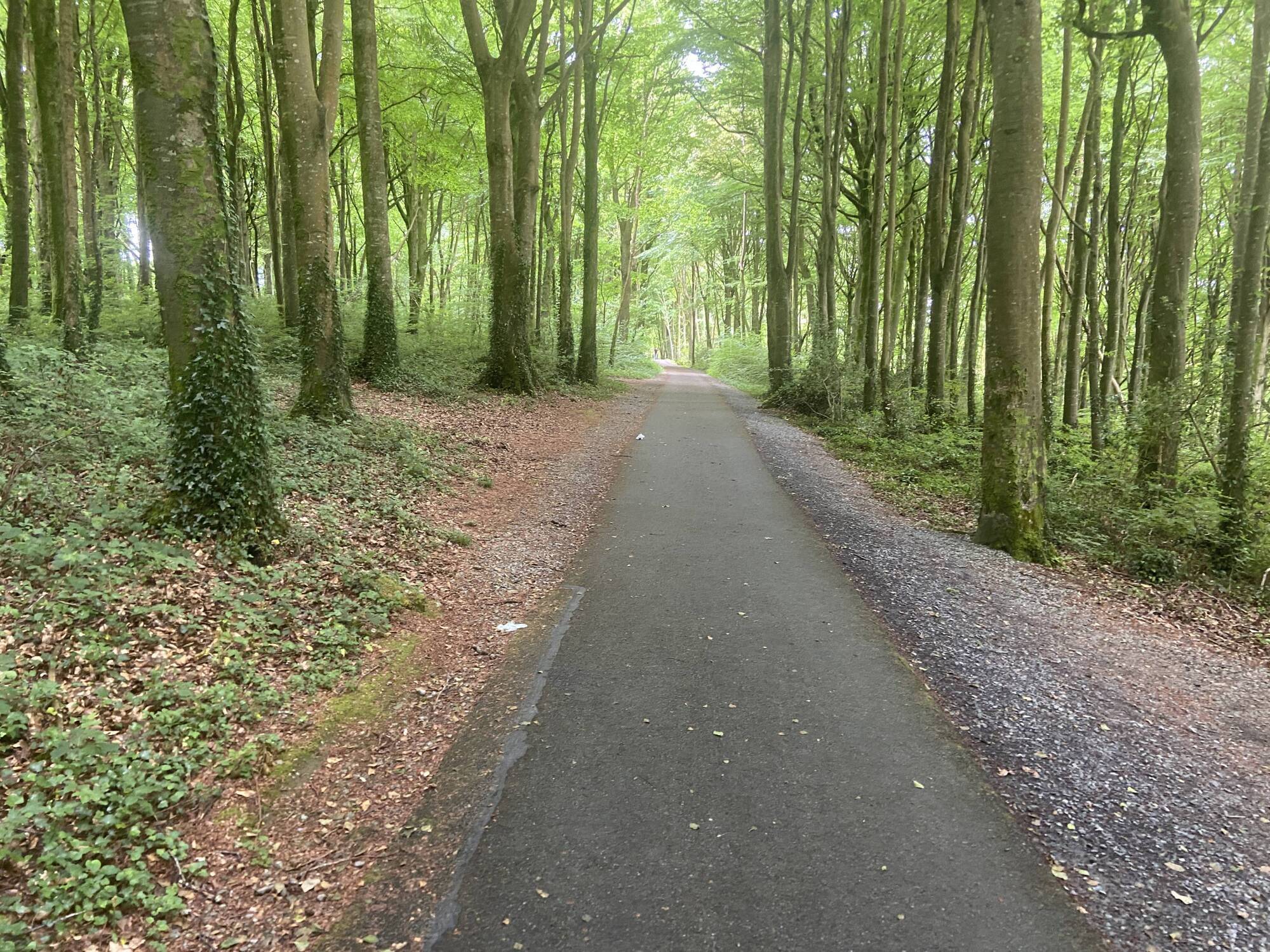
Eventually abandoning the waterside, I wended my way along woodland paths that were charmingly dappled with tree-mediated sunlight. A delightfully wide variety of tree species flanked the trail like a guard of honour, including a collection of exotic conifers imported from North America by William Gregory.
Next stop was the splendid walled garden that contains the famous Autograph Tree. It was here, at the bidding of Lady Gregory, the superstars of the Literary Revival carved their initials into the trunk. The letters have, of course, faded with the passage of time, although the flamboyant initials of George Bernard Shaw immediately capture the eye above the more reticent autographs of Synge, Hyde, O’Casey, Russell and Gregory herself.

Beyond is the elevated plinth, where once stood the great house of Coole. Sold to an uncaring Irish state by Lady Gregory in 1927, the contents were auctioned after she died and her vast literary collection was scattered worldwide. The three-story mansion was then allowed fall into decay and, in a monumental act of State vandalism, was eventually demolished, thus removing a great part of Ireland’s literary heritage.
Returning to the car park with a somewhat heavier tread, I reflected that had the great house at Coole and its contents been allowed to survive, it would now be among the great attractions of Ireland, with visitors flocking from across the world.
The Seven Woods Trail is an easy 4.5 km loop that takes just over an hour to complete. It links the woodland areas celebrated in the poetry of Yeats with majestic Coole Lough.