I was fit and healthy but got a bowel cancer screening anyways – it saved my life
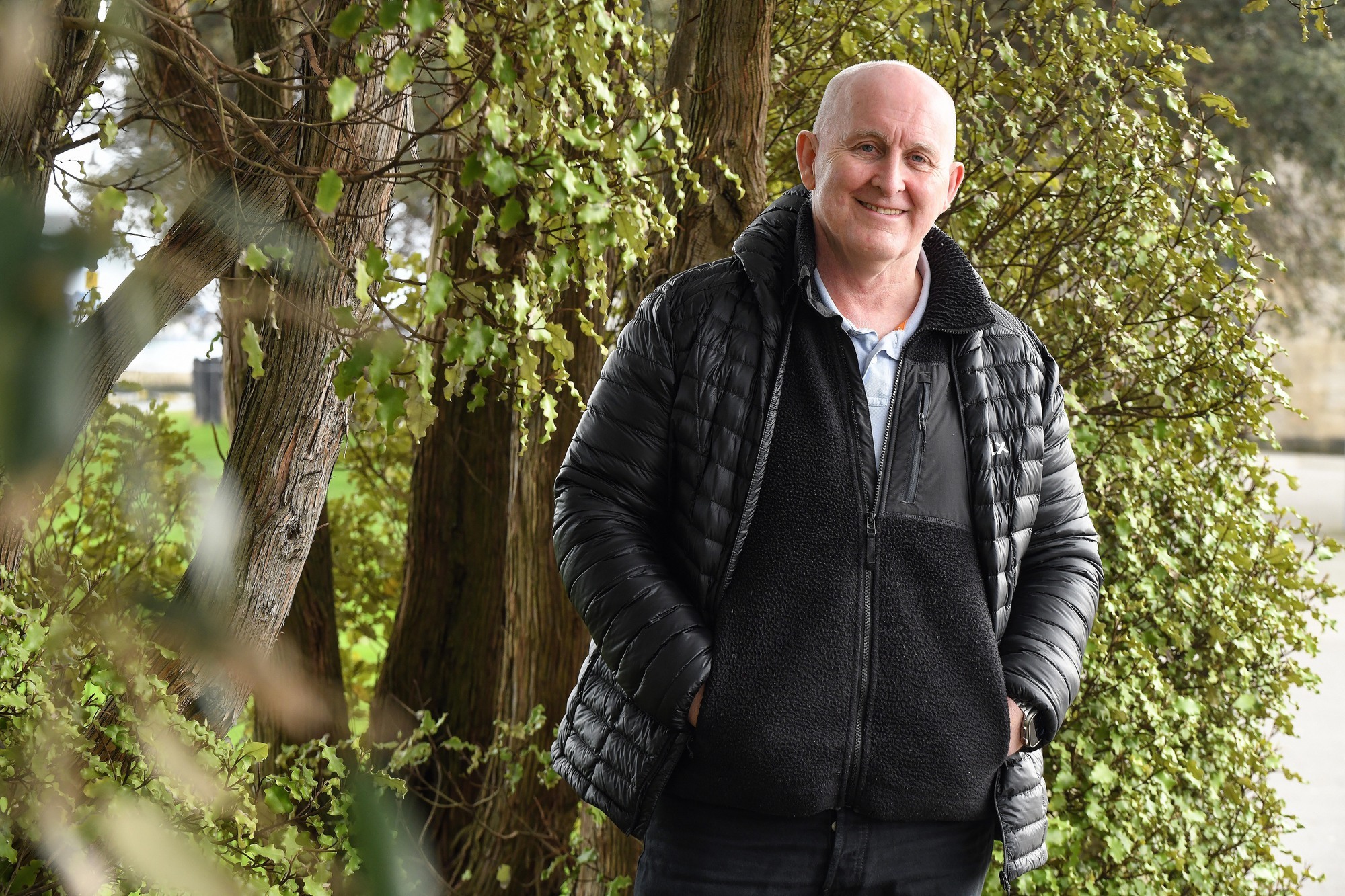
Brendan Looney registered for BowelScreen after hearing a radio ad. The decision proved life-saving when cancer was detected in September 2025. He is now a Marie Keating Foundation ambassador. Picture: Moya Nolan
“The one thing I never got checked was my bowel,” Looney says. “But shortly after hearing that ad, I was talking to a friend whose brother had stage-four bowel cancer, so I decided I’d register for the screening. I was healthy. I had no symptoms. I felt great, so I wasn’t expecting any problems.”
Soon after registering, Looney received a FIT (faecal immunochemical test). This simple, at-home, non-invasive screening test detects hidden blood in the stool, which may indicate a bleeding lesion in the bowel and, in turn, bowel cancer.
“I got a letter in late July, saying they’d found traces of blood in my sample and that I needed to go in and get a colonoscopy. I went for the scope and then they sent me for a CT scan, so, at that stage, I knew there was an issue.”
A high-risk, stage-two tumour had been found, and after a consultation with his oncologist, Looney went on four cycles of chemotherapy, which lasted two months. In December, he got the news that the tumour had shrunk and was now operable. He was sent for a bowel resection.
“That was five weeks ago,” says Looney. “And I’m doing great. I’m back swimming. The first week was probably the toughest, because you’re on medication for pain. But now I’m back in the water.”
Looney, who is originally from Cork, has been open about his illness and has documented his treatment and recovery on his Instagram account (@brendan.j.looney). His sons, Elliott, 21, and Zac, 17, often feature alongside him, either before or after they go swimming off the Forty-Foot near their home in Glasthule, Dublin.
“The toughest conversation was with them,” he says. “I put it off until I started chemo. A friend of mine had died from cancer the same week, so it was a tough conversation. But I was always confident I’d be OK, because we’d caught it early, and it’s so curable at an early stage. This is why screening is so important, because it’s only when you get to stage 3 or 4 that you start getting the symptoms, and then you’ve got a problem.”
Almost 2,500 people are diagnosed with bowel cancer in Ireland every year. Also known as colon, rectal, or colorectal cancer, it is the second most common cancer in men, following prostate cancer, and the second most common cause of death.
Ireland’s BowelScreen programme has been in place since 2012 and is open to both men and women aged 58 to 70.
“Most of the value of the bowel screening programme is in picking up pre-cancer lesions that can be treated and therefore reduce the chances of getting cancer,” says Prof Pádraic MacMathúna, clinical director of BowelScreen.
“There’s a view out there that we’re mostly trying to pick up cancer with the test, but only about 4% to 5% of people who have a colonoscopy have cancer and almost 50% have pre-cancer. So the benefit is really in that pre-cancer stage.”

The “whole point” of screening, he says, is to identify individuals who do not have symptoms.
“You target an age group, in this case, those who are most likely to have started to develop polyps, which, if not dealt with, may lead to cancer.
“We’re doing it primarily for people in their 60s, though we are gradually lowering the age for qualification to the late 50s - that’s the prime age for developing polyps. But the prime age for developing cancer of the bowel is about 65 onwards. When a polyp starts, if it’s going to become a cancer, it takes about 10 years.”
As well as age, other risk factors include being overweight, diet, and a family history.
It’s because of a family history that I had two colonoscopies: In my mid-40s and late 40s. While many men might have a fear of the procedure, the colonoscopy is harmless. The worst part is the night before, when you’re required to drink a mouldy-tasting laxative to clean out the bowel.
“When it comes to colonoscopy, preparation is very important,” says MacMathúna. “You’re going to be putting a camera into the bowel, so the bowel has to be cleared out of stool. Many people find the preparation as bad, if not worse, than the procedure itself, but it’s critical. Then, you go to the clinical centre and the procedure will be explained to you, so you know what’s involved. You’re given what we call conscious sedation. It’s a combination of a Valium-type drug and a type of morphine to help you relax.”
A camera is inserted through the rectum, which then looks down the entire length of the colon. The procedure usually lasts about 15 minutes, but that will depend on what’s found.
“In about 50% of cases, there will be polyps and then in one in 20 cases, we will detect cancer,” says MacMathúna. “If there are polyps, the endoscopist will remove them, and likewise if there’s cancer there, then biopsies are taken.”
Afterwards, the patient is given a cup of tea and a slice of toast, then monitored as the sedation wears off. The endoscopist or a nurse will discuss the results with you and may even provide pictures of your bowel as a visual aid.
“Most people find the procedure tolerable,” says MacMathúna. “It’s normal to be anxious, but the professionalism involved, particularly from the nurses in preparing people and discussing things afterwards, is exceptional. Everyone in our programme is very well trained and the consultants are very experienced. They’ve done hundreds of colonoscopies.”
Endoscopists can identify polyps, and, by “default”, they’re removed; they’re not just sampled. “If they suspect cancer, samples are taken. In both cases, they are taken to the lab for analysis.
“If it’s cancer, then the biopsy will confirm the endoscopist’s suspicion, and that has to be dealt with in its own way. Polyps vary in terms of level of concern, from entirely benign to being on the margin of pre-cancer. What’s important about the polyps is that once all have been taken away, the individual is put into a surveillance programme for follow-up.
“That’s because if you’re a polyp former, then you’re likely to form polyps in the following decade, and so you need to be followed up.”
Helen Forristal, director of nursing services at the Marie Keating Foundation, says, “Traditionally, young men are not as accustomed to going to the doctor in the same way as young women are with issues such as menstruation and managing birth control.”
“It is something that only occurs for young men if they’ve had a sports injury, generally speaking. So, inherently, men are less exposed to the medical world and are less likely to seek help. Men are very practical beings, and for the most part would need to be unwell in order to consider going to their doctor in the first instance.”

That said, in Forristal’s experience, men who are well informed about the benefits of bowel screening are open to taking the necessary steps.
“I’ve worked with men over many years,” she says. “And I’ve seen this happen, for instance, when we’ve visited some Men’s Sheds around Ireland.
“If there’s not an understanding of what it is and why it is needed, then it will be put on the long finger, a screening opportunity is missed and the possibility of an early diagnosis of bowel cancer is gone.”
As always, knowledge is power, and this is the reason Brendan Looney has been so public about his own cancer.
“Early detection is the way forward,” he says.
“Anyone I meet, I tell them you’ve got to get screened. It’s such a simple test. You talk to people, and they get the test delivered, stick it in their drawer and forget about it. But I’m living proof that early detection works. If I hadn’t heard that ad, I could have been another year down the line or maybe not have got tested until I started getting symptoms, and I’d be with a whole raft of issues.”
- See: exa.mn/HSE-BowelScreen and mariekeating.ie
- Changes in bowel habits — diarrhoea, runny bowel movements, constipation, needing to poo more or less often than usual.
- Blood in your poo, which may look red or black.
- Abdominal issues — cramps, general abdominal pain, bloating that doesn’t go away.
- Weight loss when you’re not trying to lose weight.
- Tiredness and lack of energy when you’ve had enough rest.
- Any unusual change you know isn’t right for you.
- If you experience one or more of these symptoms, you should make an appointment to see your GP.
- For information on bowel cancer screening and using home test kits, see: hse.ie/conditions/bowel-screening